Category: Citrus

  • When Life Gives you Sour Lemons, Use Genetics to Find Out Why!

    A team of researchers, including two from the University of California, Riverside, has identified the genes responsible for the hallmark sour taste of many citrus fruits. Published Tuesday, Feb. 25 in Nature Communications, the research could help plant breeders develop new, sweeter varieties.

    Modern citrus varieties have been bred over thousands of years to generate a broad palette of sour and sweet-tasting fruits. Analyses of their pulp reveals that a single chemical element—hydrogen—is largely responsible for the difference between sour and sweet-tasting varieties, which usually have similar sugar content. The pulp from sour fruits contains more hydrogen ions, giving it a lower pH and a tangy taste that is recognized by acid-sensitive cells in our taste buds. Conversely, pulp from sweeter varieties contains fewer hydrogen ions and tastes less acidic.

    Ronald Koes and colleagues at the University of Amsterdam in the Netherlands set out to untangle how some citrus varieties wind up with more acidic juice than others, a process that until now has remained a mystery. Their interest stemmed from a previous study showing that higher acidity in purple petunia flowers resulted in more petal pigmentation.

    Intrigued by the Faris variety of lemon tree, which produces branches bearing both sweet and sour fruits, and white and purple-tinged flowers, Koes’ team turned to UCR plant scientists Mikeal Roose and Claire Federici. Using the university’s vast Citrus Variety Collection, which preserves over 1,000 living citrus and related fruit varieties, Roose and Federici selected the Faris lemon and 20 other citrus fruits ranging from wincingly sour to sugary sweet for Koes’ team to analyze.

    By studying the expression of genes related to those controlling acidity in petunias, Koes’ team identified two citrus genes, CitPH1 and CitPH5, that are highly expressed in sour varieties and weakly expressed in sweet-tasting varieties. The CitPH1 and CitPH5 genes encode transporter proteins that pump hydrogen ions into the vacuole, a large storage compartment inside juice cells, thus increasing their overall acidity.

    Next, the team turned its attention to genes that control the levels of CitPH1 and CitPH5 in juice cells. While down-regulation of CitPH1 and CitPH5 in sweeter tasting varieties arose multiple times independently in different varieties, the researchers found that mutations in genes for a handful of transcription factors (proteins that help turn specific genes on and off) were responsible for reduced expression of CitPH1 and CitPH5, and therefore a sweeter taste.

    Roose, a professor of genetics in UCR’s College of Natural and Agricultural Sciences, said the findings could help breeders develop better-tasting citrus fruits. However, he said breeding varieties with severe mutations in the transcription factors such as those studied in the “acidless” citrus would be “overkill,” producing sugary citrus fruits with none of their popular acidic kick. Instead, plant scientists should look to target mutations that have a less dramatic effect on the production and activity of transporter proteins.

    “By understanding the mechanism acidification of fruit cells, we can now look for related genes that might reduce the expression of CitPH1 and CitPH5 just enough to engineer or select for new, sweeter varieties,” Roose said.

    The title of the paper is “Hyperacidification of Citrus fruits by a vacuolar proton-pumping P-ATPase complex.” In addition to Koes, authors at the University of Amsterdam are Pamela Strazzer, Cornelis Spelt, Shuangjiang Li, Mattijs Bliek, and Francesca Quattrocchio. Roose and Federici’s work was supported by the United States Department of Agriculture (USDA)’s National Institute of Food and Agriculture.

    About UC Riverside: The University of California, Riverside (www.ucr.edu) is a doctoral research university, a living laboratory for groundbreaking exploration of issues critical to Inland Southern California, the state and communities around the world. Reflecting California’s diverse culture, UCR’s enrollment is now nearly 23,000 students. The campus opened a medical school in 2013 and has reached the heart of the Coachella Valley by way of the UCR Palm Desert Center. The campus has an annual statewide economic impact of more than $1 billion. To learn more, call (951) UCR-NEWS.

  • Kern County Spring Citrus Meeting – March 8

    The University of California Kern County Cooperative Extension is holding a spring citrus meeting on Friday, March 8 from 8:30 a.m. to noon at the Kern County Cooperative Extension auditorium. Meeting topics include the latest Asian citrus psyllid treatment strategies, the 2019 Kern County ACP coordinated treatment plan and more. The meeting is open to all citrus growers and affiliates.

    Continuing Education (CE) units or Certified Crop Advisor (CCA) units are not available for this meeting. A full list of speakers and topics is provided below.

    8:30 a.m.
    Registration

    9 a.m.
    Latest Treatment Strategies for Asian Citrus Psyllid
    Dr. Beth Grafton-Cardwell, director, Lindcove Research & Extension Center

    ACP-HLB Update and 2019 Kern Coordinated ACP Treatment Plan
    Judy Zaninovich, Kern County ACP-HLB Grower Liaison

    Are You Applying Imidacloprid Properly?
    Rick Leonard, Bayer

    What Should We Do About California Red Scale?
    Dr. Beth Grafton-Cardwell, director, Lindcove Research & Extension Center

    Spider Mites of Concern in the Lower San Joaquin Valley
    David Haviland, Kern County Cooperative Extension entomologist and Farm Advisor

    Noon
    Adjourn

    Meeting details:
    Friday, March 8
    8:30 a.m. to Noon
    Kern County Cooperative Extension Auditorium
    1031 S. Mount Vernon Ave.
    Bakersfield, CA 93307

    For questions, please contact: 
    Judy Zaninovich
    Kern County ACP-HLB Grower Liaison
    jsleslie@msn.com

  • Automated System Would Deliver Chemicals to Help Ward off Citrus Greening

    GAINESVILLE, Fla. — Imagine using a robotic arm to grip and puncture the trunk of a citrus tree to deliver chemicals into the vascular parts of the plant, reducing its susceptibility to the citrus greening disease.

    Ozgur Batuman, an assistant professor of plant pathology at the University of Florida Institute of Food and Agricultural Sciences, leads a team of researchers trying to make the automated delivery system a reality to help growers deal with the disease. Greening has led to huge losses for Florida’s multibillion dollar-a-year citrus industry.

    “The automated delivery system can be installed on any farm equipment and be operated by anyone who is driving – physically or remotely,” Batuman said. The person will be trained to use a joystick to control the arm that delivers the chemicals, he said.

    To conduct the research, scientists will use a $3.4 million grant from the National Institute of Food and Agriculture, an arm of the USDA.

    The system would extend from a tractor or ATV to grab the tree trunk. Because the grip has many small needles, it can create numerous tiny openings in the tree, said Batuman, a faculty member at the UF/IFAS Southwest Florida Research and Education Center in Immokalee, Florida.


    Psyllids Thumb

    Bactericides can enter the tree through those small openings, he said. These areas on the trunk with openings will be covered with a reservoir, such as a funnel or plastic balloon, that will hold the liquid containing the bactericide, Batuman said. The liquid then slowly enters through the holes of the trunk.

    This contrasts with traditional tree trunk injections, in which a grower would use large, single-needle syringes to inject liquid materials in one spot, Batuman said.

    Most bactericide treatments are not very effective at staving off citrus greening because they were not directly delivered into the citrus vascular system, where greening — and its associated bacterium, Candidatus Liberibacter asiaticus (CLas) lives, he said. The therapeutic chemicals can kill or suppress the growth of CLas and can be used in greening-affected plants, Batuman said. The system can also help newly planted trees fight greening by controlling the Asian citrus psyllid, which can transmit greening into citrus plants, he said.

    Researchers see the automated delivery system as part of an integrated pest management program to help stem the psyllid.

    “We are developing a delivery method that will send chemicals with therapeutic potential into phloem, where bacteria live,” Batuman said.

    This four-year project will also study citrus vascular systems with a multidisciplinary research team. Members of the team are
    , an associate professor of plant pathology; Amit Levy, an assistant professor of plant pathology; Ute Albrecht, an assistant professor of horticultural sciences; Fernando Alferez, an assistant professor of horticultural sciences; Yiannis Ampatzidis, an assistant professor of agricultural and biological engineering and Tara Wade, an assistant professor of food and resource economics – all with UF/IFAS. Also on the team are Louise Ferguson, an Extension specialist with the University of California-Davis and Veronica Ancona, an assistant professor of plant pathology at the Texas A&M University-Kingsville Citrus Center.

    By: Brad Buck, 352-294-3303, bradbuck@ufl.edu

  • Challenges and Successes for the California Citrus Industry

    With all the regulatory and economic challenges facing our agricultural industries, California growers understandably have a lot to grunt and complain about; however, if growers see these challenges as opportunities and work together to overcome them, so much more can be accomplished, as has been done in the California citrus industry.  Check out this brief video interview with former President of the California Citrus Mutual, Joel Nelsen, as he explains. Read more about it in the coming issue of California Fresh Fruit Magazine.  Don’t currently receive the publication?  Subscribe for free at https://malcolmmedia.com/california-fresh-fruit-subscriptions/.

  • International Trade Dispute Impacts CA Citrus Shipments

    The ongoing international trade dispute has disrupted many California agricultural industries which rely heavily on foreign exports, including California citrus.  Watch this brief interview with former President of the California Citrus Mutual Joel Nelsen as he shares how this is impacting citrus shipments.  Read more about the outgoing President of California Citrus Mutual and his outlook for the industry in the coming issue of California Fresh Fruit Magazine.  Don’t currently receive the publication?  Subscribe for free at https://malcolmmedia.com/california-fresh-fruit-subscriptions/.

  • California Citrus Mutual Appoints Casey Creamer as President/CEO

    CCM appoints current Executive Vice President and veteran agriculture industry representative.  Current President, Joel Nelsen to step down after 37 years at the helm and assume new role within the organization.

    Joel Nelsen Steps Down After 37 Years of Dedicated Service as President of the California Citrus Mutual

    The California Citrus Mutual (CCM) Board of Directors has named current Executive Vice President Casey Creamer as its new President and CEO effective February 1st.  Creamer came to CCM last February after a national search process to eventually assume the role of President.  He succeeds Joel Nelsen, who has guided CCM for the last 37 years.

    “The citrus industry is very fortunate to have had an individual of Joel’s caliber the last 37 years.  That kind of loyalty is not only rare, it’s unheard of,” stated Board Chairman Curt Holmes.  “Joel has taken a relatively small industry and has given us a huge voice.  We’ve faced many challenges over the years and have addressed them head on with his energy and passion leading the way.  We are incredibly grateful to him for his service and we appreciate his willingness to stay engaged in the industry.

    “We are also very excited to have Casey on board as our new President and CEO,” continued Holmes.  “The Board conducted an extensive search process and interviewed viable candidates from across the country.  We ultimately found the right person in our own backyard.  His prior experience working for a sister commodity organization and his work representing growers on water issues made him an ideal selection.  Over the last year his knowledge of the citrus industry has greatly expanded and he has quickly become a valuable member of the CCM team on behalf of the industry.”

    “I’m humbled by the opportunity to serve,” stated Creamer.  “I’ve been extremely fortunate to work with some of the best leaders over my career and have nothing but respect and admiration for the job that Joel has done advancing issues important to the citrus industry.  I’m looking forward to carrying on the many successful traditions at CCM, while constantly seeking new ideas and pathways to address the significant challenges we face.  With the enthusiasm and commitment that exists in this industry, I am confident that together we tackle any obstacle thrown our way.”

    About CCM – CCM is the only advocacy organization representing CA citrus growers on the economic, regulatory, and political issues that impact them most. We are a voluntary, non-profit trade association dedicated to enhancing the sustainability of the CA citrus industry by advocating for sound, reasonable policy that allows for fair competition in the market place. Our 2,500 members represent 75% of California’s 320,000 acre, $3.8 billion citrus industry.
  • CA Detections of Citrus Disease HLB up 160 Percent

    HLB infected Tree

    Stakes at All-Time High for Backyard & Commercial Trees in 2019

    Detections of Huanglongbing (HLB), an incurable plant disease that kills citrus trees, increased by 160 percent in 2018 compared to the previous year, signaling the growing threat to the state’s iconic citrus trees, landscape and economy.

    HLB is spread by a small pest called the Asian citrus psyllid as it feeds on citrus tree leaves. The disease is not dangerous to humans or pets, but it is fatal for citrus trees and has no cure. Once a tree is confirmed with the disease, it must be removed from the property in order to protect neighboring citrus trees.

    The disease was first discovered in California in 2012 in Hacienda Heights. HLB was detected in 269 trees in 2017 and 699 trees in 2018, with a majority of these occurring in Los Angeles and Orange counties. The disease has not yet been detected in a California commercial grove.

    HLB has devastated commercial citrus production in Florida. Over the course of 10 years, Florida’s commercial citrus industry lost $7.8 billion in revenue, 162,200 citrus acres and more than 7,500 jobs due to HLB. Should the disease spread from backyard trees in Southern California to nearby commercial citrus groves, the livelihood of California’s citrus production could impact about 3,900 farmers and 292,000 acres of citrus production in the state. Commercially grown citrus contributes $7 billion in economic impact to the state and employs more than 22,000 individuals.

    “The livelihood of California’s commercial citrus industry and the generations of families it supports is at risk because of HLB,” said Jim Gorden, a citrus grower in the San Joaquin Valley and chair of the Citrus Pest & Disease Prevention Committee. “We are at a crossroads, and we must all work together to do what is necessary to protect our citrus.”

    Asian Citrus Psyllid Adults

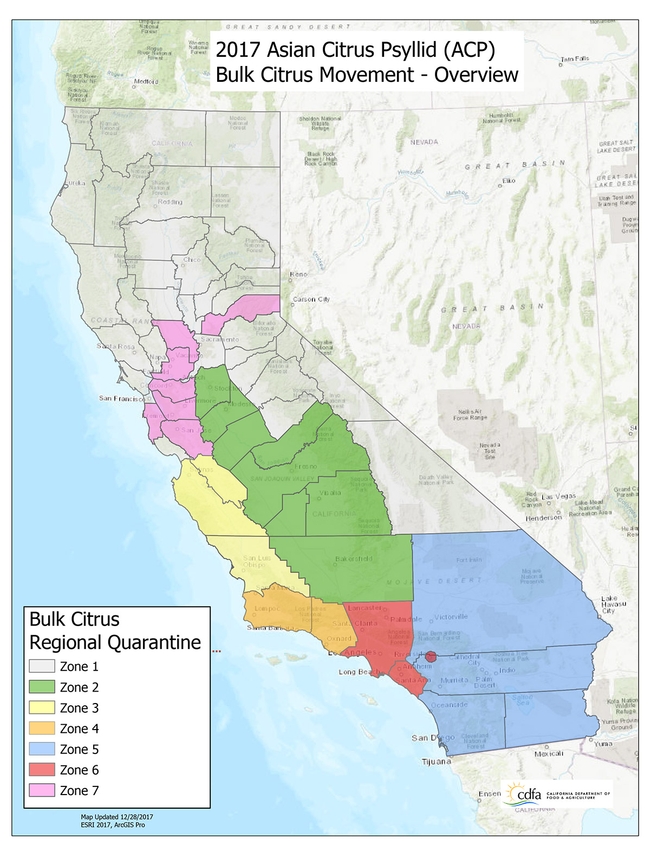
    The California Department of Food and Agriculture (CDFA) has established quarantines throughout the state that limit the transport of citrus across state and international lines, and between areas where the psyllid and disease have been found. Additionally, CDFA has agriculture crews canvasing the state to inspect backyard citrus trees for the Asian citrus psyllid and HLB.

    “The Department is committed to our partnership with California’s commercial citrus industry and residential citrus growers to fight HLB,” said Victoria Hornbaker, interim director of the citrus program at CDFA. “With more than half of California residences estimated to have a citrus tree on their property, and California citrus production supporting billions of dollars in our state’s economy, we all play an instrumental role in protecting our citrus.”

    California residents play an important role in protecting the state’s citrus trees. Residents should: 

    • Proactively inspect their citrus trees for the Asian citrus psyllid and HLB monthly, and whenever watering, spraying, pruning or tending trees.
      • Adult Asian citrus psyllids are brown, about one-eighth of an inch long, and feed with their body at a 45-degree angle on citrus leaves.
      • Symptoms of HLB include blotchy and yellowing leaves, premature and excessive fruit drop, lopsided fruit, and bitter, inedible fruit.
    • Call the state’s pest hotline at 800-491-1899 if the pest or disease is spotted.
    • Cooperate with agriculture officials who may ask to inspect or treat their citrus tree.
    • As part of tree maintenance, visit a local nursery or garden center to get advice on products that can help protect citrus trees.
    • When pruning citrus trees, be sure to dry out citrus clippings or double bag them before removing the plant material from the property.
    • Refrain from moving citrus plants, foliage or fruit as doing this may unknowingly spread the pest.

    More information and photos of Asian citrus psyllids and HLB symptoms are available at CaliforniaCitrusThreat.org.

  • Huanglongbing Eradication Status in California Citrus

    To date, the deadly citrus greening disease Huanglongbing or HLB has not been found in California’s commercial citrus orchards; however, it’s only a matter of time. HLB strikes continue to be detected in residential areas, and its vector has spread all over the state. Watch this brief interview with Victoria Hornbaker, head of the CDFA’s statewide citrus program, as she shares the current status of the spread of HLB and its vector the Asian citrus psyllid, and CDFA’s eradication efforts. Read more about it in California Fresh Fruit Magazine.

  • Citrus Crop Update with Central Valley Grower Arlen Miller

    Harvest of the 2018-2019 citrus crop is underway, and growers are excited to reap the fruits of their labors. Watch this brief interview with third generation Central Valley citrus grower Arlen Miller as he shares his perspective on the coming crop and read more about him and his many diverse varieties of citrus in the coming issue of California Fresh Fruit Magazine.

  • Delegate Removed from the Bulk Citrus Spray and Move Treatment List

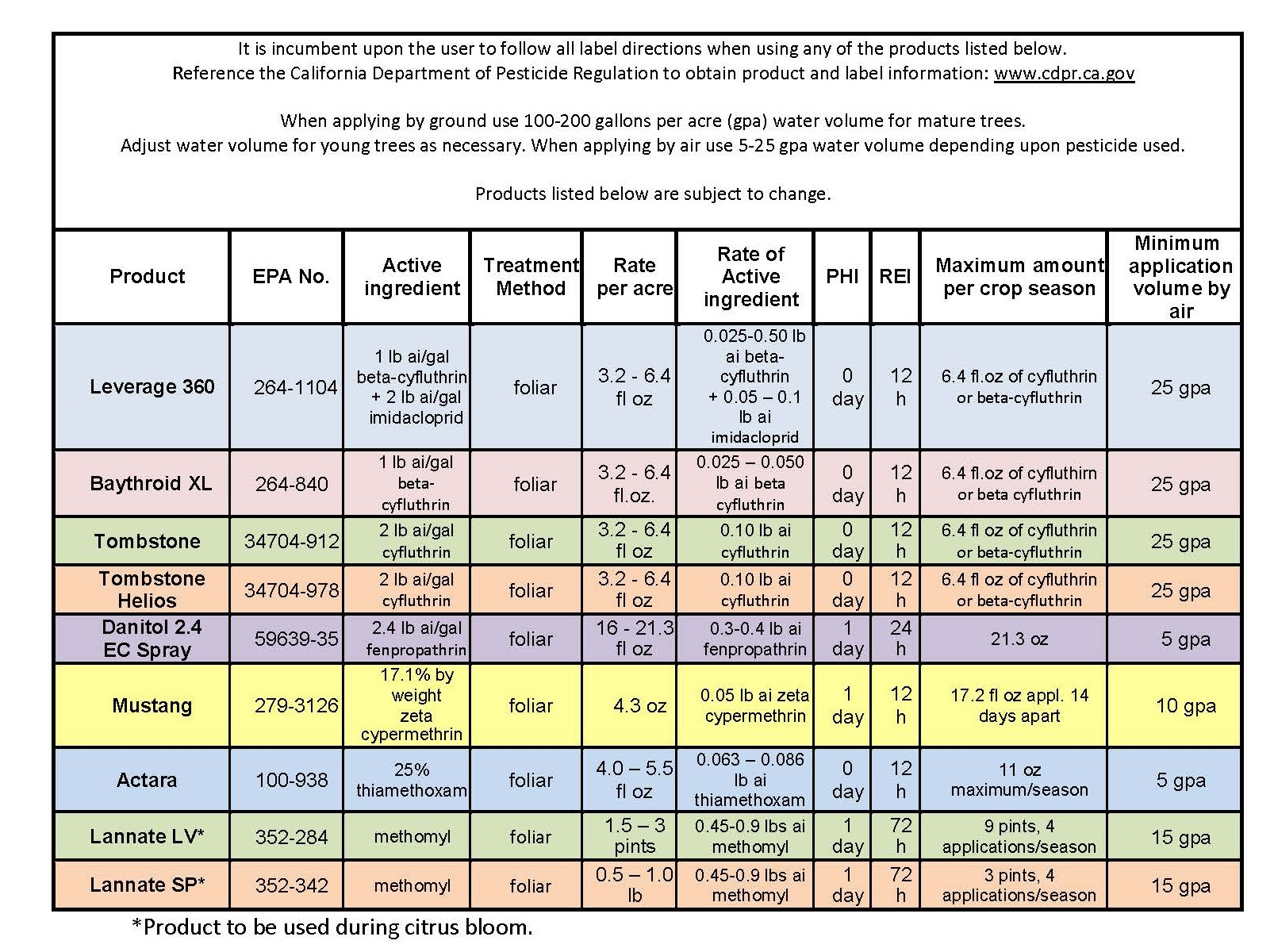
    As of APRIL 20, 2018 Delegate (spinetoram) has been removed from the list of approved insecticides for the treatment of citrus  just prior to harvest for the purpose of disinfesting citrus prior to moving citrus-filled bins between quarantine zones in California.  The regulations for ‘spray and move’ can be found on the CDFA information for citrus growers/grove managers web page and the table from that document is shown below.   The reason for removing Delegate, is that it shows significantly less control of psyllids than the other treatments on the list.  It is critical to achieve high kill of psyllids to ensure fruit is disinfested, so that psyllids, and potentially HLB, are not moved around the state.  The alternative to ‘spray and move’ is field cleaning (brushing or washing fruit) and removing leaves and stems from the fruit and bins.  The eggs and nymphs attach themselves to leaves and stems and the adults can ride on fruit.

    In recognition of the issues related to treating citrus just prior to harvest, research is being conducted by the USDA and University of California to develop fogging and fumigant post harvest systems to disinfest fruit that will ultimately replace ‘spray and move’ treatments.

    acpgrowerinformation bulk citrus treatments table

    2018.01 ACP BulkCitrus Overview