Category: Featured Post

  • USDA Announces $39M Purchase for Pears, Split Peas

    U.S. Secretary of Agriculture Brooke L. Rollins announced the U.S. Department of Agriculture’s (USDA) intent to purchase up to $263 million in agricultural products from American farmers and producers to distribute to food banks and nutrition assistance programs across the country. These purchases are being made through USDA’s authority under Section 32 of the Agriculture Act of 1935 and will assist producers and communities in need.

    This includes $15 million for fresh pears and $24 million for split peas.

    “From milk and dairy to fruits, legumes, and tree nuts, these staples are essential for feeding families and sustaining America’s agricultural economy,” said Secretary Brooke Rollins. “Through these Section 32 purchases, USDA is delivering wholesome, real food to Americans while injecting critical dollars into local economies. By turning harvests into meals, we are not only stabilizing farm income and protecting rural jobs—we are nourishing our nation and supporting the farmers who feed America. Under President Trump’s leadership, these investments strengthen the food supply, sustain rural communities, and reinforce agriculture as a cornerstone of economic resilience.”

    Agricultural Marketing Service Section 32 Purchases

    AMS continuously purchases a variety of domestically produced and processed agricultural products. These “USDA Foods” are provided to USDA’s Food and Nutrition Service (FNS) nutrition assistance programs, including food banks that operate The Emergency Food Assistance Program (TEFAP), and are a vital component of the nation’s food safety net. USDA AMS will purchase up to $263 million of the following commodities:

    • Butter: $75 million
    • Cheddar Cheese and Cheese Products: $32.5 million
    • Swiss Cheese: $10 million
    • Fresh Fluid Milk: $20.5 million
    • Ultra-High Temperature Milk: $10 million
    • Chickpeas: $12 million
    • Dried Beans (Black and Pinto): $25 million
    • Fresh Pears: $15 million
    • Lentils: $14 million
    • Pecans: $10 million
    • Split Peas: $24 million
    • Walnuts: $15 million

    By the USDA

  • Fusarium Wilt in Lettuce

    A new strain of fusarium wilt has been detected in lettuce, putting crops in danger. Researchers at UC Riverside are exploring new ways to combat this potentially devastating fungal disease. Alexander Putman spoke at the World Ag Expo in Tulare and with Matthew Malcolm from Malcolm Media Ag Publishing to discuss the issue. Watch this quick video and learn more in California Fruit & Vegetable Magazine.

    Please thank this video’s sponsor Simplot for their industry support.

  • Using Predators to Counter Asian Citrus Psyllids


    The Asian citrus psyllid is an active threat for growers and the main vector for Huanglongbing disease. These invasive insects have wreaked havoc in Florida and spread to Southern California, but researchers at UC Riverside are finding ways to counter them. Matthew Malcolm from Malcolm Media Ag Publishing interviewed Bodil Cass at the World Ag Expo to discuss the use of predators against psyllids. Watch this quick video and read more in California Fruit & Vegetable Magazine.

    Please thank this video’s sponsor Simplot for their industry support.

  • Opportunities Emerge for California Blueberries


    Blueberries have become a global industry with growing demands creating opportunities for California growers, thanks in large part to the adoption of improved cultivars. David Magaña from Rabobank spoke with Matthew Malcolm of Malcolm Media Ag Publishing about his findings at the World Ag Expo. Watch this quick video and read more in California Fruit & Vegetable Magazine.

    Please thank this video’s sponsor, Simplot for their industry support.

  • UCCE Hosting South Sacramento Valley Prune Meeting

    UC Ag and Natural Resources will host its annual South Sacramento Valley Prune Metting in Yuba City. The event is an opportunity for prune growers to learn the latest updates in prune orchard systems and grower regulation updates. Growers will also be able to learn about disease management and Johnson grass management in tree crops, as well as how to control sunburn in crops and more.

    The event counts for 2.5 continuing education credits. Registration for the Prune Meeting begins at 8 a.m. at Yuba City Veterans Hall and it run until 12:30 p.m., followed by a hosted lunch. Pre-registration can be found HERE.

    Schedule:

    8:00 AM Registration & Coffee and Refreshments

    8:15 AM California Prune Board Update

    Donn Zea, Executive Director, Prune Board of California

    Kiaran Locy, Director of Brand and Industry Communications, Prune Board of California

    8:30 AM New developments in prune orchard systems

    • New prune rootstock trial plans and goals

    Jaime Ott, UCCE Orchard Systems Advisor; Tehama, Glenn, and Butte Counties

    • High density prune orchards

    Charles Brannon, Director of Agronomy, Agromillora CA

    • New prune rootstocks and new orchard opportunities

    Chuck Fleck, Director of Horticulture Research, Sierra Gold Nurseries

    9:30 AM What can growers learn from Dormex® rest breaking trials in prune?

    Franz Niederholzer, UCCE Orchards Advisor, Colusa/Sutter/Yuba Counties

    10:00 AM Break

    10:15 AM Prune grower regulatory update.

    Sean Nelson, Sutter Co Ag Comm Office; Matt Bozzo, Yuba Co Ag Comm Office

    10:45 AM Disease management in prune

    Jim Adaskaveg, Professor, Department of Plant Pathology, UC Riverside

    11:30 AM Developments in Johnson grass management in tree crops

    Ryan Hill, UCCE Agronomy and Weeds Advisor; Tehama, Shasta, and Glenn Counties

    12:00 PM A first look at sunburn control in prunes.

    Franz Niederholzer, UCCE Orchards Advisor, Colusa/Sutter/Yuba Counties

    12:30 PM Hosted lunch

    By UC Ag and Natural Resources

  • Registration Open for UC Riverside Citrus Day

    Registration is now open for the upcoming UC Riverside Citrus Field Day, which will run from 9 AM. to 3 PM on Thursday, February 19.

    The Field Day will cover a number of subjects of interest to citrus growers. This includes the latest updates on pesticide regulations and pest control, weed control, rootstock applications, citrus scion breeding and evaluation program fruit displays and updates on UCR Research.

    Registration is $50 per person, with lunch included. Parking is available in Lot 30 (across Martin Luther King Jr. Blvd. from the Ag Operations Office). The cost of parking is $11 and must be paid for through the ParkMobile app. There will be a shuttle available from the parking lot to the location.

    The Citrus Field Day is an outdoor field meeting. Attendees are advised to come with footwear appropriate for walking in citrus groves and on uneven ground, and to be prepared for potential changes in weather conditions.

    Agenda

    February 19, 2026

    8:45 AM     

    Registration and Parking

    9:00 AM     

    Welcome – Dr. Peggy Mauk and Dr. Tracy Kahn, University of California, Riverside

    9:15 AM     

    Updates on Changes in Pesticide Regulations, Fruit Fly Quarantine, ACP/HLB Regulations – Delia Cioc, Agricultural Commissioner and Chris Blake, Deputy Agricultural Commissioner, Riverside County

    10:00 AM

    First Rotation (30 minutes per speaker)

    Strategies for Controlling Phytophthora spp. in Citrus – Dr. Jim Adaskaveg, University of California, Riverside

    Role of the California Citrus Clonal Protection Program in Disease Prevention – Dr. Georgios Vidalakis, University of California, Riverside

    11:10 AM

    Second Rotation (30 minutes per speaker)

    Strategies for Controlling Asian Citrus Psyllid – Dr. Bodil Cass, University of California, Riverside

    Weed Control Strategies – Dr. Matt Fatino, University of California, Agricultural and Natural Resources San Diego/Riverside Co.

    12:15 PM

    Lunch and Tasting Selections

    Tables for Tasting Selections:

    • Long-term Solutions for Citrus Huanglongbing – Dr. Chandrika Ramadugu, University of California, Riverside
    • UCR Citrus Scion Breeding and Evaluation Program Fruit Display – Toni Siebert Wooldridge, Karen Trunnelle, Dr. Tracy Kahn, Dr. Mikeal Roose, Dr. Danelle Seymour, and Dr. Claire Federici, University of California, Riverside
    • Citrus Relatives Rootstock Trial Tasting: Determining if using relatives as rootstocks impacts the flavor of navel oranges– Zach Thomas and Dr. Mikeal Roose, University of California, Riverside

    1:30 PM

    Third Rotation (30 minutes per speaker)

    Research Update and Overview of the CRaFT Program – Dr. Melinda Klein and Dr. Ivan Milosavljević, Citrus Research Board

    Strategies for Nutritional Management – Dr. Ben Faber, University of California, Agricultural and Natural Resources Ventura

    2:30 PM

    Wrap Up

    3:00 PM

    Adjourn

    Continuing Education Units: This event is approved for 1.0 Laws & Regulations and 2.5 Other CEUs from the California Department of Pesticide Regulations.

    For more information, call UCR Ag Operations at (951) 827-5906 or email agops@ucr.edu

    UC Riverside

  • Kula Bio® Launches Soluble Powder (SP) Line of Its Innovative Nitrogen Fixing Biological Products

    —Sponsored Content—

    Boston, MA — February 2, 2026 — Kula Bio, a sustainable nitrogen provider, today announced the commercial launch of Kula-NSP and Kula-NextSP, two shelf-stable, soluble powders that deliver efficient nitrogen-fixing bacteria directly to the root zone.

    Kula Bio’s SP product line builds on the strong agronomic performance of its liquid formulations introduced in 2024, translating that success into a dry, soluble powder engineered to simplify operations, eliminate cold storage requirements, and significantly extend shelf life. With OMRI certification, Kula-NSP is approved for certified organic production, while Kula-NextSP is designed for conventional agriculture. Both products extend the proven platform established by Kula-N, Kula Bio’s flagship solution approved as a Certified Biostimulant by The Fertilizer Institute (TFI), and the company plans to pursue the same certification pathway for its new dry formulations as part of its broader commitment to quality, credibility, and leadership in the biologicals space.

     “This launch reflects our commitment to delivering practical, reliable solutions that are easy for farmers and distributors to adopt at scale. Our focus was on combining consistent biological performance with a product that can be stored, handled, and applied seamlessly in commercial agricultural settings without compromising quality,” said Harrison Yoon, CEO at Kula Bio. How It Works

    Both products feature Xanthobacter autotrophicus, a nitrogen-fixing microbe, distinct for its ability to store its own energy. Kula Bio’s proprietary manufacturing process supercharges these microbes, providing them with a robust internal carbon reserve, enhancing their natural nitrogen‑fixing capabilities. In comparative studies, Xanthobacter autotrophicus has demonstrated up to 65% greater efficiency in nitrogen fixation compared to conventional nitrogen-fixing bacteria.

    Once applied to the soil, the organism actively converts atmospheric nitrogen into plant available forms directly in the root zone, ensuring a steady and targeted uptake of nitrogen.

    How Kula-NSP and Kula-NextSP help Growers:

    •       Boost traditional nitrogen programs

    Maintain nitrogen availability between fertilizer applications with a consistent supply that supports crops through critical growth stages.

    •       Replace a portion of synthetic nitrogen

    Provide an alternative that supports compliance in regions facing strict nitrogen regulations while improving economic flexibility.

    •       Support Organic farmers

    Deliver a reliable organic source (Kula-NSP) of sustainable nitrogen without compromising quality or yield.

    •       Improve Nitrogen Use Efficiency (NUE)

    Deliver plant ready nitrogen directly to the root zone, maximizing uptake and reducing losses from leaching or volatilization.

    “Growers are under pressure to produce more with fewer inputs, tighter regulations, and unpredictable markets. Kula-NextSP and Kula-NSP give them a reliable biological alternative that performs in realworld conditions with cost competitiveness to fit their Nitrogen programs,” said Geraldo Mattioli, CCO at Kula Bio. 

    About Kula Bio

    Kula Bio is advancing sustainable agriculture by harnessing the power of naturally occurring microbes to provide a reliable alternative to traditional nitrogen fertilizers. Through biological innovation and precision application, Kula Bio delivers environmentally responsible, efficient, and cost‑competitive nitrogen solutions for modern crop production.

  • Favorable Weather Yields Abundant Avocado Crop for Chile

    In marketing year (MY) 2024/25, favorable climatic conditions and abundant rainfall boosted avocado production to 240,000 metric tons (MT), a 60 percent increase from MY 2023/24. Post expects MY 2025/26 production to remain unchanged at 240,000 MT. The planted area remains stable at 33,025 hectares, with the Valparaíso region accounting for 61.9 percent of total production. In MY 2024/25, exports surged to 134,255 MT, a 50.3 percent increase, driven by strong demand from markets such as Argentina, the Netherlands, and Spain, while imports declined by 27.6 percent due to higher domestic supply. Chileans maintain high per capita avocado consumption, incorporating avocados into daily meals and foodservice offerings like sandwiches and sushi, with prices remaining competitive due to increased supply.

    Production

    In MY 2024/25, avocado output in Chile experienced a significant recovery despite the persistence of a multi-year drought. Favorable winter conditions, including well-distributed and above-average rainfall, contributed to improved yields and higher overall production. According to the Chilean Avocado Committee, in MY 2024/25, from July 2024 to June 2025, avocado production reached 240,000 MT, a 60 percent increase from the 150,000 MT produced in MY 2023/24.

    In MY 2024/25, the Chilean avocado area planted totaled 33,025 hectares (ha), virtually unchanged from the previous marketing year (see Figure 1). In MY 2025/26, production is expected to remain unchanged and reach 240,000 MT, assuming high yields and no changes in area planted.

    The planted area spans from the Coquimbo region in the northern part of Chile to the O’Higgins region in the central-south part of the country (see Map 1). The Valparaiso region is the top avocado producing region with 20,434 hectares, accounting for 61.9 percent of the total area planted with avocados. The Metropolitan, Coquimbo, and O’Higgins regions also hold significant shares of the area planted with avocados. Over the past three marketing years, the avocado planted area has grown in all regions (see Table 1).

    Hass is the main avocado variety produced in Chile. Consumers prefer Hass avocados for their creaminess and high oil content. However, Hass is sensitive to  frost and excessive soil humidity, which limits its cultivation to hillsides and well-drained soils. Other avocado varieties produced in Chile in smaller quantities include Edranol, Negra de la Cruz, Fuerte, and Bacon.

    Trade

    Exports

    In MY 2024/25, Chilean avocado exports reached 134,255 MT, a 50.3 percent increase compared to the 89,346 MT exported in MY 2023/24. Export volumes in the first three months of MY 2025/26 totaled 15,232 MT, two percent lower than the 15,550 MT exported during the same period in MY 2024/25 (Table 2).

    Chile’s top export markets in MY 2024/25 include by Argentina (21.7 percent), which accounted for 21.7 percent of total exports, the Netherlands (19.1 percent), Spain (12.3 percent), and the United Kingdom (11.3 percent) (Table 2). Export values also saw substantial growth. In MY 2024/25, Chilean avocado exports reached $364.4 million, a 58.6 percent increase compared to the $229.7 million recorded in MY 2023/24 (Table 3).

    Chilean avocado exports peak between October and November, coinciding with the bulk of the harvest (see Figure 2). In August 2025, avocado exports were slightly lower than the previous year, while in September 2025, they were slightly higher, reflecting expectations of relatively stable yields.

    Figure 3 shows the unit value (USD/MT) for Chilean avocado exports by month. Export values peak from April to July each year, during the Chilean offseason when avocado supply is lower. In the beginning of MY 2025/26, July to September 2025, unit values were significantly lower than the previous marketing years, which is consistent with an increase in production and exports.

    Imports

    In MY 2024/25, Chilean avocado imports decreased by 27.6 percent, totaling 49,751 MT, due to higher domestic production. Import volumes in the first three months of MY 2024/25 totaled 34,998 MT, a significant 82.3 percent increase compared to the 19,202 MT imported during the same period in MY 2023/24 (Table 4). Peru remains Chile’s dominant supplier, accounting for 99.8 percent of total imports (49,651 MT). Other smaller suppliers include Brazil and Argentina (Table 4).

    Import values also declined significantly. In MY 2024/25, Chile imported avocados valued at $74.9 million, a 33.7 percent decrease compared to the $112.8 million recorded in MY 2023/24. Peru accounted for 99.8 percent of total import value ($74.7 million), while Brazil and Argentina contributed marginal shares of $78,651 and $67,319, respectively (Table 5). Avocado imports peak during Chile’s non-production months, typically between May and August, when domestic supply is unavailable (Figure 4).

    Consumption

    After Mexico, Chile has the second highest per capita avocado consumption level in the world. Domestic demand is consistently strong, as Chileans consider avocados a staple food and incorporate them into everyday meals. The food service industry also incorporates avocados broadly into products such as sandwiches, hot dogs, salads, and sushi.

    In general, larger and defect-free avocados are sold in retail markets, while smaller sized avocados are typically preferred by the food service sector. Consumption tends to rise around July and August when domestic supply increases and retail prices fall. Despite its cultural importance, avocado demand in Chile is price-sensitive, and consumption levels can fluctuate noticeably when prices peak due to limited supply or increased export activity.

    Since there is a high demand for avocado, domestic prices are high and competitive compared to export price. Avocado prices are higher during the offseason between February and April each year (Figure 5). Prices are usually from $4.50 USD per kilogram (kg) to $5.00 USD per kg, but they can reach values as high as $6.10 USD per kg when the avocado supply is low. In MY 2024/25, prices did not pick up too much because of the high supply of avocado.

    By the USDA Foreign Ag Service Chile and Sergio Gonzalez

  • Slight Citrus Production Decrease Predicted for Mexico

    In market year (MY) 2025/26, total citrus production in Mexico is expected to decrease slightly by 0.4 percent from the previous year, driven primarily by a decrease in orange production. MY 2024/25 fresh orange production is estimated down on heavy rains caused by tropical storms Raymond and Priscilla that hit main producing regions in October 2025 postponing harvesting in some areas until early MY 2025/26. Environmental factors, such as prolonged drought, extreme heat, and erratic rainfall, are expected to hamper production. Orange juice production is subsequently also projected down slightly on lower available orange supplies and inconsistent fruit quality. Exports of fresh citrus fruit are projected to maintain a relatively moderate upward trend for fresh lemons/limes and a marginal decrease for fresh oranges.

    Executive Summary:

    MY 2025/26 total production in Mexico of fresh oranges, lemons, limes, and grapefruit is expected to decrease by 0.4 percent from the previous year as Mexican citrus production remains challenged by adverse environmental conditions such as prolonged drought and high temperatures affecting many of Mexico’s key producing areas.

    Mexico’s total domestic consumption is up an average 4 percent across all fresh citrus, driven by a 6 percent increase in fresh lemon/lime consumption. However, consumer purchasing behavior continues to be primarily constrained by the economic environment. While included in the Mexican Department of Agriculture’s official basic food basket, or “canasta basica,” fresh citrus and other fruit products are generally not prioritized as staple food items by medium and low-income Mexican consumers.

    Fresh citrus fruit exports are expected to continue to rise due to a moderate increase in lemon/lime exports offsetting declining orange exports. MY 2025/26 fresh citrus exports are projected to be above MY 2024/25 exports due to higher available exportable lemon/lime supplies. Mexico’s imports of fresh citrus fruit are minimal and largely unchanged year to year. In 2024, according to Agri-food and Fisheries Information Service (SIAP), total area planted with citrus fruits covered in this report (oranges, lemons, limes, and grapefruit) reached over 604,000 hectares, a 1.2 percent increase from the previous year. Oranges make up 58 percent of total citrus planted area, lemons 38 percent, and grapefruit 3.6 percent. This distribution has remained consistent for the last 11 years.

    Planted Area

    For MY 2025/26 (November/October), Post projects orange planted area at 356,800 hectares (ha), a 0.97 percent increase from the previous year. Over the last couple of years, Mexico’s largest orange growing regions have been affected by prolonged drought, and recently in October, tropical storm Priscilla caused severe flooding in the state of Veracruz. Most of the damage took place in orange groves close to riverbanks. Additionally, HLB (Huanglongbing), also known

    as yellow dragon disease, and other pests continue to reduce yields in Veracruz and other major

    producing states.

    In general, farmers face higher operational costs, driven by increasing prices of fertilizer, electricity, and fuel. To address these challenges, large-scale growers are exploring improved post-harvest strategies as well as implementing sustainable solutions such as the use of bio-stimulant products and good agroecological practices. Across the

    country, for the last five years constant weather fluctuations like extreme heat, limited water availability, and intense downpours in short periods of time have hampered crop production and fruit quality, especially in terms of size and juice content.

    For MY 2024/25, large growers producing under irrigation systems expect their fruit to be well-sized and with more juice content but anticipate a decline in their external (cosmetic) appearance, making the fruit less attractive for the retail market. Consequently, growers often delay cutting/harvesting the fruit produced in irrigated orchards to secure a better market price with improved product quality.

    Based on available official data, Mexico’s MY 2024/25 orange planted area is estimated to be 353,342 hectares, a marginal decrease from 353,609 ha in MY 2023/24. In 2024, the majority of Mexico’s total orange planted area was concentrated in the states of Veracruz (48.6 percent), Puebla (10 percent), Tamaulipas (10 percent), San Luis Potosi (9 percent), and Nuevo Leon (7 percent). Other states combined accounted for the remaining 15 percent.

    Production

    Despite a moderate increase in planted area, Post forecasts orangeproduction for MY 2025/26 will decrease 2.8 percent from the previous year at 4.7 million metric tons (MMT) on adverse weather. In October 2025, tropical storms Raymond and Priscilla damaged many orange orchards near riverbanks in major producing areas in Veracruz and interrupted end-of-marketing year harvesting activities. Although the storms caused major fruit loss in those affected areas, many fruits remained unharvested on the trees and were unable to be harvested until November-December 2025 and thus will be counted towards MY 2025/26 production.

    Mexico’s MY 2024/25 orange production is estimated at 4.83 MMT based on available official data. This represents a decrease of 2.1 percent from the previous year’s estimated production of 4.96 MMT. Over past few years, production has been unstable due mainly to adverse environmental conditions including prolonged droughts, high temperatures, and erratic rainfall. In the current year, growers anticipate lower output and average external (aesthetic) fruit quality, although with good flavor and juice content. According to estimates from both Post and USDA official data for MY 2024/25, Mexico holds a firm fourth position in global orange production, accounting for 11 percent of the worldwide total, behind Brazil, China, and the European Union.

    Using available official data, Post estimates Mexico’s national orange yield for MY 2024/25 at 14.17 metric tons per hectare (MT/ha), a decrease of 2.2 percent from the previous year as a result of the unprecedented heavy rains in October. Post anticipates that the environmental conditions mentioned will continue to negatively affect planting, harvesting, and overall citrus yields in MY 2025/26.

    The state of Veracruz largely determines the trajectory of Mexico’s orange crop, as it accounts for almost half of the total national planted area for oranges. According to SIAP official data, orange production in MY 2024/25 is 2.1 percent lower than the 4.94 MMT crop in MY 2023/24. The decrease in volume is mainly attributable to a 23.2 percent decrease in production in Tamaulipas, the second largest orange producing state, although the loss was offset by a 1.1 percent increase in production in Veracruz and a 9.8 percent volume increase in Puebla, the third largest producer in CY 2024. In CY 2024, according to available official data, Nuevo Leon ranks fifth with 5 percent of total national orange production. Based on Mexican official available data, in CY 2024, national orange production exceeded 4.83 MMT. The Valencia orange continues to be the predominant variety with over 95 percent of national orange production followed by the Hamlin variety with 4 percent. The Marrs, Navel, and Criolla varieties account for the remaining 1 percent. The ratio among orange varieties has remained stable for many years. Based on expectations among orange growers/packers regarding current higher fresh orange retail market prices versus prices offered for fresh oranges by juice processors, the price difference could potentially lower available fresh orange inputs for the juice industry in MY 2025/26.

    Phytosanitary Issues Huanglongbing (HLB) or yellow dragon is a phytosanitary hazard to citrus growers and present in Mexico’s major citrus producing areas. To mitigate the impact of HLB, Mexico’s federal and state governments continue to work together to implement measures such as biological control and integrated pest management, in addition to training and promoting good agricultural practices.

    Consumption

    Post forecasts Mexico’s domestic fresh orange consumption at 2.7 MMT in MY 2025/26, a moderate 3 percent increase from the previous marketing year. This increase is largely due to the marketing year shift of many MY 2024/25 fruits that were delayed in being harvested due to tropical storms in October 2025. The uptick is also due to fewer fruits being destined for processing into juice as prices for fresh oranges currently outpace those offered by the juice industry, creating higher available fresh fruit supplies for consumers. However, this expected increase in consumption is likely to be curbed by economic factors that continue to affect consumers’ purchasing power. According to the Instituto Nacional de Estadística y Geografía (INEGI) in September 2025, the cost of basic food basket products increased by 3.6 percent year-over-year in rural areas, slightly below the overall annual inflation rate (3.8 percent), whereas in urban areas the increase in food basic basket products reached 4.7 percent. The rising price of food continues impacting consumers’ purchasing decisions, making them more selective when buying food items such as fruits. Oranges, for example are included in the basic food basket “Canasta Básica,” but they are prioritized lower by lower/middle class families than animal proteins such as poultry and eggs. Fresh orange consumption in MY 2024/25 is estimated at 2.61 MMT.

    Trade

    For MY 2025/26, Post forecasts Mexico’s fresh orange exports at 49,000 MT, a decrease of 9 percent versus 54,000 MT estimated for MY 2024/25 due to lower available exportable fruit and SPS-related logistical challenges for producers in Nuevo Leon. Nuevo Leon’s orange production for CY 2024 is up 7 percent from CY 2023 according to available official data; however, exporters in this region face costly logistical burdens with the cessation of APHIS’ roving seasonal inspection services in the high production area of Montemorelos a few years ago. Although Nuevo Leon borders the United States, fruit packers in Nuevo Leon must now send their shipments down south around 180 miles to San Luis Potosi to have their fruits irradiated at an APHIS-approved facility before sending them back north for export to United States, per information on SENASICA’s website Moreover, according to producers, fresh orange prices in Mexico are lucrative enough that many suppliers are choosing to sell to the local market over exporting. Consequently, Post estimates a

    drop in the volume of fresh orange exports from Mexico to the United States in MY 2025/26. Historically, the United States has accounted for over 98 percent of Mexican orange exports.

    MY 2025/26 fresh orange imports are forecast at 31,000 MT, a 24 percent increase from 25,000 MT of imports in MY 2024/25, considering the drop in domestic production volume and relatively steady fruit imports from the United States. Mexico imports fresh oranges exclusively from the United States, which go to retail and wholesale markets.

    Policy

    At the time of this report, the exportation of fresh oranges, grapefruit, and tangerines from Mexico to the United States is allowed for compliant products under current USDA/APHIS and SADER/SENASICA work plans. Since 1988, the state of Sonora has been a fruit fly-free zone according to USDA/APHIS, and fruit grown in this state is not regulated by the applicable work plans for citrus fruits. Read the full report at https://apps.fas.usda.gov/newgainapi/api/Report/DownloadReportByFileName?fileName=Citrus%20Annual_Monterrey%20ATO_Mexico_MX2025-0069.pdfBy USDA Foreign Ag Service Mexico and Eduardo Lozano

  • Increased Citrus Yield Predicted for Brazil

    The Brazilian orange crop for Marketing Year (MY) 2025/26 is forecast at 330 million 90-pound boxes (MBx) – standard reference, equivalent to 13.5 million metric tons (MMT), an increase of 3.7 percent compared to previous Post estimate (320 million boxes or 13 MMT), primarily due to satisfactory weather conditions expected in 2026. Post forecasts the Brazilian FCOJ 65 Brix equivalent production in MY 2025/26 at 1.03 MMT, an increase of 1.86 percent from Post’s revised estimate for MY 2024/25 (1.01 MMT).

    FRESH ORANGES

    PS&D Table

    The following table provides data for Brazilian fresh orange production, supply, and distribution (PS&D) for Brazilian (BR) marketing years (MY, July-June) 2024/25, 2025/26, and 2026/27. The MY mentioned above are equivalent to U.S. MY 2023/24, 2024/25, and 2025/26, respectively.

    Production

    Post forecasts the total Brazilian orange crop for MY 2025/26 (July/June) at 330 million 40.8-kg boxes (MBx) – standard reference equivalent to 90 pounds – or 13.5 million metric tons (MMT). This is an increase of 3.7 percent compared to the Post estimate for MY 2024/25 (320 million boxes or 13 MMT), due to satisfactory weather conditions expected in 2026.

    According to Post contacts, despite the incidence of greening, MY 2025/26 crop is projected to perform well, especially if orchards benefit from milder temperatures, with little expected variation.

    The citrus belt, which is composed of the northwest of São Paulo state and the western part of Minas Gerais state, known as “Triângulo Mineiro”, is the main production region in Brazil. The MY 2024/25 orange crop forecast for the citrus belt, released on December 10, 2025, by Fundecitrus in collaboration with FCAV/Unesp, projects total production at 294.81 million boxes (40.8 kg each). Of this total, approximately 26.93 million boxes are expected to be produced in the Triângulo Mineiro region.

    According to Fundecitrus, the MY 2024/25 orange harvest began with two primary blooms, with the second bloom playing a critical role in crop development. Below-average rainfall and slower fruit maturation marked the early months, but conditions improved by late 2025, enhancing fruit quality, Brix-to-acidity ratios, and sensory attributes of the juice. While greening remains a concern, the outlook for production quality is increasingly positive.

    From May to November 2025, total rainfall in the citrus belt reached 392 mm, 20 percent below the 1991–2020 average. According to Fundecitrus, the citrus belt experienced drier-than-normal conditions during the first nine months of 2024, a period critical for orange tree flowering. During this period, accumulated rainfall was 55 percent below average, resulting in insufficient soil moisture for non-irrigated groves to induce flowering.

    In Brazil, approximately 20 percent of orange production is sold as fresh fruit (in natura), while the remaining 80 percent is processed for juice. The main orange varieties that Brazil produces are Hamlim, Westin, Rubi, Valencia Americana, Seleta, Pineapple, BRS Alvorada, Pera Rio – pear orange, Valencia, “Folha Murcha” Valencia, and Natal.
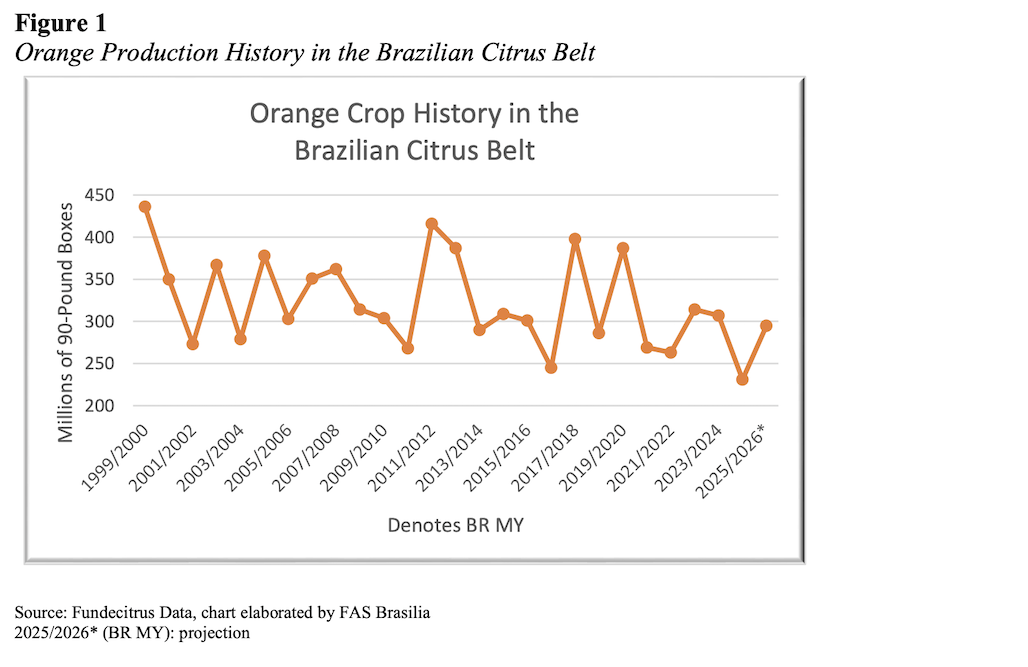
    Figure 1 shows the history of orange production in the Brazilian citrus belt, reflecting significant oscillations over the course of twenty-five years. Production ranged from 436 million 40.8-Kg/90-pound boxes (18.36 MMT) in BR MY 1999/2000 to the estimated 294 million (12 MMT) BR MY 2025/26, aprojected decrease of 32 percent from the previous harvest (BR MY 2024/25), due to fruit drop and reduction in size. Nevertheless, Post contacts indicate the current harvest is the largest since 2020.According to the latest estimates from Fundecitrus, the average weight of fruit is 4 grams lower than projected in September. As a result, the number of oranges required to fill a 40.8 kg box has increased from 258 (158 g/5.57 oz each) to 265 (154 g/5.43 oz each).

    The southwest region (Itapetininga and Avaré) leads with 1,103 boxes/hectare, up 23 percent from last season, likely maintaining top status, according to Fundecitrus. The most challenging area is northwest region (Votuporanga and São José do Rio Preto), with low yield at 552 boxes/hectare, still 16 percent above previous levels. The north region experienced the highest change, at 41.8 percent.

    September 2025 rainfall in key citrus regions of São Paulo and Minas Gerais helped induce flowering in certain orchards, but the volume remained insufficient to offset the ongoing water deficit. October 2025 rains begun improving conditions for orange trees and preparing them for next season’s blooms, according to the Center for Advanced Studies on Applied Economics (Cepea). Mid-season oranges, which are essential for the juice industry, were previously in high supply. However, concerns about fruit drop may limit the total harvest volume for the MY 2024/25 (BR MY 2025/26) season.

    A recent NOAA report indicates that although La Niña is currently weak, it is expected to continue influencing Brazil’s climate through early summer 2025. The phenomenon will likely bring increased rainfall to the Center-West and Southeast regions, milder temperatures along the coast, and more frequent storms. In contrast, the South is expected to experience variable, but not extreme, weather conditions.

    According to Post contacts, weather conditions in 2025 were generally stable, which supported strong crop production. However, the citrus belt faces ongoing dry spells, heat waves, and rising temperatures from La Niña, expected to last until March 2026. The past five years have also seen high temperatures, with 2026’s outlook depending on La Niña’s strength.

    By mid-2026, the likelihood of El Niño – typically associated with hotter weather and irregular rainfall in Brazil – begins to rise, potentially becoming dominant in 2027. This could significantly alter rainfall patterns and temperatures, making it essential for Brazilian farmers and to monitor updates and prepare for possible climate extremes.

    Climatempo reports that rainfall in Brazil’s citrus belt from May to August 2025 averaged 94 mm, 33 percent below the historical average (1991-2020), except in São José do Rio Preto, which saw 21 percent above-average precipitation. Despite this, April and June rains provided sufficient soil moisture, keeping the weight of early varieties like Hamlin, Westin, and Rubi stable at 134 g (305 fruits per box). Within the citrus belt regions, in 2025, only Porto Ferreira exceeded historical rainfall levels; all other regions fell short. The North experienced the steepest declines, with deficits between 32 percent and 47 percent. São José do Rio Preto and Brotas saw drops of 21 percent, followed by Matão and Duartina (18 percent), Avaré (17 percent), Itapetininga (15 percent), Votuporanga (11 percent), and Limeira (6 percent).

    Exports

    Post forecasts Brazilian FCOJ 66 Brix equivalent exports in MY 2025/26 at 973,276 MT, a slight increase of 2 percent compared to Post estimate for the previous crop (953,840 MT). According to Post contacts, the country is exploring new markets in Europe, as well as the People’s Republic of China (PRC), with a slight presence already in place. There are a few projects and campaigns from the Brazilian Trade and Investment Promotion Agency (Apex) already underway to promote the Brazilian orange juice to other markets, such as “Orange Juice, a good choice”; and the IFU Juice Conference.

    Organized by the International Fruit and Vegetable Juice Association (IFU) in partnership with CitrusBR, the event brought together Brazilian business leaders and international buyers from over 28 countries. ApexBrasil was the official sponsor of the 2025 edition, which hosted around 250 participants and served as a key platform for business development, networking, and strengthening Brazil’s presence in the global juice market.

    Brazil is the world’s largest supplier of concentrated juice, remaining capable of large-scale production, despite oscillations in production. The country plays a crucial role in meeting U.S. demand, as 80 percent of the orange juice consumed in the U.S. is imported, primarily from Brazil and Mexico. This reliance has grown due to Florida’s declining citrus production, driven by the spread of greening disease (HLB).

    The European Union (EU) remains the dominant market for Brazilian orange juice. However, there is a downward trend over the period. Exports to the EU decreased from 654,098 MT in MY 2019/20 to. MY 2025/26 161,413 MT so far in MY 2025/26.

    Exports to the U.S. fluctuated but generally remained robust, peaking at 340,736 MT in MY 2021/22. Since then, there has been a gradual decline, with 309,668 MT exported in MY 2023/24 and 161,958 MT in the partial MY 2025/26. Despite the decrease, the U.S. continues to be a critical destination for Brazilian orange juice, due to its large consumer base and established trade relationships.

    — By USDA Foreign Ag Service Brazil and Carolina Castro