The Citrus Research Board (CRB) is preparing to host the 2026 Citrus Growers Educational Webinar Series. CRB will be holding two one-hour webinars, scheduled for June 9 and 23, which will highlight research and discussions for growers.
The first webinar, “Plant Growth Regulators and California Citrus — Review and Updates,” will review the plant growth regulators (PGRs) currently available to the California citrus industry. This will include uses and effects of each of the PGRs covering both a historical perspective and current needs. The importance of 2,4-D timing will also discussed with respect to the premature fruit drop observed in Fall 2025.
Registration for the June 9 webinar can be done here.
The second webinar, “On the Ground with CA-CRaFT,” was started by California Research and Field Trials in 2023 to develop practical, field-based ACP management strategies under real commercial conditions across California. A major focus of this webinar will be updates on canine-assisted Asian citrus psyllid (ACP) inspections, field scouting, tap sampling, sticky traps and drone imagery are being integrated to support regional ACP management decisions and strengthen early detection efforts. Additional updates will include planned expansion of CA-CRaFT activities into Ventura County with stronger emphasis on biological control using self-release Tamarixia radiata cage systems. Ongoing Argentine ant management efforts will also be discussed, as invasive ants continue to be an important factor Tamaraxia establishment and overall biological control success in California citrus.
Registration for the June 23 webinar can be done here. — Story contributed by the Citrus Research Board
Rep. David Valadao (R-CA) hosted USDA Sec. Brooke Rollins last Friday at Allied Potato for a roundtable discussion on the challenges facing Central Valley growers, ranchers and producers.
The event brought together agricultural leaders from across the region to discuss key industry priorities and celebrate the USDA’s finalizing of the Specialty Crops Farmers program. This will provide $1.6 billion in payments to eligible specialty crop producers to help offset rising input costs and market disruptions — $625 million more than previously announced.
Prior to the roundtable, Valadao and Rollins toured Allied Potato, where the visited the fields and observed the processing and packaging operations. Attendees included representatives from the California Farm Bureau, Western Growers, Wonderful Citrus, California Dairies Inc., Milk Producer’s Council, California Citrus Mutual, Grimmway Farms, Western Tree Nut Association, Blue Diamond Almonds, California Fresh Fruit Association, California Farmworker Foundation, Family Tree Farms, Monte Vista Farming Company, and Cauzza Growers.
“Agriculture drives the Central Valley’s economy, and I was honored to welcome USDA Secretary Brooke Rollins to Bakersfield for a discussion with local agricultural leaders today,” Valadao said “For years, I’ve worked closely with producers across the Valley to address the challenges they face—rising input costs, workforce shortages, burdensome regulations, and the need for a stronger specialty crop safety net—and this conversation reinforced the importance of continued collaboration. As the sole dairy farmer in Congress, I understand these issues firsthand, which is why I was proud to join the Secretary as she announced USDA finalized $1.6 billion in assistance for specialty crop growers to help offset high costs and market disruptions. I appreciate her engagement with our local leaders, and I look forward to continuing to work with USDA on commonsense policies that support Central Valley agriculture and give producers the certainty they need to plan for the future.”
“Thank you Congressman Valadao, a leader on the House Commitee on Agriculture, for hosting an incredible roundtable today at Allied Potato here in your beautiful Bakersfield, California. Your extraordinary farmers, ranchers, and dairymen exemplify what it means to feed the country and the world,” Rollins said. “Everyday, the Trump Administration is putting Farmers First. As we announced after the roundtable, we are committed to ensuring the economic strength of our specialty crop operations aswe continue openingnew markets abroad and strengthening demand domestically for American produce. Congressman Valadao was critical to helping pass the Working Families Tax Cut Act, which is already helping over 63,000 California farms sell more agriculture products than any other state, protecting 2 million family farms from the death tax, increasing reference prices for the first time in more than a decade, and making the largest investment in rural America in history. And we are just getting started.”
In the summer of 1993, I visited the two small farms on the campus of UC Santa Cruz (UCSC). One of them was a flat, sunny site near the coast, the air pleasantly warm instead of blistering hot like further inland. The tour guide showed us a field in which small, round, bright-red tomatoes peeked out from brown, withered, un-staked vines. I felt appalled to see a UC growing tomatoes so incorrectly.
The tour guide then extracted some of the red globes from the brown rubble of vines and gave each of us one to try. The juicy tomato erupted with deep, complex flavor and sweetness. Feeling disloyal to the Jersey tomatoes I had enjoyed every summer growing up, I had to admit that this was the best tomato I had ever tasted. It still is 33 years later. I happily revised my opinion of the UCSC farming methods.
The tour group leader explained that the tomatoes were dry farmed, meaning that they were grown with only the water that the soil absorbed the previous winter. The tomato vines did not need staking because the dry surface of the ground was inhospitable to harmful insects and fungi.
The lack of water concentrated the flavor and sugars into a smaller volume. As researcher, Yvonne Socolar said at a recent dry farming webinar, “Dry-farmed tomatoes and grapes taste incredible, and consumers are willing to pay for that. But most dry-farmed crops don’t have a quality bump, so it is not a slam dunk for dry farming.”
Dry farming concentrates rich flavor in the tomatoes. Photo by Berkeley Food Institute
However, dry farming is getting more attention across California as growers look for ways to farm in a water-constrained environment. But what does dry farming actually involve, where does it work well and what are the tradeoffs?
The dry farm webinar, sponsored by the Berkeley Food Institute, dug into those questions. Socolar — one of two presenters — noted that the changing climate is making the water supply in California less predictable, and 16% of California’s main groundwater systems are running dry.
As in other Mediterranean climates, rain falls mainly in the cool winter season and typically not at all in the summer growing season. Dry farming of tomatoes occurs in coastal areas but potentially could work in parts of the western foothills of the Sierras. By contrast, the inland valley floors are too hot and dry.
Socolar presented a map of suitable locations for dry farming in California that she generated based on interviewing dry-farm tomato growers. The map can be seen in her research paper at Where dry farming could work in CA. Fortunately, the high priority water areas do have land suitable for dry farming.
Researcher Yvonne Socolar of Berkeley Food Institute conducted a study on dry farming. Photo by Berkeley Food Institute
How Do the Plants Survive?
Socolar explained that dry farming is inherently a diversified farming system, with cover cropping and hedgerows complementing the crop. The plants need deep roots in soil that holds moisture. Organic matter from cover crops is central for holding water and creating a conducive microbiome.
Although not widely used yet, biochar can also hold water, and it does not break down, so it might help even in years when the cover crop does not thrive. Cover crops, however, also provide nutrients. Foliar sprays also may be used to distribute micronutrients.
Eight of the 10 farmers who Socolar interviewed also rotate crops, but two do not, growing tomatoes repeatedly (10 years in a row and counting), or switching between tomatoes and fallow.
Socolar wrote in her article, “These management decisions to maintain fields as dry farmed rather than rotating irrigated crops through are particularly compelling in light of recent research on many of the same fields, showing that repeated seasons without any external irrigation result in soil microbial communities that are associated with improved dry farm tomato performance.”
Water Savings
The dry-farm methods used in California come from Greece and Spain, which have the namesake Mediterranean climate. Whereas the average water consumption for irrigated crops on typical dry-farm land is roughly 3 acre-feet per acre, most dry-farm tomato growers use between zero and ten inches of water.
Socolar estimates that nearly half of the water of the Shasta reservoir could be saved — 776 billion gallons/year — if all the potential dry farmland were dry farmed.
Built-In Pest Control
Because the surface of dry-farmed soils is dry during the growing season, weeds, pests and diseases have a harder time gaining a foothold. That lessens the need for labor. “Weed seeds need water to germinate, so they don’t emerge as easily, and fungal diseases that thrive in moisture do not have the conditions they need to take hold and spread,” Socolar described.
But Socolar cautions that not all that potential dry-farm land is ready to be dry farmed immediately. Rehabilitation with cover cropping and incorporating green manure may take years before the field reaches the level of performance needed to dry farm.
For farmers renting land, the lease term would need to be at least ten years to make the investment in soil benefits worthwhile and so the farmer can get to know the fields. The grower also needs a market willing to pay the quality premium.
Socolar notes that some farmers have also found nuts and orchard fruits to be desirable options to add to tomatoes and grapes for dry farming. “These crops have similar market appeal and quality premiums, making them economically viable,” Socolar wrote. Olives, too, being from the Mediterranean area are traditionally dry farmed, and were grown without irrigation until the 1970s. Globally, by far most olive oil crops are still dry farmed, according to Leandro Ravetti of Cobram Estate Olive Oil.
Whatever the crop, the current dry farmers are paving the way for viable options for other California farmers as the squeeze on water tightens.
The UC Ag and Natural Resources Agritourism is approaching and accepting registrations. From Sept. 23–25, San Luis Obispo County will become a hub for agritourism knowledge exchange.
Through keynote speakers, panel discussions and breakout sessions, summit participants will gain practical tools to strengthen agritourism in California. By visiting local farms, attendees can learn directly from business owners.
Event organizer Rachael Callahan, UC SAREP statewide agritourism coordinator, is excited to introduce attendees to the area’s diverse operations.
“We’re going to an urban farm. Then we’ll be out on a big, huge cattle ranch. And an indoor mushroom growing facility,” said Callahan. “San Luis Obispo just has a lot to offer in terms of scale and products.”
The program is tailored for multiple audiences: current agritourism operators, policymakers, regulators and tourism and economic development professionals.
Growers may take interest in breakout sessions on emergency preparedness or strategies for accessing capital. Tourism and economic development professionals can learn how to attract agritourism to their regions. The networking sessions hosted by event supporter California Grown will bring all stakeholders together while enjoying the state’s agricultural bounty.
According to Callahan, the summit coincides with the agritourism industry receiving increased attention and validation. Last year, California lawmakers passed legislation that streamlines permitting for low-impact camping on private sites. The decision was met with cheer from the agritourism industry, especially growers interested in hosting campers.
“Passing low-impact camping legislation was a big accomplishment,” said Callahan, who hopes the law will inspire conversations and new ideas to facilitate continued growth in the industry. “What can we learn? What other pathways can we open up?”
Lynette Sonne, founder of FARMstead ED, a summit partner and agritourism nonprofit in San Luis Obispo, expressed gratitude about the summit coming to her county.
“We look forward to wandering off the beaten path, with new friends and old, to discover urban farms, tucked-away family ranches and hand-crafted goods made right along the trail. These are places shaped by seasons, sweat and tradition,” Sonne said.
For growers or other land managers interested in adding agritourism to their operations, visit the California Agritourism website to learn about getting started in the industry and sign up for the e-newsletter to find local workshops hosted by UC ANR.
The 2026 California Agritourism Summit is organized by UC SAREP in collaboration with the 2026 planning committee, summit supporters and sponsors. Summit co-hosts include California Grown, FARMstead ED/SLO County Farm Trail, the Governor’s Office of Business and Economic Development (GO-Biz) and Siskiyou Economic Development. — Story contributed by UC Ag and Natural Resources
The 2025/26 stone fruit growing season faced significant weather challenges, as late frosts and excessive rainfall in southern producing regions reduced yields. With modest export volumes, most stone fruit production is consumed domestically. The sector confronts volatile weather conditions, high production costs, and competition from imports, but benefits from government support programs and ongoing investments in orchard modernization.
The Brazilian stone fruit sector focuses primarily on peaches, with some plum and nectarine production.
Brazil is the 16th largest global peach producer, according to 2024 FAO (The Food and Agriculture Organization), with average annual production of 200,000 metric tons (MT). Main varieties include Chimarrita, Eldorado, Dourado-2, and Maciel, selected for adaptation to subtropical conditions and early harvest. The sector is fragmented and dominated by small and medium producers.
While the Brazilian Institute of Geography and Statistics (IBGE) reported 4,735 peach-producing establishments in 2017 (most recent data available), industry contacts indicate this number likely decreased sharply by 2026, reflecting significant consolidation.
Despite this contraction, peaches remain easily marketable and command premium prices in the Brazilian market. Technological advances have improved production efficiency. Some producers registered with the Brazilian National Registry of Seeds and Seedlings (RENASEM) now propagate varieties commercially, with certain operations working under royalty agreements to distribute improved cultivars.
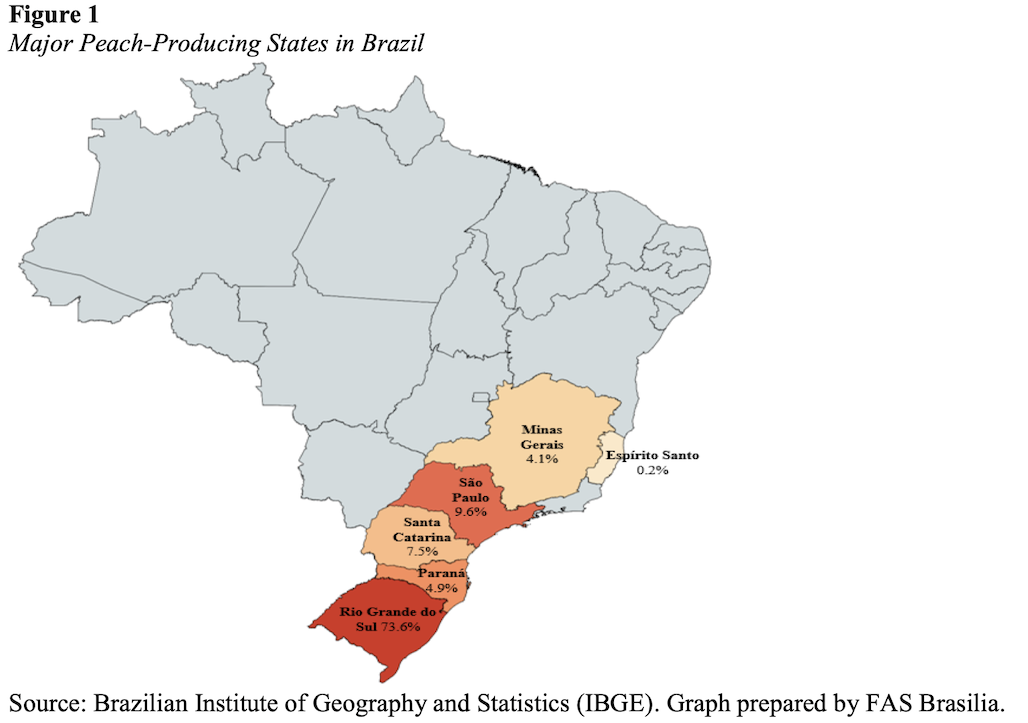
Peach cultivation is a significant agricultural activity in the southern and southeastern regions of Brazil. The state of Rio Grande do Sul is the largest producer of peaches, with the city of Pelotas as the main city for both fresh and processed peach production.
Brazil’s peach production has evolved significantly through genetic improvement programs led by the Temperate Agriculture branch of Embrapa, Brazil’s Agricultural Research Corporation (Embrapa Clima Temperado), which plays a key role in developing peach cultivars adapted to local conditions.
Since 1975, Embrapa Clima Temperado has developed 32 cultivars, particularly for canning peaches, including nine major varieties – Esmeralda, Granada, Maciel, Santa Áurea, Jade, Sensação, BRS Citrino, BRS Bonão, and Eldorado – that offer superior fruit size, firmness, appearance, and productivity. These innovations include dual-purpose cultivars for both canning and fresh consumption, low-chilling varieties adapted to subtropical conditions, and improved disease resistance with reduced fruit development periods. One notable example is BRS Sarau, launched in 2023, which extends the harvest season for fresh consumption.
While the Southern region remains Brazil’s largest producer, much of this production targets the industrial sector (canned, dehydrated products). Other regions, including São Paulo state, focus on fresh fruit production, which requires different management techniques including specialized pruning, thinning, and cultivation practices to achieve optimal color and flavor.
Production shifted from manual to automated processing, with industry estimating that one pit removal machines now replace the work of 40 workers each. Modern operations employ sorting machines, automated packaging equipment, and harvesting techniques processing 12-15 tons daily, alongside enhanced nutritional management using efficient fertilizers that improve shelf life and fruit quality.
Despite technological advances, the sector faces significant challenges including labor shortages and pest management issues. The 2016 San José Scale outbreak – insects that withdraw nutrients from the tree – required 60 percent replanting after causing trees to abort fruit formation, though producers have since developed management expertise. Other threats include fruit flies, Oriental Fruit Moth controlled through pheromone traps, and Monilinia fructicola which causes brown rot in humid zones. Southern Embrapa maintains an alert system with trap monitoring and regular meetings covering pest management and orchard fertilization, while biological control research offers promise for future improvements.
In 2025, Rio Grande do Sul produced 45-46 million cans of peaches, representing over 95 percent of Brazil’s canning peach production. The Pelotas microregion directed approximately 90 percent of its peach output to the canning industry.
While nearly 100 factories historically operated in the region, only about 11 industrial facilities remain operational. Small-scale peach juice and pulp production exists but remains limited, with the major juice industry in Espírito Santo relying on imported pulp.
According to Post contacts in Rio Grande do Sul, several producers traded peach cultivation for soybeans or tobacco, which offer more comprehensive technical assistance and insurance coverage. Labor shortages are driving investments in electric or automatic pruning equipment.
Read the full USDA Foreign Ag Service here. — Story by Carolina Castro, USDA Foreign Ag Service
The University of California, Davis, celebrated the grand opening of the Resnick Center for Agricultural Innovation.
Made possible by philanthropic support, including a lead transformative gift from Lynda and Stewart Resnick, through their foundation in 2022, the new center is housed within the UC Davis College of Agricultural and Environmental Sciences. The center builds on the university’s longstanding global leadership in agriculture with a focus on translating research into real-world impact.
“This center represents the best of UC Davis, uniting our strengths in agriculture, engineering and environmental sciences to address challenges facing communities across California and around the world,” said Chancellor Gary S. May. “We are deeply grateful to Lynda and Stewart for their partnership and support, which expand research opportunities and drive solutions that will shape the future of agriculture.”
Students, faculty, staff, donors and industry partners joined university leaders May 19 to celebrate the opening with a ribbon-cutting ceremony, open house and tours.
“Lynda and I have always believed that growing more food with fewer resources is one of the most important things we can do,” said Stewart Resnick, chairman of The Wonderful Company. “UC Davis is the leading ag university in the country, and we all have a stake in giving them everything they need to continue leading on this important work. This center will train the next generation, drive practical solutions, and get this urgently needed progress to growers and communities around the world.”
The Resnick Center reflects a broader commitment from the couple and their foundation, whose $50 million gift to UC Davis in 2022 included $40 million for the facility and $10 million to establish the Resnick Agricultural Innovation Research Fund, advancing research into sustainable uses for agricultural byproducts. Stewart Resnick also serves on the Chancellor’s Board of Advisors, underscoring the Resnicks’ longstanding commitment to the university and its mission.
The 34,000-square-foot facility includes hands-on learning in an innovative and immersive environment that connects education to research and discovery. Experts across disciplines will work in labs equipped with robotics, sensors, data science and artificial intelligence — technologies transforming how agriculture is managed and scaled. Research efforts will focus on making agricultural systems more resilient, developing advanced technologies, maximizing sustainability through water and energy efficiencies, and expanding access to nutritious food.
“The new Resnick Center strengthens our ability to integrate research, teaching and extension in ways that directly serve California and beyond,” said Ashley M. Stokes, dean of the College of Agricultural and Environmental Sciences. “It creates a dynamic environment where discovery, learning and community engagement come together — accelerating innovation, deepening partnerships with industry, and translating knowledge into real-world solutions. The design and flexibility of the space allow us to reimagine ideas and respond with agility to the evolving needs of our communities.”
The center will incorporate specialized labs and equipment that bolster efforts to transform agricultural byproducts into useable materials. This work is supported by the annual competitive research grants funded by the Resnicks, through their foundation.
Over the past three years, UC Davis researchers have explored how agricultural waste — including discarded hulls and shells from California’s iconic specialty crops like almonds, pistachios and pomegranates — can be repurposed as soil amendments, sustainable food products and low-cost industrial materials. The new facility will allow for widespread exploration of even more agricultural crops and potential uses.
In addition to experiential learning opportunities, the facility houses The Wonderful Scholar Center, a student success hub that offers academic and career advising for more than 50 students who are attending UC Davis on a Wonderful Scholarship. With a commitment to supporting first-generation students, the Resnicks, their foundations and The Wonderful Company have awarded over 3,500 scholarships of up to $40,000, providing mentorship and tutoring support with dedicated coaches, and equipping students with the tools to succeed in college and beyond.
“As a first-generation college student who grew up around agriculture, I came to UC Davis with a deep appreciation of what farming families are up against. The Wonderful Scholarship brought me here, and this center has shown me how research, innovation, and policy all have to work together to change the future of agriculture,” said Jose Gomez, Wonderful Scholar and second-year political science major. “What the Resnicks have built isn’t just a building. It’s a bridge across disciplines — driving research, innovation, and people forward. I intend to spend my life serving others and advancing solutions that strengthen our communities.”
“Today marks the beginning of a new era,” Chancellor May said. “The discoveries made inside this building will extend into farms, fields, and communities around the globe, shaping a more resilient and sustainable future for agriculture.” — Story by Courtney Tompkins, UC Davis
UC Ag and Natural Resources will hold the 42nd International Carrot Conference, scheduled for June 2-3 at the Bakersfield Marriott Convention Center.
The Carrot Conference is an opportunity to share and discuss research findings and a way for people to exchange ideas and concerns in all aspects of carrot production. Topics such as breeding, new products, production, and pest management are discussed in formal paper sessions, poster sessions, and a field tour, as well as other social gatherings.
The conference also provides continuing education opportunities with 4.5 other DPR hours approved for June 2. More details and an agenda can be found here. For additional information please contact: Jaspreet Sidhu, Kern County Cooperative Extension, 661-868-6222, 661-304-8870. — Contributed by UC Ag and Natural Resources
The Hass Avocado Board has proceeded with elections with voting taking place electronically. Those who previously registered to vote electronically and/or provided an email address on a past paper ballot should have received an email with voting instructions. For those associated with multiple entities, separate emails have been sent for each entity — each containing a unique username and password for voting. Emails were distributed on April 27 and will come from either noreply@eballot.com or noreply@votenet.com.
Participants are encouraged to open each email individually and use the corresponding credentials to cast their votes.
The ballot includes the names and information of nominees running for open seats on the Board. HAB Chair Gwen Jackimek encourages all eligible voters to take the time to participate, emphasizing that every vote is important. — Story contributed by the Hass Avocado Board
The award ceremony for the Japan Olive Oil Prize (JOOP), the international competition dedicated to extra virgin olive oil quality, was held recently in Tokyo.
The 2026 edition set a new record for entries: 691 oils from 25 countries competed, compared to 577 oils in the previous year. An increase of nearly 20% in the number of samples, which consolidates JOOP as one of the most important and fastest-growing competitions worldwide in the EVOO sector.
“OOP 2026 saw a significant increase not only in the number of participants, but also in the overall quality of the competing oils. We are particularly pleased with the growing participation of Japanese producers, which speaks to the trust they have chosen to place in JOOP. We are confident that the competition represents a real opportunity for them to grow and engage in international dialogue,” said Panel Leader Miciyo Yamada.
This year’s United States winner was Arbequina Extra Virgin Olive Oil from the Durant Olive Mill in Oregon.
JOOP promotes extra virgin olive oil excellence and raises awareness among Japanese consumers to recognize high-quality products through masterclasses, guided tastings and educational activities. The goal is to support producers and facilitate their success in the Japanese market.
Japan is one of the leading Asian markets for olive oil. According to GTAIC data, in 2024 Japanese imports reached a value of approximately USD 383 million. Per capita consumption remains modest — just 0.4 kg per year according to the International Olive Council — highlighting considerable room for growth. The main suppliers are Spain (53.2%), Italy (35.8%), and Turkey (8.1%), while the growing interest of Japanese consumers in the Mediterranean diet makes Japan one of the most promising destinations for EVOO producers worldwide. — Story Contributed by the Japan Olive Oil Prize
UC Ag and Natural Resources is planning a Pre-Plant Fertilization and Establishment Irrigation Strategies for Strawberry Production
Growers will gather May 21 at Crisalida Berry Farms in Oxnard to go over insights on establishing strawberries with drip tape versus micro sprinklers, irrigation choices and their influence on crop development, practical approaching to improving water and nutrient use efficiency, how to visualize treatments effects on plots and discuss events. Fertilizer strategies like banded, broadcast and no fertilizer will also be discussed.
Spanish translation will be provided, along with refreshments. Participants including certified crop adivsers will receive two continuing education units.