The 2025/26 stone fruit growing season faced significant weather challenges, as late frosts and excessive rainfall in southern producing regions reduced yields. With modest export volumes, most stone fruit production is consumed domestically. The sector confronts volatile weather conditions, high production costs, and competition from imports, but benefits from government support programs and ongoing investments in orchard modernization.
The Brazilian stone fruit sector focuses primarily on peaches, with some plum and nectarine production.
Brazil is the 16th largest global peach producer, according to 2024 FAO (The Food and Agriculture Organization), with average annual production of 200,000 metric tons (MT). Main varieties include Chimarrita, Eldorado, Dourado-2, and Maciel, selected for adaptation to subtropical conditions and early harvest. The sector is fragmented and dominated by small and medium producers.
While the Brazilian Institute of Geography and Statistics (IBGE) reported 4,735 peach-producing establishments in 2017 (most recent data available), industry contacts indicate this number likely decreased sharply by 2026, reflecting significant consolidation.
Despite this contraction, peaches remain easily marketable and command premium prices in the Brazilian market. Technological advances have improved production efficiency. Some producers registered with the Brazilian National Registry of Seeds and Seedlings (RENASEM) now propagate varieties commercially, with certain operations working under royalty agreements to distribute improved cultivars.
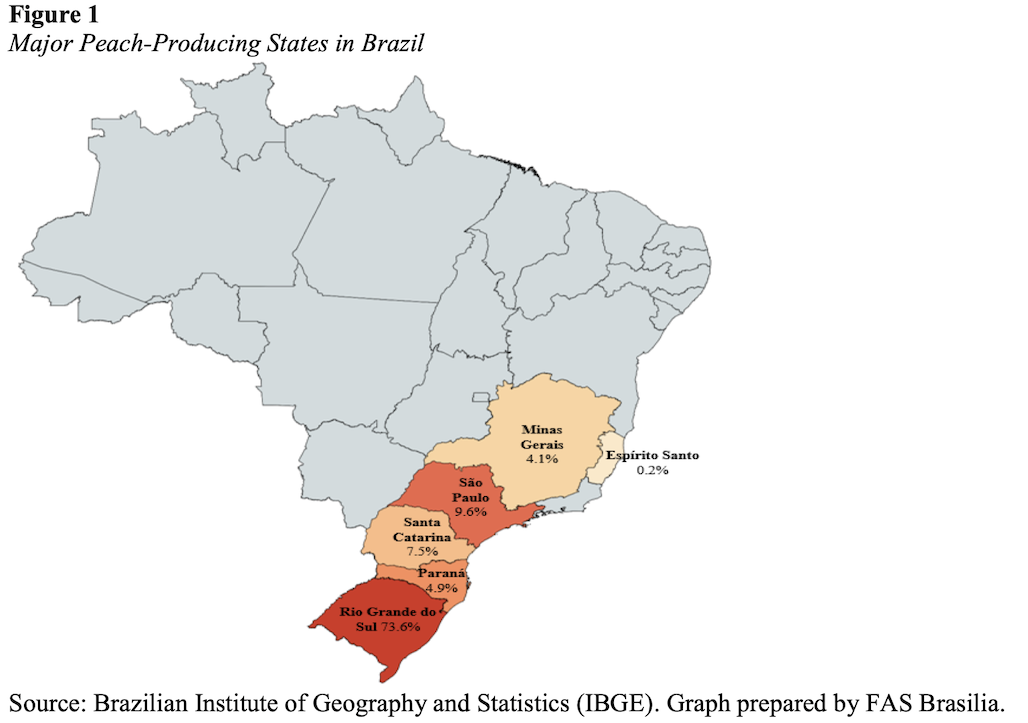
Peach cultivation is a significant agricultural activity in the southern and southeastern regions of Brazil. The state of Rio Grande do Sul is the largest producer of peaches, with the city of Pelotas as the main city for both fresh and processed peach production.
Brazil’s peach production has evolved significantly through genetic improvement programs led by the Temperate Agriculture branch of Embrapa, Brazil’s Agricultural Research Corporation (Embrapa Clima Temperado), which plays a key role in developing peach cultivars adapted to local conditions.

Since 1975, Embrapa Clima Temperado has developed 32 cultivars, particularly for canning peaches, including nine major varieties – Esmeralda, Granada, Maciel, Santa Áurea, Jade, Sensação, BRS Citrino, BRS Bonão, and Eldorado – that offer superior fruit size, firmness, appearance, and productivity. These innovations include dual-purpose cultivars for both canning and fresh consumption, low-chilling varieties adapted to subtropical conditions, and improved disease resistance with reduced fruit development periods. One notable example is BRS Sarau, launched in 2023, which extends the harvest season for fresh consumption.
While the Southern region remains Brazil’s largest producer, much of this production targets the industrial sector (canned, dehydrated products). Other regions, including São Paulo state, focus on fresh fruit production, which requires different management techniques including specialized pruning, thinning, and cultivation practices to achieve optimal color and flavor.
Production shifted from manual to automated processing, with industry estimating that one pit removal machines now replace the work of 40 workers each. Modern operations employ sorting machines, automated packaging equipment, and harvesting techniques processing 12-15 tons daily, alongside enhanced nutritional management using efficient fertilizers that improve shelf life and fruit quality.
Despite technological advances, the sector faces significant challenges including labor shortages and pest management issues. The 2016 San José Scale outbreak – insects that withdraw nutrients from the tree – required 60 percent replanting after causing trees to abort fruit formation, though producers have since developed management expertise. Other threats include fruit flies, Oriental Fruit Moth controlled through pheromone traps, and Monilinia fructicola which causes brown rot in humid zones. Southern Embrapa maintains an alert system with trap monitoring and regular meetings covering pest management and orchard fertilization, while biological control research offers promise for future improvements.
In 2025, Rio Grande do Sul produced 45-46 million cans of peaches, representing over 95 percent of Brazil’s canning peach production. The Pelotas microregion directed approximately 90 percent of its peach output to the canning industry.
While nearly 100 factories historically operated in the region, only about 11 industrial facilities remain operational. Small-scale peach juice and pulp production exists but remains limited, with the major juice industry in Espírito Santo relying on imported pulp.

According to Post contacts in Rio Grande do Sul, several producers traded peach cultivation for soybeans or tobacco, which offer more comprehensive technical assistance and insurance coverage. Labor shortages are driving investments in electric or automatic pruning equipment.
Read the full USDA Foreign Ag Service here. — Story by Carolina Castro, USDA Foreign Ag Service