Harvest of the 2018-2019 citrus crop is underway, and growers are excited to reap the fruits of their labors. Watch this brief interview with third generation Central Valley citrus grower Arlen Miller as he shares his perspective on the coming crop and read more about him and his many diverse varieties of citrus in the coming issue of California Fresh Fruit Magazine.
Tag: California Fresh Fruit Magazine
-
Introducing the Mega Kiwi with California Grower Jerry Kliewer
Jerry Kliewer and his family have been growing kiwifruit in the Central Valley since the 1970s, but they are on to something really BIG now with a new variety they have introduced to America, known as the Mega Kiwi. Watch this brief video interview as Jerry talks about growing this new variety, and read more about it in the November issue of California Fresh Fruit Magazine.
-
Dealing with Wild Pig Pests on the Farm
Farmers are used to dealing with insect pest and small furry rodents, but how about wild pigs? Now, this is a more common issue in some areas more than others; nonetheless, pigs can wreak a lot of havoc in vineyards, orchards and field crops, so exploring your management options is key. Watch this brief interview with Julie Finzel from the UC Cooperative Extension as she provides some recommendations for growers.
-
Growing Fresh Market Figs with Steve Schafer
With oncoming groundwater regulations and an increasingly tight water supply, California farmers are searching for alternative crops that require less water, not to mention lower labor costs, and Madera grower Steve Schafer has more recently invested in the fresh fig market for those reasons. Watch his brief interview here and read more about growing figs in California Fresh Fruit Magazine.
-
Berry Grower Embraces Conservation & History
Sweet Present, Rich Past

A honey bee helps pollinate Carolyn Read’s boysenberry bushes. Photo by Jonathan Snapp-Cook/USFWS. By Joanna Gilkeson – It would be easy to call Carolyn Read a preservationist and leave it at that. How many people would settle in a ranch house built 130 years ago and raise a family there?
Or call her a conservationist. Read has made sure that native plants that were in danger of getting choked out by other invasives are again thriving in the arid reaches of her San Diego-area ranch.
Make sure you give Read credit for her business sense, too. She started a horse-themed magazine more than 30 years ago that remains an award-winning publication on the West Coast. She’s also raising and selling boysenberries.
Read is a rancher, an active community member, an equestrian advocate, a conservationist, a historian, an entrepreneur, a grower, a mother and a grandmother — all of which stem from her opportunity to build a life on the land.

A honey bee gathers nectar from black sage (Salvia mellifera), a coastal sage scrub plant, on Carolyn Read’s property. Photo by Jonathan Snapp-Cook/USFWS. She’s worked with others to ensure that a ranch started in the 1800s remains viable, even as development nears its borders. Among her collaborators: the U.S. Fish and Wildlife Service (Service), which advised her as Read restored a hillside with coastal sage scrub. From that collaboration came a friendship with a Service biologist. That connection has roots as hearty as the sage scrub growing on the hills.
Read, 86, is just happy to remain on the land that she has tended so carefully for more than five decades.
“I am grateful for the opportunity to acquire and raise my family in this home,” she said recently, “and for the living heritage the area has given us.”

Read walking along her boysenberry bushes before demonstrating the irrigation system. Photo by Joanna Gilkeson/USFWS. A Blessing
In 1874, an Arkansan by the name of Reynold Bascomb Borden traveled cross-county in a covered wagon. It came to a halt in a valley blanketed by coastal sage scrub and sunshine. In 1882, he would construct one of the first homesteads in this remote valley, now present-day San Marcos, in San Diego County.
The family kept the clapboard house until 1929. It went through more owners until 1963, when it was put up for sale. Three parties expressed interest in it. One was a young woman who needed space for a growing family.
“At the time, I was a single mom with four children,” Read said. “…For some reason the family who owned the property at the time chose me.”
It was a blessing. “I was able to establish roots, a chance to make a home.”

A Belding’s Orange Throated Whiptail on Carolyn’s property. Photo by Jonathan Snapp-Cook/USFWS. Today, the property also is home to California quail, hummingbirds, pollinators, lizards, rattlesnakes and birds of prey.
She pointed to a hawk’s nest in the top of a eucalyptus tree.
“That’s the 12th generation of this pair of hawks,” Read said. “They just had their babies. The small sparrows torment them.”
‘Strong Connection’
In 2012, Read decided she needed help to restore wildlife habitat on her land. She worried that the native flora was getting overwhelmed by invasive plants.

Jonathan Snapp-Cook, Partners Biologist, translocates California sagebrush (Artemisia californica) to the restoration site. Photo by Carmen Wilson. Jonathan Snapp-Cook, a Service biologist, visited her ranch. He knew right away that they shared an appreciation of land stewardship.
“It was obvious she had a strong connection to the historical and cultural aspects of her property and wanted to conserve wildlife,” said Snapp-Cook. “I knew it was going to be the beginning of a good partnership.”
Snapp-Cook and Read embarked on a restoration project to benefit native wildlife. A portion of the hillside behind Read’s house was chock-full of invasive plants while native coastal sage scrub voluntarily grew on the property’s dirt roads.
The idea: transplant the coastal native sage scrub in the roadway to the tract where invasives grew. It was best, they decided, to use the plants they already had to make the restoration take root.
As Read described it: “If the plants are able to make it on their own, then that’s who survives. They are the survivors.”
So far, the native plants are winning. Snapp-Cook and Read have completed three small, flourishing sections of restoration — but they didn’t do it alone. Read’s hired farm hands, family and grandchildren helped restore the hillside, one plant at time.
The restoration project has been a lesson for Read and her family; they see the sage scrub as a valuable member of the ranch ecosystem.
“Jonathan has been quite an inspiration to me, to walk across the property with a biologist, and the native plants he finds, he points out all these things happening at my feet,” she said. “It’s become a very enlightening friendship.”

U.S. Fish and Wildlife Service Partners Biologist Jonathan Snapp-Cook overlooking the invasive species on Carolyn Read’s property. Photo by Celeste Medina-Ontiveros/USFWS. Horses & Berries
The view from Read’s front porch has changed since she moved in. Over the years she has watched development slowly creep toward her ranch. The 14-acre property is flanked by rows of white-and-beige houses on one side. An open space soon to be developed shares a property line on another. A hillside of coastal sage shrub touches a third.
Even as San Marcos extends its borders toward her, Read remains determined to protect the land and the creatures that live there.

Carolyn Read walks a horse out to pasture. Behind her is a remnant of her previous career as founder of Horsetrader magazine. Photo by Joanna Gilkeson/USFWS. Every inch of the 14-acre ranch continues to be productive, which includes seven acres of preserved habitat. Read has four horses on site, with pastures to match. Three years ago, she turned her attention to a local delicacy.
Read began growing boysenberries – a move driven in equal parts by an appreciation of history as well as the bottom line.
The boysenberry enjoys historic importance in Southern California. In 1932, Knott’s Berry Farm in Buena Park, California, created a new kind of produce – a cross between red raspberries, blackberries and loganberries. The Knott family dubbed it the boysenberry.
The new berry was a tough thing to cultivate, its bushes riddled with thorns, but the payoff was good, too. Consumers loved the boysenberry. So does Read.

Carolyn Read’s boysenberries straight out of the crisper and ready to sell. Read became organically certified in April 2018. Photo courtesy of Carolyn Read. “I started selling my berries to the neighbors, and I’ve gotten so much good feedback from the community,” she said. “I’ve connected with my neighbors because of the berries and they’re wonderful people.”
The berries also have made their way into local high-end restaurants through a contract with a San Diego produce distributor. “I don’t even know how it all happened,” Read said, “but I’m grateful.”
Growing and sharing California’s homegrown classic fruit is the way Read has chosen to share the living heritage of the homestead with the greater community.
For Read, the boysenberry provides a tangible, tasty link to the area’s rich history.
“Without the places that keep our stories alive…we lose some of the most profound parts of our local history,” she said.
She feels that way about her ranch, too. “It is part of who I am,” she said. “I would like to see some of that lifestyle preserved for future generations.”

California quail make themselves at home on the Pepper Hill Borden Homestead. The U.S. Fish and Wildlife Service supported this Nature’s Good
Neighbor through our Partners for Fish and Wildlife program. Our Partners program would like to acknowledge the USDA’s Natural Resources Conservation Service for introducing them to this local landowner. The Partners program is a voluntary initiative that works with private landowners to improve fish and wildlife habitat on their land. A phone call or email is all it takes to learn more with one of our 250 private lands biologists. If you are interested in improving habitat for fish and wildlife on your land, find your local Partners for Fish and Wildlife biologist.Joanna Gilkeson is a public affairs specialist out of the Pacific Southwest Region in Carlsbad, California.
-
New UC Raspberry Production Cost Study
Growers get help from UC in estimating raspberry production costs: https://coststudies.ucdavis.edu
Spanish version: COSTOS DE MUESTRA PARA PRODUCIR Y COSECHAR FRAMBUESAS DE MERCADO FRESCO Producción de Primocañas
When growers are considering a new crop to plant, and penciling out their expenses and income, cost estimates from the University of California may help. A new cost and return study for commercially producing raspberries released by UC ANR Agricultural Issues Center and UC Cooperative Extension includes an expanded section on labor.
Sample costs to establish, produce and harvest raspberries for fresh market in Santa Cruz, Monterey and San Benito counties are presented in “Sample Costs to Produce and Harvest Fresh Market Raspberries in the Central Coast Region – 2017.”
“The study focuses on the many complexities and costs of primocane raspberry production over a three-year period, including crop establishment, fertility practices, overhead tunnel management, harvest and rising labor costs,” said Mark Bolda, UC Cooperative Extension farm advisor and co-author of the study.
The analysis is based upon a hypothetical well-managed farming operation using practices common to the region. The costs, materials, and practices shown in this study will not apply to all farms. Growers, UC Cooperative Extension farm advisors and other agricultural associates provided input and reviewed the methods and findings of the study.
“This raspberry cost and return study is the result of significant effort on the part of UC Cooperative Extension, the Agricultural Issues Center and several grower and industry collaborators, who shared their expertise and contributed mightily to the end product,” said Laura Tourte, UC Cooperative Extension farm management advisor and co-author of the study.
This study assumes a farm size of 45 contiguous acres of rented land. Raspberries are planted on 42 acres. The crop is hand-harvested and packed into 4.5-pound trays. There is a fall harvest during production year 1, a spring and fall harvest during production year 2, and a spring harvest during production year 3. Each harvest is three months long.
The authors describe the assumptions used to identify current costs for production material prices and yields. Tables show the phase-in schedules for California’s minimum wage and overtime laws through the year 2022. Other tables show the monthly cash costs, the costs and returns per acre, hourly equipment costs, and the whole farm annual equipment, investment and business overhead costs.
Free copies of “Sample Costs to Produce and Harvest Fresh Market Raspberries in the Central Coast Region – 2017” can be downloaded from the UC Davis Department of Agricultural and Resource Economics website https://coststudies.ucdavis.edu. Sample cost of production studies for many other commodities are also available at the website.
The cost and returns studies program is funded by the UC Agricultural Issues Center and UC Cooperative Extension, both of which are part of the UC Division of Agriculture and Natural Resources, and the UC Davis Department of Agricultural and Resource Economics.
For additional information or an explanation of the calculations used in the studies, contact the UC Agricultural Issues Center at (530) 752-4651 or UC Cooperative Extension advisors Mark Bolda at (831) 763-8025 or Laura Tourte at (831) 763-8005 in Santa Cruz County.
UC Agriculture and Natural Resources researchers and educators draw on local expertise to conduct agricultural, environmental, economic, youth development and nutrition research that helps California thrive. Learn more at ucanr.edu.
-
Delegate Removed from the Bulk Citrus Spray and Move Treatment List
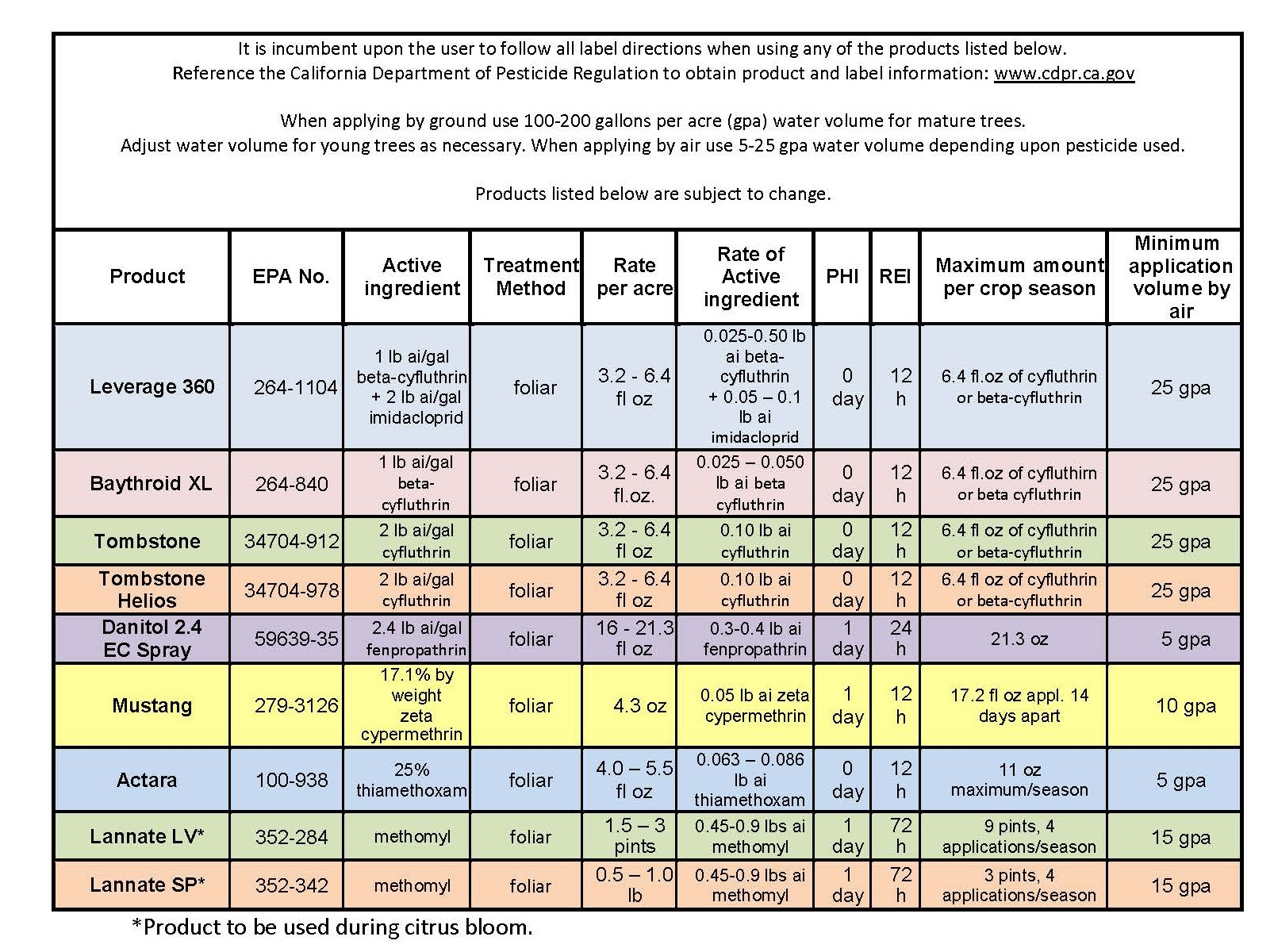
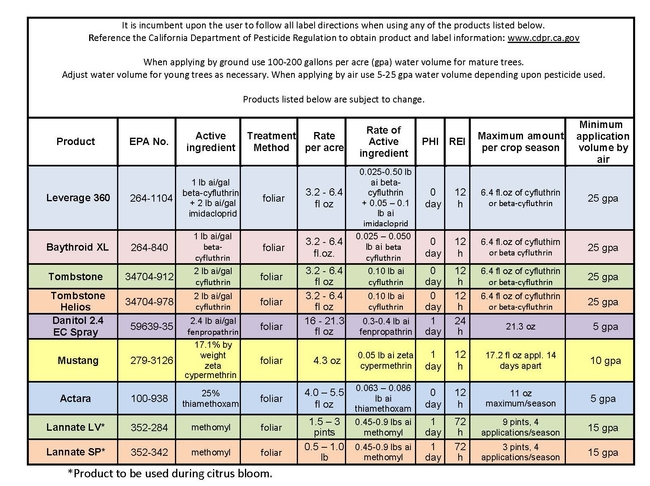
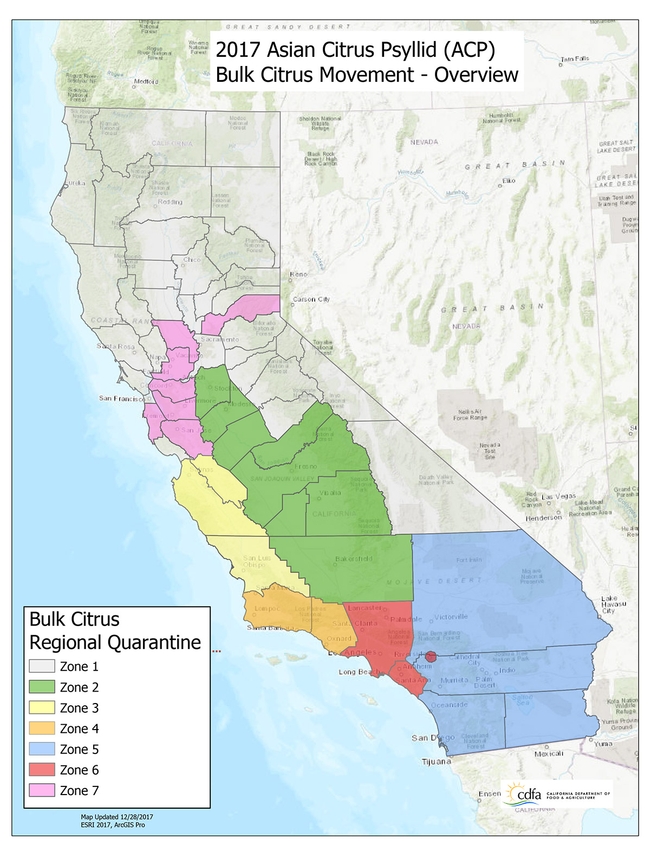
As of APRIL 20, 2018 Delegate (spinetoram) has been removed from the list of approved insecticides for the treatment of citrus just prior to harvest for the purpose of disinfesting citrus prior to moving citrus-filled bins between quarantine zones in California. The regulations for ‘spray and move’ can be found on the CDFA information for citrus growers/grove managers web page and the table from that document is shown below. The reason for removing Delegate, is that it shows significantly less control of psyllids than the other treatments on the list. It is critical to achieve high kill of psyllids to ensure fruit is disinfested, so that psyllids, and potentially HLB, are not moved around the state. The alternative to ‘spray and move’ is field cleaning (brushing or washing fruit) and removing leaves and stems from the fruit and bins. The eggs and nymphs attach themselves to leaves and stems and the adults can ride on fruit.
In recognition of the issues related to treating citrus just prior to harvest, research is being conducted by the USDA and University of California to develop fogging and fumigant post harvest systems to disinfest fruit that will ultimately replace ‘spray and move’ treatments.
-
Research Reveals a New Direction for Halting the Citrus Greening Epidemic
ITHACA, NEW YORK, March 26, 2018—New clues to how the bacteria associated with citrus greening infect the only insect that carries them could lead to a way to block the microbes’ spread from tree to tree, according to a study in Infection and Immunity by Agricultural Research Service (ARS) and Boyce Thompson Institute (BTI) scientists.
Citrus greening, also known as “huanglongbing,” is a serious disease dramatically affecting citrus production across the world. Trees with this disease all die after only a few years. Citrus greening has been detected in every citrus-producing county in Florida, throughout the southern citrus growing states and in isolated spots in southern California. There is no effective prevention or cure.
The disease is associated with the bacterium Candidatus Liberibacter asiaticus, CLas for short, which is spread from tree to tree only by a tiny insect vector—the Asian citrus psyllid. If CLas cannot infect the psyllid, its ability to spread citrus greening is halted.
With the long-term goal of disrupting this CLas-Asian citrus psyllid interaction, research molecular biologist and BTI professor Michelle Heck, with the ARS Emerging Pests and Pathogens Research Laboratory, and BTI researcher Marina Mann focused on an important point: not all psyllids spread CLas equally well.
To be spread by the Asian citrus psyllid (ACP) effectively, the bacteria must pass through the cells lining the insect’s gut and multiply. Scientists in Heck’s lab had previously shown that the gut cells of adult ACP show severe stress responses when infected by CLas. The cell nuclei become fragmented, and some cells react to the point of dying, allowing the bacteria to move out of the psyllid and into the tree.
Now, the researchers have found that, unlike adult psyllids, young psyllid nymphs appear to be resistant to the effects of exposure to CLas, and their nuclei rarely reach the same level of disruption. This means CLas cannot enter psyllid gut cells to multiply.
The next step will be to identify the mechanism for this resistance in the nymphs so that it might be manipulated to also halt the spread of CLas by the adults. An important clue lies in how psyllid nymphs interact with symbiotic bacteria in their gut, especially Wolbachiapipientis.
Many insects are hosts for Wolbachia and often depend on these bacteria for important benefits—much like how human health depends on gut bacteria. In their study, Mann and Heck showed that in psyllid nymphs, Wolbachia and CLas are commonly found within the same cells.
The authors hypothesize that, in accommodating the beneficial bacteria, the nymphs also let in more CLas. This is supported by their finding that CLas levels in psyllid nymphs are strongly correlated with Wolbachia levels. Though this link remains to be tested directly, understanding its mechanism could yield an important target for disrupting CLas-psyllid interaction.
“CLas exploits the way nymph and adult psyllids differ in their guts to gain entry into its insect vector,” Heck said. “We may be able to use this new foothold in our understanding to develop ways to block transmission by insects in the citrus grove.”
If this works, “citrus growers will be in a much better situation in terms of disease control and saving the U.S. citrus industry,” said Dan Dreyer, Chairman of the California Citrus Research Board, which funds this and other research aimed at developing a management strategy for citrus greening.
“There are still many unanswered questions about CLas, how it is acquired and transmitted via the Asian citrus psyllid, and how it causes the disease,” continued Dreyer. “The more we learn about CLas and its vector, the closer we will get to moving citrus production past the threat of citrus greening.”
The Agricultural Research Service is the U.S. Department of Agriculture’s chief scientific in-house research agency. Daily, ARS focuses on solutions to agricultural problems affecting America. Each dollar invested in agricultural research results in $20 of economic impact.