Tag: stone fruit

  • Tulare County Sheriffs Arrest Peach Thieves

    On June 29, Sheriff’s detectives assigned to the Agricultural Crimes Task Force have arrested Francisco Lopez, 54, of Reedley and Josue Vargas, 46, of Orange Cove for felony grand theft of farm crops. Lopez has a bail set at $10,000. Vargas, who faces additional charges related to D.U.I. warrants, has a total bail of $50,000.

    On Monday, detectives developed information about a suspect’s vehicle tied to ongoing stone fruit thefts in Fresno and Tulare Counties. Detectives worked with patrol deputies and Reedley Police officers to find the vehicle. Later that night, a deputy stopped a matching pickup truck towing a trailer at Kamm Ave. and Road 56 near Dinuba. The trailer was reportedly loaded with crates containing approximately 2,000 pounds of Pink Moon peaches, valued at $8,500. Detectives responded and determined the peaches were stolen on Sunday from a farm in Tulare County. Lopez and Sanchez were placed under arrest. An additional passenger of the truck, 56-year-old Jesus Chacon of Reedley, was also arrested for outstanding warrants related to drug possession and battery.

    The Tulare County Sheriff’s Office will be pursuing additional criminal charges against Lopez and Vargas due to the theft occurring within its jurisdiction.

    Anyone with further information on this case or a related case is asked to contact Sheriff’s Detective North at (559) 600-8150 or email agcrimes@fresnosheriff.org or contact Crime Stoppers at (559) 498-7867, www.valleycrimestoppers.org. You will remain anonymous and may receive a cash reward. Reference case # 26-7616.

    The Ag Crimes Task force encourages growers to follow these tips to protect themselves against theft.

    Increase Visibility

    • Install cameras overlooking entrances, loading areas and packing facilities.

    • Use trail cameras in remote orchards.

    • Ensure entrances and loading areas are well lit.

    • Trim vegetation around gates and roads to eliminate hiding spots.

    Harvest Management

    • Harvest ripe fruit as soon as practical.

    • Avoid leaving harvested bins in fields overnight.

    • Schedule picking crews so fruit spends the least amount of time unattended.

    • Keep loaded trailers in secured yards whenever possible.

    Secure Fruit Bins

    • Mark bins with permanent farm identifiers.

    • Record the number of bins left in each block.

    • Conduct daily inventory counts during harvest.

    • Store empty bins in secured compounds.

    Clearly Mark Equipment

    • Clearly mark all equipment and fruit bins with your farm name or unique identifier.

    • Record serial numbers and photograph valuable equipment.

    • Use permanent, tamper-resistant markings whenever possible.

    Story Contributed by the Tulare County Sheriff’s Office
  • Brazil Sees Reduced Stone Fruit Yields

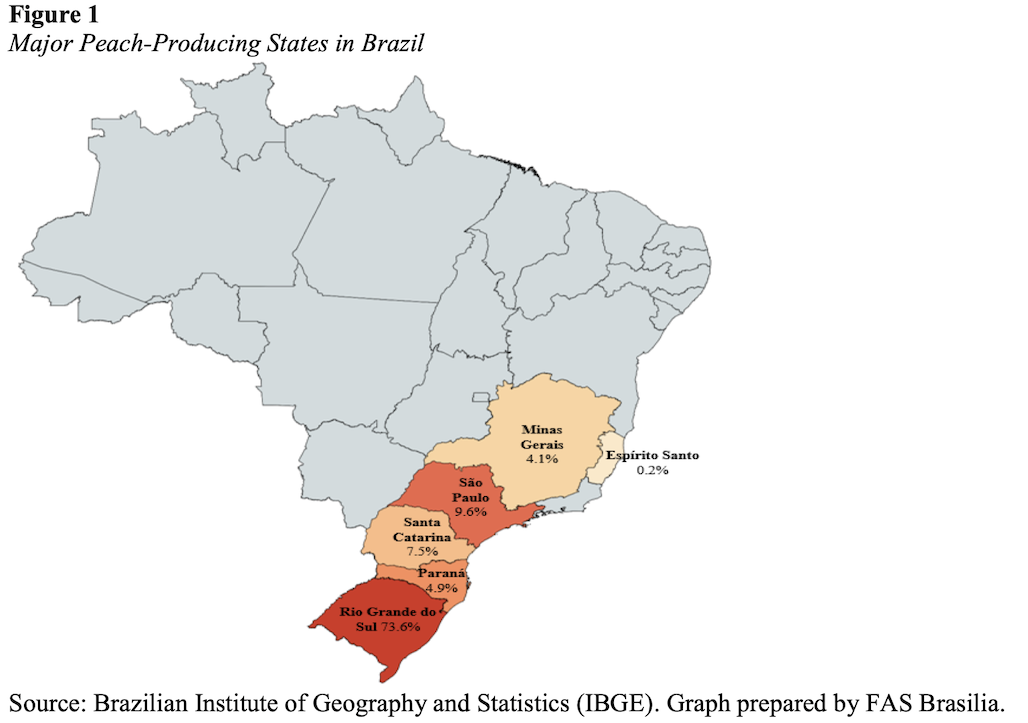
    The 2025/26 stone fruit growing season faced significant weather challenges, as late frosts and excessive rainfall in southern producing regions reduced yields. With modest export volumes, most stone fruit production is consumed domestically. The sector confronts volatile weather conditions, high production costs, and competition from imports, but benefits from government support programs and ongoing investments in orchard modernization.

    The Brazilian stone fruit sector focuses primarily on peaches, with some plum and nectarine production.

    Brazil is the 16th largest global peach producer, according to 2024 FAO (The Food and Agriculture Organization), with average annual production of 200,000 metric tons (MT). Main varieties include Chimarrita, Eldorado, Dourado-2, and Maciel, selected for adaptation to subtropical conditions and early harvest. The sector is fragmented and dominated by small and medium producers.

    While the Brazilian Institute of Geography and Statistics (IBGE) reported 4,735 peach-producing establishments in 2017 (most recent data available), industry contacts indicate this number likely decreased sharply by 2026, reflecting significant consolidation.

    Despite this contraction, peaches remain easily marketable and command premium prices in the Brazilian market. Technological advances have improved production efficiency. Some producers registered with the Brazilian National Registry of Seeds and Seedlings (RENASEM) now propagate varieties commercially, with certain operations working under royalty agreements to distribute improved cultivars.

    Peach cultivation is a significant agricultural activity in the southern and southeastern regions of Brazil. The state of Rio Grande do Sul is the largest producer of peaches, with the city of Pelotas as the main city for both fresh and processed peach production.

    Brazil’s peach production has evolved significantly through genetic improvement programs led by the Temperate Agriculture branch of Embrapa, Brazil’s Agricultural Research Corporation (Embrapa Clima Temperado), which plays a key role in developing peach cultivars adapted to local conditions.

    Since 1975, Embrapa Clima Temperado has developed 32 cultivars, particularly for canning peaches, including nine major varieties – Esmeralda, Granada, Maciel, Santa Áurea, Jade, Sensação, BRS Citrino, BRS Bonão, and Eldorado – that offer superior fruit size, firmness, appearance, and productivity. These innovations include dual-purpose cultivars for both canning and fresh consumption, low-chilling varieties adapted to subtropical conditions, and improved disease resistance with reduced fruit development periods. One notable example is BRS Sarau, launched in 2023, which extends the harvest season for fresh consumption.

    While the Southern region remains Brazil’s largest producer, much of this production targets the industrial sector (canned, dehydrated products). Other regions, including São Paulo state, focus on fresh fruit production, which requires different management techniques including specialized pruning, thinning, and cultivation practices to achieve optimal color and flavor.

    Production shifted from manual to automated processing, with industry estimating that one pit removal machines now replace the work of 40 workers each. Modern operations employ sorting machines, automated packaging equipment, and harvesting techniques processing 12-15 tons daily, alongside enhanced nutritional management using efficient fertilizers that improve shelf life and fruit quality.

    Despite technological advances, the sector faces significant challenges including labor shortages and pest management issues. The 2016 San José Scale outbreak – insects that withdraw nutrients from the tree – required 60 percent replanting after causing trees to abort fruit formation, though producers have since developed management expertise. Other threats include fruit flies, Oriental Fruit Moth controlled through pheromone traps, and Monilinia fructicola which causes brown rot in humid zones. Southern Embrapa maintains an alert system with trap monitoring and regular meetings covering pest management and orchard fertilization, while biological control research offers promise for future improvements.

    In 2025, Rio Grande do Sul produced 45-46 million cans of peaches, representing over 95 percent of Brazil’s canning peach production. The Pelotas microregion directed approximately 90 percent of its peach output to the canning industry.

    While nearly 100 factories historically operated in the region, only about 11 industrial facilities remain operational. Small-scale peach juice and pulp production exists but remains limited, with the major juice industry in Espírito Santo relying on imported pulp.

    According to Post contacts in Rio Grande do Sul, several producers traded peach cultivation for soybeans or tobacco, which offer more comprehensive technical assistance and insurance coverage. Labor shortages are driving investments in electric or automatic pruning equipment.

    Read the full USDA Foreign Ag Service here. — Story by Carolina Castro, USDA Foreign Ag Service

  • Prima Wawona Empowers Stone Fruit Retailers with Key Category Data

    Prima® Wawona (prima.com), the largest stone fruit producer in the U.S., has partnered with a leading fresh produce strategic insight and research company to provide retailers with key stone fruit category data. These insights help retailers identify areas of growth and opportunity within the category and allow Prima® Wawona to develop programs specifically tailored to their retail partners. Leveraging Nielsen data from thousands of grocery stores throughout the United States, this service from Prima® Wawona enables retailers to customize their programs and promotions to achieve higher sales performance.

    “Our goal in everything we do is to help our retail partners provide consumers with the right quantities of the highest-quality stone fruit available,” said Ben Vived, Retail Sales Manager at Prima® Wawona. “Our category management program allows us to monitor national trends and analyze category data on a per-retailer basis to provide recommendations and keenly tailored retail programs. For example, we can see if a retailer isn’t experiencing the expected sales volumes on yellow peaches or if there’s a growth opportunity on white nectarines, and work with them to fill gaps and capitalize on opportunities.”

    Prima® Wawona reviews and analyzes data such as margins, the effect of price on sales volumes over time, retailer performance compared to the industry average, sales promotion performance, price gaps and more, segmented by commodity across the stone fruit category.

    “We’re the only producer offering this strategic data service so it’s a game-changer for retailers looking to serve existing customers and attract those who will buy organic—an increasingly important segment of the category,” added Dan Gerawan, CEO of Prima® Wawona. “We’re giving our retail partners insight on factors that drive success in this category, including how other leading retailers are performing, and that’s giving them a competitive edge in their market.”

    Prima® Wawona offers a full line of organic and conventional stone fruit under the Prima® and Sweet2Eat® brands, allowing retailers to meet demand for this important summer fruit category. For more information or to place an order, please call 559-528-4000 or email b.hammack@gerawan.com.

    About Prima® Wawona:

    Prima® Wawona is the largest producer of stone fruit in the U.S. Based in the heart of California’s central San Joaquin Valley, the company is a category leader both in terms of volume, quality, and the unique data insights and services it provides to retail partners to support them and promote their success. Prima® Wawona offers a full line of premium-quality organic and conventional stone fruit and citrus under the Prima®, Sweet2Eat®, Sweet2Eat® Organic and Sweet Value® brands, with a robust stone fruit season running from May through October. Visit prima.com to learn more.