Category: Featured Post

  • Registration Open for 2026 California Agritourism Summit

    The UC Ag and Natural Resources Agritourism is approaching and accepting registrations. From Sept. 23–25, San Luis Obispo County will become a hub for agritourism knowledge exchange.

    Through keynote speakers, panel discussions and breakout sessions, summit participants will gain practical tools to strengthen agritourism in California. By visiting local farms, attendees can learn directly from business owners.

    Find all the details on the event and register.

    Event organizer Rachael Callahan, UC SAREP statewide agritourism coordinator, is excited to introduce attendees to the area’s diverse operations.

    “We’re going to an urban farm. Then we’ll be out on a big, huge cattle ranch. And an indoor mushroom growing facility,” said Callahan. “San Luis Obispo just has a lot to offer in terms of scale and products.”

    The program is tailored for multiple audiences: current agritourism operators, policymakers, regulators and tourism and economic development professionals.

    Growers may take interest in breakout sessions on emergency preparedness or strategies for accessing capital. Tourism and economic development professionals can learn how to attract agritourism to their regions. The networking sessions hosted by event supporter California Grown will bring all stakeholders together while enjoying the state’s agricultural bounty.

    According to Callahan, the summit coincides with the agritourism industry receiving increased attention and validation. Last year, California lawmakers passed legislation that streamlines permitting for low-impact camping on private sites. The decision was met with cheer from the agritourism industry, especially growers interested in hosting campers.

    “Passing low-impact camping legislation was a big accomplishment,” said Callahan, who hopes the law will inspire conversations and new ideas to facilitate continued growth in the industry. “What can we learn? What other pathways can we open up?”

    Lynette Sonne, founder of FARMstead ED, a summit partner and agritourism nonprofit in San Luis Obispo, expressed gratitude about the summit coming to her county.

    “We look forward to wandering off the beaten path, with new friends and old, to discover urban farms, tucked-away family ranches and hand-crafted goods made right along the trail. These are places shaped by seasons, sweat and tradition,” Sonne said.

    For growers or other land managers interested in adding agritourism to their operations, visit the California Agritourism website to learn about getting started in the industry and sign up for the e-newsletter to find local workshops hosted by UC ANR.

    The 2026 California Agritourism Summit is organized by UC SAREP in collaboration with the 2026 planning committee, summit supporters and sponsors. Summit co-hosts include California Grown, FARMstead ED/SLO County Farm Trail, the Governor’s Office of Business and Economic Development (GO-Biz) and Siskiyou Economic Development. — Story contributed by UC Ag and Natural Resources
  • Brazil Sees Reduced Stone Fruit Yields

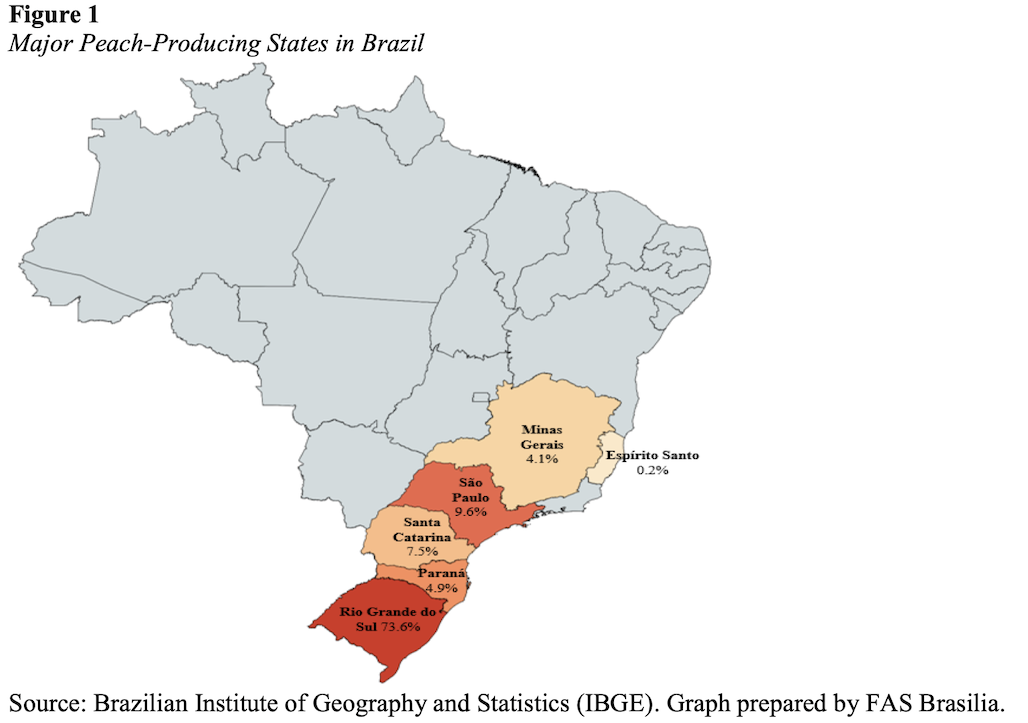
    The 2025/26 stone fruit growing season faced significant weather challenges, as late frosts and excessive rainfall in southern producing regions reduced yields. With modest export volumes, most stone fruit production is consumed domestically. The sector confronts volatile weather conditions, high production costs, and competition from imports, but benefits from government support programs and ongoing investments in orchard modernization.

    The Brazilian stone fruit sector focuses primarily on peaches, with some plum and nectarine production.

    Brazil is the 16th largest global peach producer, according to 2024 FAO (The Food and Agriculture Organization), with average annual production of 200,000 metric tons (MT). Main varieties include Chimarrita, Eldorado, Dourado-2, and Maciel, selected for adaptation to subtropical conditions and early harvest. The sector is fragmented and dominated by small and medium producers.

    While the Brazilian Institute of Geography and Statistics (IBGE) reported 4,735 peach-producing establishments in 2017 (most recent data available), industry contacts indicate this number likely decreased sharply by 2026, reflecting significant consolidation.

    Despite this contraction, peaches remain easily marketable and command premium prices in the Brazilian market. Technological advances have improved production efficiency. Some producers registered with the Brazilian National Registry of Seeds and Seedlings (RENASEM) now propagate varieties commercially, with certain operations working under royalty agreements to distribute improved cultivars.

    Peach cultivation is a significant agricultural activity in the southern and southeastern regions of Brazil. The state of Rio Grande do Sul is the largest producer of peaches, with the city of Pelotas as the main city for both fresh and processed peach production.

    Brazil’s peach production has evolved significantly through genetic improvement programs led by the Temperate Agriculture branch of Embrapa, Brazil’s Agricultural Research Corporation (Embrapa Clima Temperado), which plays a key role in developing peach cultivars adapted to local conditions.

    Since 1975, Embrapa Clima Temperado has developed 32 cultivars, particularly for canning peaches, including nine major varieties – Esmeralda, Granada, Maciel, Santa Áurea, Jade, Sensação, BRS Citrino, BRS Bonão, and Eldorado – that offer superior fruit size, firmness, appearance, and productivity. These innovations include dual-purpose cultivars for both canning and fresh consumption, low-chilling varieties adapted to subtropical conditions, and improved disease resistance with reduced fruit development periods. One notable example is BRS Sarau, launched in 2023, which extends the harvest season for fresh consumption.

    While the Southern region remains Brazil’s largest producer, much of this production targets the industrial sector (canned, dehydrated products). Other regions, including São Paulo state, focus on fresh fruit production, which requires different management techniques including specialized pruning, thinning, and cultivation practices to achieve optimal color and flavor.

    Production shifted from manual to automated processing, with industry estimating that one pit removal machines now replace the work of 40 workers each. Modern operations employ sorting machines, automated packaging equipment, and harvesting techniques processing 12-15 tons daily, alongside enhanced nutritional management using efficient fertilizers that improve shelf life and fruit quality.

    Despite technological advances, the sector faces significant challenges including labor shortages and pest management issues. The 2016 San José Scale outbreak – insects that withdraw nutrients from the tree – required 60 percent replanting after causing trees to abort fruit formation, though producers have since developed management expertise. Other threats include fruit flies, Oriental Fruit Moth controlled through pheromone traps, and Monilinia fructicola which causes brown rot in humid zones. Southern Embrapa maintains an alert system with trap monitoring and regular meetings covering pest management and orchard fertilization, while biological control research offers promise for future improvements.

    In 2025, Rio Grande do Sul produced 45-46 million cans of peaches, representing over 95 percent of Brazil’s canning peach production. The Pelotas microregion directed approximately 90 percent of its peach output to the canning industry.

    While nearly 100 factories historically operated in the region, only about 11 industrial facilities remain operational. Small-scale peach juice and pulp production exists but remains limited, with the major juice industry in Espírito Santo relying on imported pulp.

    According to Post contacts in Rio Grande do Sul, several producers traded peach cultivation for soybeans or tobacco, which offer more comprehensive technical assistance and insurance coverage. Labor shortages are driving investments in electric or automatic pruning equipment.

    Read the full USDA Foreign Ag Service here. — Story by Carolina Castro, USDA Foreign Ag Service

  • UC Davis Opens Resnick Center for Agricultural Innovation

    The University of California, Davis, celebrated the grand opening of the Resnick Center for Agricultural Innovation.

    Made possible by philanthropic support, including a lead transformative gift from Lynda and Stewart Resnick, through their foundation in 2022, the new center is housed within the UC Davis College of Agricultural and Environmental Sciences. The center builds on the university’s longstanding global leadership in agriculture with a focus on translating research into real-world impact.

    “This center represents the best of UC Davis, uniting our strengths in agriculture, engineering and environmental sciences to address challenges facing communities across California and around the world,” said Chancellor Gary S. May. “We are deeply grateful to Lynda and Stewart for their partnership and support, which expand research opportunities and drive solutions that will shape the future of agriculture.”

    Students, faculty, staff, donors and industry partners joined university leaders May 19 to celebrate the opening with a ribbon-cutting ceremony, open house and tours.

    “Lynda and I have always believed that growing more food with fewer resources is one of the most important things we can do,” said Stewart Resnick, chairman of The Wonderful Company. “UC Davis is the leading ag university in the country, and we all have a stake in giving them everything they need to continue leading on this important work. This center will train the next generation, drive practical solutions, and get this urgently needed progress to growers and communities around the world.”

    The Resnick Center reflects a broader commitment from the couple and their foundation, whose $50 million gift to UC Davis in 2022 included $40 million for the facility and $10 million to establish the Resnick Agricultural Innovation Research Fund, advancing research into sustainable uses for agricultural byproducts. Stewart Resnick also serves on the Chancellor’s Board of Advisors, underscoring the Resnicks’ longstanding commitment to the university and its mission.

    The 34,000-square-foot facility includes hands-on learning in an innovative and immersive environment that connects education to research and discovery. Experts across disciplines will work in labs equipped with robotics, sensors, data science and artificial intelligence — technologies transforming how agriculture is managed and scaled. Research efforts will focus on making agricultural systems more resilient, developing advanced technologies, maximizing sustainability through water and energy efficiencies, and expanding access to nutritious food.

    “The new Resnick Center strengthens our ability to integrate research, teaching and extension in ways that directly serve California and beyond,” said Ashley M. Stokes, dean of the College of Agricultural and Environmental Sciences. “It creates a dynamic environment where discovery, learning and community engagement come together — accelerating innovation, deepening partnerships with industry, and translating knowledge into real-world solutions. The design and flexibility of the space allow us to reimagine ideas and respond with agility to the evolving needs of our communities.”

    The center will incorporate specialized labs and equipment that bolster efforts to transform agricultural byproducts into useable materials. This work is supported by the annual competitive research grants funded by the Resnicks, through their foundation.

    Over the past three years, UC Davis researchers have explored how agricultural waste — including discarded hulls and shells from California’s iconic specialty crops like almonds, pistachios and pomegranates — can be repurposed as soil amendments, sustainable food products and low-cost industrial materials. The new facility will allow for widespread exploration of even more agricultural crops and potential uses.

    In addition to experiential learning opportunities, the facility houses The Wonderful Scholar Center, a student success hub that offers academic and career advising for more than 50 students who are attending UC Davis on a Wonderful Scholarship. With a commitment to supporting first-generation students, the Resnicks, their foundations and The Wonderful Company have awarded over 3,500 scholarships of up to $40,000, providing mentorship and tutoring support with dedicated coaches, and equipping students with the tools to succeed in college and beyond.

    “As a first-generation college student who grew up around agriculture, I came to UC Davis with a deep appreciation of what farming families are up against. The Wonderful Scholarship brought me here, and this center has shown me how research, innovation, and policy all have to work together to change the future of agriculture,” said Jose Gomez, Wonderful Scholar and second-year political science major. “What the Resnicks have built isn’t just a building. It’s a bridge across disciplines — driving research, innovation, and people forward. I intend to spend my life serving others and advancing solutions that strengthen our communities.”

    “Today marks the beginning of a new era,” Chancellor May said. “The discoveries made inside this building will extend into farms, fields, and communities around the globe, shaping a more resilient and sustainable future for agriculture.” — Story by Courtney Tompkins, UC Davis

  • 42nd Carrot Conference Planned by UCANR

    UC Ag and Natural Resources will hold the 42nd International Carrot Conference, scheduled for June 2-3 at the Bakersfield Marriott Convention Center.

    The Carrot Conference is an opportunity to share and discuss research findings and a way for people to exchange ideas and concerns in all aspects of carrot production. Topics such as breeding, new products, production, and pest management are discussed in formal paper sessions, poster sessions, and a field tour, as well as other social gatherings.

    The conference also provides continuing education opportunities with 4.5 other DPR hours approved for June 2. More details and an agenda can be found here. For additional information please contact: Jaspreet Sidhu, Kern County Cooperative Extension, 661-868-6222, 661-304-8870. — Contributed by UC Ag and Natural Resources

  • Hass Avocado Board Elections Underway

    The Hass Avocado Board has proceeded with elections with voting taking place electronically. Those who previously registered to vote electronically and/or provided an email address on a past paper ballot should have received an email with voting instructions. For those associated with multiple entities, separate emails have been sent for each entity — each containing a unique username and password for voting. Emails were distributed on April 27 and will come from either noreply@eballot.com or noreply@votenet.com.

    Participants are encouraged to open each email individually and use the corresponding credentials to cast their votes.

    The ballot includes the names and information of nominees running for open seats on the Board. HAB Chair Gwen Jackimek encourages all eligible voters to take the time to participate, emphasizing that every vote is important. — Story contributed by the Hass Avocado Board

  • JOOP 2026 Competition in Tokyo Sees Record-Breaking Participation

    The award ceremony for the Japan Olive Oil Prize (JOOP), the international competition dedicated to extra virgin olive oil quality, was held recently in Tokyo.

    The 2026 edition set a new record for entries: 691 oils from 25 countries competed, compared to 577 oils in the previous year. An increase of nearly 20% in the number of samples, which consolidates JOOP as one of the most important and fastest-growing competitions worldwide in the EVOO sector.

    “OOP 2026 saw a significant increase not only in the number of participants, but also in the overall quality of the competing oils. We are particularly pleased with the growing participation of Japanese producers, which speaks to the trust they have chosen to place in JOOP. We are confident that the competition represents a real opportunity for them to grow and engage in international dialogue,” said Panel Leader Miciyo Yamada.

    This year’s United States winner was Arbequina Extra Virgin Olive Oil from the Durant Olive Mill in Oregon.

    JOOP promotes extra virgin olive oil excellence and raises awareness among Japanese consumers to recognize high-quality products through masterclasses, guided tastings and educational activities. The goal is to support producers and facilitate their success in the Japanese market.

    Japan is one of the leading Asian markets for olive oil. According to GTAIC data, in 2024 Japanese imports reached a value of approximately USD 383 million. Per capita consumption remains modest — just 0.4 kg per year according to the International Olive Council — highlighting considerable room for growth. The main suppliers are Spain (53.2%), Italy (35.8%), and Turkey (8.1%), while the growing interest of Japanese consumers in the Mediterranean diet makes Japan one of the most promising destinations for EVOO producers worldwide. — Story Contributed by the Japan Olive Oil Prize

  • Fertilization and Irrigation Strategies Tutorial Planned for Strawberry Growers

    UC Ag and Natural Resources is planning a Pre-Plant Fertilization and Establishment Irrigation Strategies for Strawberry Production

    Growers will gather May 21 at Crisalida Berry Farms in Oxnard to go over insights on establishing strawberries with drip tape versus micro sprinklers, irrigation choices and their influence on crop development, practical approaching to improving water and nutrient use efficiency, how to visualize treatments effects on plots and discuss events. Fertilizer strategies like banded, broadcast and no fertilizer will also be discussed.

    Spanish translation will be provided, along with refreshments. Participants including certified crop adivsers will receive two continuing education units.

  • California Citrus Breeding Program Receives Additional Congressional Support

    California Citrus Mutual (CCM) and Citrus Research Board (CRB) voiced support for the House Committee on Appropriations for including additional funds in the FY 2027 Agriculture Appropriations bill for the citrus breeding program in Parlier.

    Congress is allocating an additional $500,000 in federal funding, on top of the $1.5 million previously granted, to expand the program into California. If approved, the program will receive $2 million in federal funds annually, in addition to the funding it receives from CRB.

    “CRB was instrumental in developing the concept for the California-based program and was also involved in efforts to establish the nationwide program, while CCM advocated to secure funding,” said CRB President Marcy Martin. “Our two organizations working together on behalf of the industry have been instrumental in getting this program off the ground.”

    “I would like to thank our Appropriators and Committee leadership for their continued support of this vital program,” said CCM Director of Governmental Affairs Jacob Villagomez. “Finding solutions for California-specific growing patterns is an essential tool in fighting HLB for years to come.”

    The California citrus breeding program will focus on fresh market citrus. Funding will go towards research and development of citrus selections suited to California growing regions, changing climatic pressures, consumer taste preferences and resistance to pests and diseases, such as huanglongbing.

    The California program is an expansion of the existing national USDA Agricultural Research Service (ARS) citrus breeding program located in Fort Pierce, Florida, which is focused primarily on varieties optimized for Florida growing conditions. Work done through the Florida program has resulted in new varieties with higher yields, increased disease resistance, improved color, and a longer shelf life.

    The Florida and California breeding programs, along with the continued support from the University of California citrus breeding program at UC Riverside, will work together to deliver results for California-based growers.

    The California citrus breeding program is located at the USDA ARS field station in Parlier. Thanks to ongoing appropriations commitment, forward progress continues to be made with the addition of a dedicated scientist, completion of a greenhouse, and future plans for laboratory and office space, and hopefully securing additional ground for further expansion.

    Story contributed by California Citrus Mutual and Citrus Research Board

  • Tomato Industry Taking Steps to Stop Spread of Parasitic Weed

    California’s processing tomato industry for the first time this past harvest season agreed to voluntary equipment cleaning and notification guidelines to prevent the spread of branched broomrape, a parasitic weed that attaches to roots and sucks out key nutrients.

    The weed’s tiny seeds can be smaller than finely ground spices, survive dormant in soils for decades and be carried by wind, footwear and other methods. Its resurgence in 2017 in Yolo County threatens the productivity of an industry that brought in $1.6 billion in 2024.

    The University of California, Davis — in conjunction with industry — federal authorities and state regulators, is playing a key research role in the battle against broomrape by testing and developing in-field sanitation guidelines for tomato harvesters and other field equipment. Researchers across campus are also evaluating herbicide treatments, weeding methods, ways to detect the weed and disrupt its ability to affect crops.

    Harvesting with Conditions

    Under former state quarantine rules, any broomrape detection would require a field be destroyed before harvest. With the new guidelines, growers may harvest if they adhere to certain management practices, including equipment cleaning standards developed by the California Broomrape Board, formed in 2024 to advise the California Department of Food and Agriculture.

    “There’s 1,000 acres that are actually reported but we know from observation that it’s probably much greater than that,” said Cassandra Swett, a UC Davis plant pathologist who is leading efforts to sanitize field equipment. “There are two main goals: reduce the economic impacts of broomrape on growers in the affected region by allowing them to harvest, and on the other side, keep broomrape out of the regions that do not currently have it.”

    In 2025, nearly all growers and processors in the state signed on to compliance agreements regarding cleaning and notification, and this year the California Department of Food and Agriculture is expected to require them, said Zach Bagley, managing director of the California Tomato Research Institute, which has been working on broomrape control issues since 2018.

    “It’s overall seen as a positive in the industry,” Bagley said. “The driver for sanitation is not just the biology of this weed and the reality in the field, but it also has regulatory components.”

    Also, this year, all processing tomato canneries in the state have agreed to build on-site wash stations or set up cleaning protocols for the 2026 season to help stop the spread from harvest trailers.

    “We can never have a 100% guarantee that we’re not moving seed, but we can do our best to take it off in the fields where we know we have a problem, and that’s where the research comes in,” said Bagley, whose organization helps fund related UC Davis research.

    Effectiveness and Timing Key 

    Swett, fabricators with the Department of Biological and Agricultural Engineering, a Cooperative Extension farm advisor and others in the industry are working on prototypes of sanitizing equipment, evaluating spray nozzle size, water pressure, aim and other factors.

    Cleaning is no simple task, and it consists of removing debris with physical cleaning and sanitizing. The right combination of debris removal followed by a sanitizer can substantially reduce dispersal risk, Swett said.

    The goal is to reach under and around tractors and remove mud, soil, plant material or anything that can collect and carry broomrape seeds. Some versions of these prototype cleaning systems are in the field and others roll under the equipment.

    “These machines are running 24 hours a day,” Swett said. “Taking that downtime to clean the machine is really messing up harvest schedules.”

    At present, cleaning a tomato harvester can take hours, but industry is hoping it can get to less than an hour to meet labor, costs and logistics needs. “One of the drivers of this work has been, ‘How can we make it faster but still be acceptable at the end of the day?” Bagley said. Agricultural engineer Dan Frank and crop advisor Patricia Lazicki have developed and are testing prototypes of automated systems that can improve cleaning time and coverage, Swett said.

    A Better Picture

    Before the broomrape compliance agreements, it was difficult to determine how many of the 185,000 to 250,000 tomato production acres might be infected because reporting would mean losing a crop and the money invested on planting, irrigation and other efforts with no hope of insurance covering the loss.

    The agreements have changed that, said Brad Hanson, a professor of Cooperative Extension in plant sciences who is an ad hoc member of the Broomrape Control Board.

    “With the risk of crop quarantine off the table for growers under the compliance agreements, we can talk about the problem out in the open,” Hanson said. “The daylighting part of this has been really helpful because for the last five years, we’ve been really in the dark.”

    Now it’s about working toward a common solution, said Neil McRoberts, a UC Davis plant pathologist who researches ways to support plant health and regulations. He is also a non-voting member of the board and familiar with pests that have caused widespread damage to other crops. With broomrape, the attention is focused before the weed has spread widely across fields in California and potentially to other crops like carrots, potato and sunflower.

    “I’m hopeful because the issues are being faced very early on,” he said.  — By Emily C. Dooley, UC Davis

  • Citrus Greening Quarantine Expands in Southern California

    Effective immediately, the Animal and Plant Health Inspection Service (APHIS), in cooperation with the California Department of Food and Agriculture (CDFA), is expanding the area quarantined for citrus greening (Huanglongbing), caused by the Asian citrus psyllid, in California. APHIS is establishing a new quarantined area in the Ramona area of San Diego County of 93 square miles and is expanding the quarantined area in the Loma Linda area of San Bernardino and Riverside Counties by 26 square miles. These measures parallel the intrastate quarantines that CDFA established on March 2, and March 6, 2026, respectively. APHIS is taking this action because of citrus greening detections in plant tissue samples collected from residential properties. There are 25.16 acres of commercial citrus impacted by the new Ramona quarantine and 411.47 acres of commercial citrus impacted by the Loma Linda area expansion.

    APHIS is applying safeguarding measures outlined in 7 CFR 301.76 and Federal Orders pertaining to the interstate movement of regulated articles from the quarantined areas in California. This action is necessary to prevent the spread of citrus greening to non-infested areas of the United States.

    The APHIS Citrus Greening webpage contains specific changes to the quarantined areas in California. APHIS will publish a notice of this change in the Federal Register.