Category: Industry News

  • USDA Assists Farmers, Ranchers & Communities Affected by Western Wildfires

    USDA Assists Farmers, Ranchers & Communities Affected by Western Wildfires

    The U.S. Department of Agriculture (USDA) today announced the availability of assistance for residents and agricultural producers affected by recent wildfires.

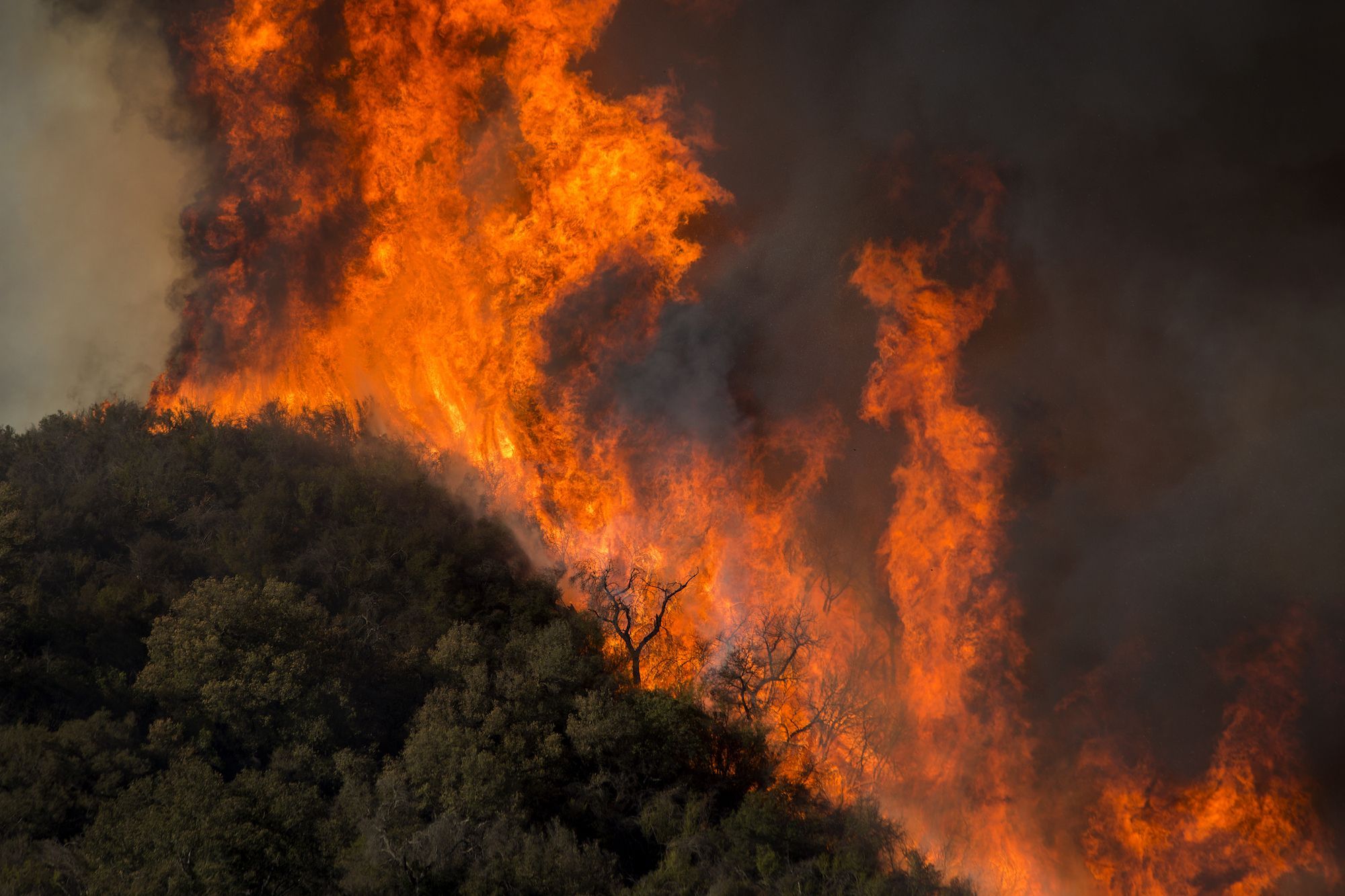
    As of today, wildfires have burned nearly 6.9 million acres across 11 states. More than 31,000 personnel from the local, state and federal levels are working to contain 61 large fires. The USDA Forest Service has more than 7,800 personnel committed to firefighting efforts along with airtankers, helicopters, and other air and ground firefighting resources.

    Food waivers and flexibilities

    On August 27, 2020, USDA’s Food and Nutrition Service (FNS) approved California’s waiver request to allow for the purchase of hot foods with Supplemental Nutrition Assistance Program (SNAP) benefits in select counties. As many California residents are not able to store food or access cooking facilities, households in those counties can purchase hot foods with SNAP benefits through September 23, 2020.

    On September 3, 2020, FNS also approved California’s request to issue automatic mass replacements of SNAP benefits to impacted households. This waiver allows households in certain counties and zip codes to receive replacement of 50% of their August SNAP benefits as a result of wildfires and power outages that began on August 17, 2020. For more information on either of these actions, contact the California Department of Social Services.

    Helping producers weather financial impacts of disasters

    When major disasters strike, USDA has an emergency loan program that provides eligible farmers low-interest loans to help them recover from production and physical losses. This program is triggered when a natural disaster is designated by the Secretary of Agriculture or a natural disaster or emergency is declared by the President under the Stafford Act. USDA also offers additional programs tailored to the needs of specific agricultural sectors to help producers weather the financial impacts of major disasters and rebuild their operations.

    Livestock owners and contract growers who experience above normal livestock deaths due to specific weather events, as well as to disease or animal attacks, may qualify for assistance under USDA’s Livestock Indemnity Program.

    Livestock producers who have suffered grazing losses due to a qualifying drought condition or fire on federally-managed land during the normal grazing period for a county may qualify for help through USDA’s Livestock Forage Disaster Program. Producers of non-insurable crops who suffer crop losses, lower yields or are prevented from planting agricultural commodities may be eligible for assistance under USDA’s Noninsured Crop Disaster Assistance Program.

    Helping operations recover after disasters

    USDA can also provide financial resources through its Environmental Quality Incentives Program to help with immediate needs and long-term support to help recover from natural disasters and conserve water resources. Assistance may also be available for emergency animal mortality disposal from natural disasters and other causes.

    Farmers and ranchers needing to rehabilitate farmland damaged by natural disasters can apply for assistance through USDA’s Emergency Conservation Program. USDA also has assistance available for eligible private forest landowners who need to restore forestland damaged by natural disasters through the Emergency Forest Restoration Program. USDA’s Emergency Watershed Protection Program can also help relieve imminent threats to life and property caused by fires and other natural disasters that impair a watershed. Orchardists and nursery tree growers may be eligible for assistance through USDA’s Tree Assistance Program to help replant or rehabilitate eligible trees, bushes and vines damaged by natural disasters.

    Producers with coverage through the Risk Management Agency (RMA) administered federal crop insurance program should contact their crop insurance agent for issues in filing claims. Those who purchased crop insurance will be paid for covered losses. Producers should report crop damage within 72 hours of discovering damage and follow up in writing within 15 days. The Approved Insurance Providers (AIP), loss adjusters and agents are experienced and well trained in handling these types of events. As part of its commitment to delivering excellent customer service, RMA is working closely with AIPs that sell and service crop insurance policies to ensure enough loss adjusters will be available to process claims in the affected areas as quickly as possible. Visit the RMA website for more details.

    Helping with the long-term recovery of rural communities

    USDA Rural Development has more than 50 programs available to rural and tribal communities for the rebuild, repair or modernization of rural infrastructure including drinking and waste water systems, solid waste management, electric infrastructure, and essential community facilities such as public safety stations, health care centers and hospitals, and educational facilities. Visit theUSDA Rural Development website for more information on specific programs.

    Visit USDA’s disaster resources website to learn more about USDA disaster preparedness and response. For more information on USDA disaster assistance programs, contact your local USDA Service Center.
  • Opportunities for US Cherries in Japan (Door Still Closed for Peaches)

    Opportunities for US Cherries in Japan (Door Still Closed for Peaches)

    Japan’s MY 2020/21 cherry production rebounds, while unfavorable weather conditions reduce peach harvest. U.S. sweet cherry exports to Japan are expected to increase as Japan lowers tariffs under the U.S.-Japan Trade Agreement. COVID-19 travel restrictions diversify stone fruit distribution channels, while demand remains steady. 

    Cherries:

    Crop Area

    Japan’s crop area for cherries continues a steady gradual decline due to aging farmers and a lack of successors. Since reaching its peak area harvested in marketing year (MY) 2008/09, Japan’s area harvested for sweet cherries has contracted approximately 0.4 percent a year. Based on this trend, FAS/Tokyo forecasts MY 2020/21 planted area at 4,680 hectares (ha) and MY 2020/21 harvested area at 4,300 ha. Japan’s Ministry of Agriculture, Forestry and Fisheries (MAFF) reported MY 2018/19 and MY 2019/20 areas harvested for sweet cherries as 4,350 ha and 4,320 ha, respectively. FAS/Tokyo estimated area planted from MAFF’s official data on planted area (published every 5 years) and harvested area (updated annually), as well as information from industry sources.

    Pursuant to the 1961 “Act on Special Measures concerning Promotion of Fruit- growing Industry” (available only in Japanese), MAFF issues a national basic plan every five years that sets the national target for the fruit tree crop, including sweet cherry, planted area for the next ten years. Based on the national basic plan, each prefecture sets its target for cherry planted area and develops a fruit promotion plan. In the last national basic plan published on April 30, 2020, MAFF lowered the national 2030 target to 4,640 ha or 1.1 percent down from the actual 2018 acreage of 4,690 ha.

    Given the recent release of the 2020 national basic plan, the latest available prefectural plans are based on the 2015 national basic plan. The 2017 basic plan of Yamagata prefecture, which produces nearly three-quarters of Japan’s sweet cherries, set its 2020 cherry acreage target at 3,100 ha, a 1.3 percent decrease from its 2014 acreage.

    The Yamagata prefectural plan also indicates a varietal shift. In 2014, 2,273 ha or 72 percent of Yamagata cherry acreage was dedicated to “Sato-nishiki,” the most common domestically produced sweet cherry variety. By 2020, Yamagata aimed to reduce the “Sato-nishiki” acreage to 2,100 ha or 67.7 percent of the total prefectural cherry acreage. On the other hand, Yamagata set a 500 ha or 16.1 percent 2020 target for “Benishuho,” a late-maturing variety with larger and hardier fruit. In 2014, “Benishuho” acreage in Yamagata represented 14 percent or 427 ha. The varietal shift indicates efforts to extend the season of the domestically produced sweet cherry.

    Production

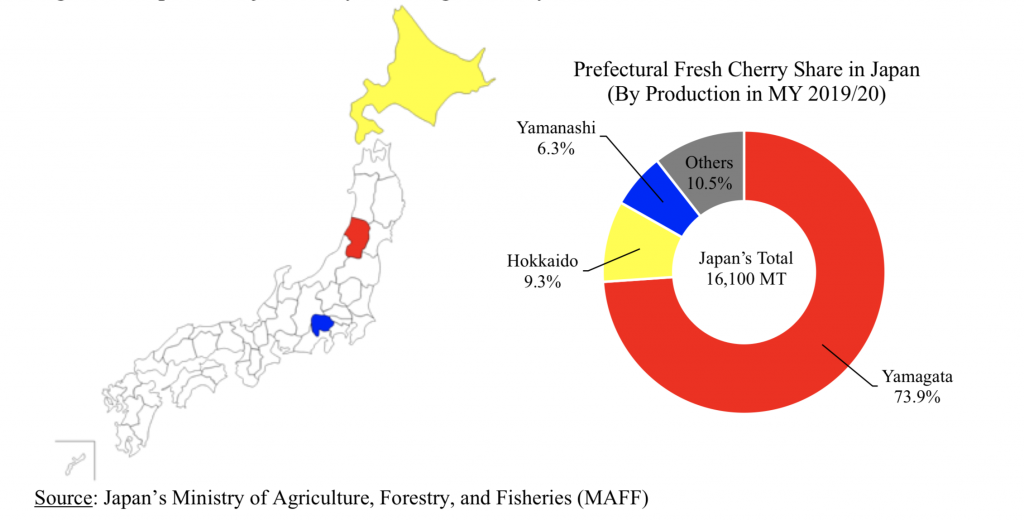
    Nearly 90 percent of Japan’s sweet cherries are grown in three prefectures: Yamagata, Hokkaido and Yamanashi (Figure 1). Following a warm winter and increased cherry flowering across the three key prefectures, FAS/Tokyo forecasts MY 2020/21 production to reach 17,000 MT, a 5.6 percent increase over MY 2019/20. Nevertheless, due to acreage declines and higher than pollinator-optimal temperatures during the flowering phase, FAS/Tokyo estimates MY 2020/21 production 9 percent below the recent MY 2009/10 – MY 2018/19 average of 18,670 MT.

    Japan’s MY 2019/20 total production fell 11 percent to 16,100 MT from 18,100 MT in MY 2018/19 due to reduced pollinator activity in Yamagata, following high precipitation and low average temperatures during the flowering season (late April-early May). Furthermore, high precipitation during the harvest season in early to mid-June caused fruit to crack.

    MAFF reports total and commercial production levels of sweet cherries. FAS/Tokyo calculated non- commercial production as the difference between these official numbers.

    Figure 1. Japan’s Major Cherry Crowing Areas by Prefecture in MY 2019/20

    Fresh cherry production is highly labor-intensive as it is done by hand. Given the relatively short harvest season, over 80 percent of cherry pickers come from neighboring prefectures. Despite initial concerns about the impact of COVID-19 related travel restrictions on MY 2020/21 sweet cherry harvesting, the impact was limited. Japan lifted the State of Emergency, which restricted people’s movement across prefectural lines, on May 25, 2020, a month prior to the peak cherry harvest season. Moreover, to assist cherry farmers, Japan Agricultural Cooperatives (JA) organized harvesting missions by students from agricultural colleges and hospitality industries affected by COVID-19.

    According to the 2020 national basic plan, despite projected cherry acreage reduction, Japan’s 2030 target for fresh cherry production is 20,000 MT.

    Japan’s sour cherry production is negligible.

    Consumption and Marketing

    Japan consumes over 90 percent of its sweet cherry supply fresh. Only five to ten percent goes toward processing (e.g., canning, jams). Reflecting a lower domestic supply in MY 2019/20, Japan’s cherry consumption fell to 20,251 MT, 5.3 percent below MY 2018/19 consumption of 21,384 MT. Despite COVID-19-related shifts in distribution channels and marketing, FAS/Tokyo forecasts Japan’s sweet cherry consumption will increase to 21,199 MT or by 4.7 percent in MY 2020/21, due to increased domestic production, relative to MY 2019/20.

    Fresh sweet cherries are available to consumers in the following ways: (i) retail through wholesale (30- 50 percent), (ii) fruit-picking directly by consumers (30-50 percent), (iii) e-commerce (5-15 percent), and (iv) gifts of premium cherries (5-15 percent). In light of COVID-19-related travel restrictions during the harvest season (mid-June through early July), fruit-picking directly by consumers in MY 2020/21 decreased and more cherries were distributed through retail and e-commerce. As a result, cherry market price decreased, though less than in MY 2019/20, characterized by relatively poor production (Figure 2). Despite a higher market price and restriction on in-store promotions in MY 2020/21, household consumption of fresh cherries increased as restaurants closed in response to measures to contain the pandemic. Industry sources shared that overall fresh cherry sales increased by 10-15 percent, compared to a recent five-year average (2015-2019). This uptick in retail sales offset the reduction in consumption in the fruit-picking channel.

    E-commerce is growing in popularity for cherry distribution. Although upfront marketing costs are greater for producers, direct sales may lead to greater profits and stable repeat customers. Since Japan’s initial announcement of the State of Emergency due to the COVID-19 pandemic on April 7, producers began to actively invest in distribution via e-commerce. Consumers, in turn, value a more immediate connection with producers and lower costs, resulting from fewer middlemen. 

    Premium fresh cherries are typically set aside for gifts. Japan has two gifting seasons a year: mid-June to late July and end of the year. As few domestically produced fruits are harvested in mid-June to mid- July, premium cherries are a symbolic summer gift in Japan. Typically, gift cherries are sold through advanced sales at high-end department stores between May and early June. Due to the closure of these outlets during the MY 2020/21 State of Emergency, gift sales of premium cherries struggled. Rather than release premium cherries into retail channels, cherry-producing prefectures promoted the Furusato Nouzei, hometown tax, system initially introduced in 2007. Under this system, taxpayers can make donations to local municipalities, in return for income tax and residence tax credits. Local municipalities also send local produce as “appreciation gifts” to donors. Cherry-producing prefectures, including Yamagata, invite donations by advertising premium fresh cherries as their appreciation gift.

    Trade

    Due to Japanese consumers’ strong preference for domestic produce, a reduction in domestic cherry production does not generally stimulate a stronger demand for imported cherries. Industry sources indicate that imported sweet cherries are in particular demand between late March and mid-May, when they compete with imported fruits, such as bananas and kiwis, available year-round.

    In MY 2019/20, Japan imported 4,152 MT of fresh cherries, valued at $40 million. The United States supplied 95.3 percent of Japan’s cherry imports. FAS/Tokyo forecasts Japan’s imports of sweet cherries to increase to 4,200 MT or 1 percent relative to MY 2019/20 imports due to steady consumption and a recently reduced tariff for sweet cherries (described in the Policy section below).

    Japan does not import sour cherries, and Japan’s cherry exports are negligible (approximately 1 MT).

    Policy

    The U.S.-Japan Trade Agreement (USJTA) came into force on January 1, 2020, and established a staged tariff reduction for U.S. sweet cherry exports to Japan (JA2020-0017). Between January and April 2020, Japan’s tariff on sweet cherries went from 8.5 percent to 2.5 percent. Japan’s tariff on sweet cherries
    will be altogether eliminated on April 1, 2023.

    Japan granted market access to U.S. cherries on the condition of annual on-site audits in the United States. In light of COVID-19-related travel restrictions, MAFF officials were not able to conduct on-site audits in 2020. As a temporary measure until on-site inspections can resume, MAFF increased on-arrival phytosanitary inspections of fresh cherries by 50 percent (JA2020-0133). 

    Peaches and Nectarines:

    Crop Area

    Every year, Japan loses approximately 50 ha of peach acreage due to aging farmers and labor shortages. Despite the national basic plan’s 2030 target of 10,400 ha for peach acreage (equivalent to MY 2018/19 area planted), FAS/Tokyo forecasts MY 2020/21 area planted to fall to 10,250 ha due to demographic trends. Moreover, MY 2020/21 area harvested is estimated at 9,300 ha due to recent weather events damaging peach trees.

    In July 2018, heavy rainfall and flooding damaged Japan’s western peach-producing region, especially Okayama and Wakayama prefectures, and many of the affected trees did not produce commercial- quality peaches in MY 2019/20. Consequently, Japan’s MY 2019/20 peach planted area shrunk by 50 ha to 10,350 ha, while area harvested fell by 160 ha to 9,540 ha.

    In October 2019, typhoon Hagibis hit eastern Japan, including peach-producing Fukushima prefecture (2019 GAIN report titled “Effects of Typhoon Hagibis on Agricultural Production in Japan”). Although the typhoon occurred after harvest, many damaged peach trees had to be replanted or need a few years to recover commercial-level production. Therefore, FAS/Tokyo forecasts MY 2020/21 peach planted and harvested areas at 10,250 ha and 9,300 ha, down 100 ha and 240 ha, respectively.

    Production

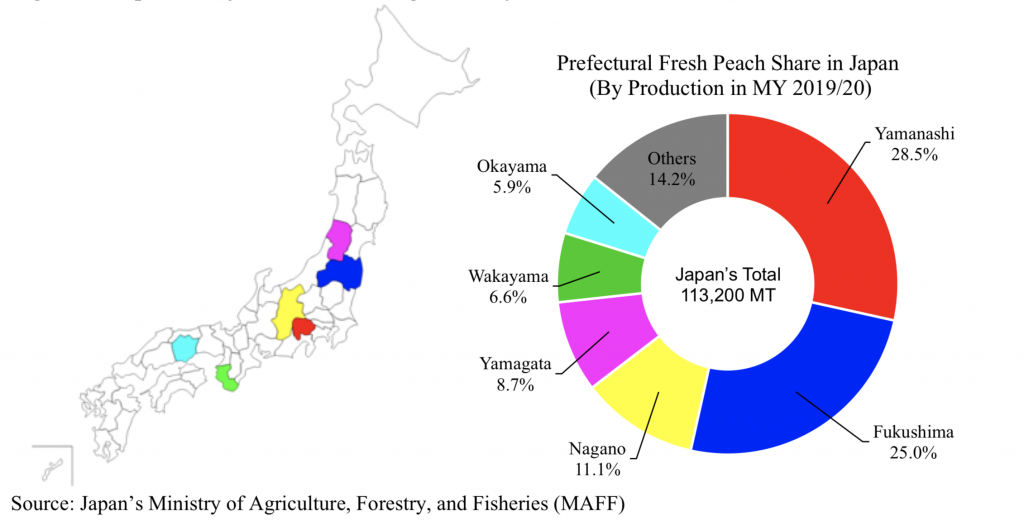
    Japan’s major peach production areas are sub-divided into eastern, central, and western regions (Figure 3). The central region, represented by Yamanashi and Nagano prefectures, has the largest acreage, followed by the eastern region, represented by Fukushima and Yamagata prefectures. Although the western region, represented by Wakayama and Okayama prefectures, accounts for only 14 percent of the total MY 2019/20 planted area, western peaches have brand recognition because Japanese consumers value first fruits of the season/year and peach harvest typically begins from the west.

    Figure 3. Japan’s Major Peach Growing Areas by Prefecture in MY 2019/20 

    In MY 2019/20, Japan’s total production of peaches and nectarines fell to 107,900 MT, 4.7 percent below MY 2018/19. The MY 2019/20 total includes 106,400 MT of peaches and 1,500 MT of nectarines. Unfavorable weather conditions precipitated a reduction in MY 2019/20 production: flooding affected the western region while the ripening season in the central region suffered from temperatures and sunlight levels well below historical averages for July. As a result, many peaches did not meet prefectural standards for commercial distribution due to reduced size and sweetness. In fact, the largest peach-producing prefecture, Yamanashi, produced 22 percent less in MY 2019/20 than in MY 2018/19. On the other hand, improved weather conditions in late July/early August boosted production in the eastern region, where harvest season occurs last. Fukushima, the second largest peach-producing prefecture, increased its MY 2019/20 production by 11 percent compared to MY 2018/19. Still, higher production in the east, did not fully offset dismal production in western and central regions.

    In MY 2020/21, Japan again experienced unfavorable weather conditions for peach and nectarine production. Typically, peach-producing regions experience about 40 days of rainy season, beginning around June 10. However, MY 2020/21 rainy season lasted an additional 10 days through the end of July. Furthermore, during the rainy season, direct sunlight hours3 were reduced to 40 percent of the historical average for the same time period. Although the weather recovered in August, peach orchards in the east experienced widespread contamination with bacterial shot hole disease that thrived in trees damaged by typhoon Hagibis. As warm winter and long rainy season facilitated survival and spread of the pest, FAS/Tokyo estimates that the eastern region lost about 30 percent of its peach/nectarine production. Although the west is expected to recover from 2018 floods, FAS/Japan forecasts Japan’s total peach production to fall by 10 percent in MY 2020/21 to 96,300 MT.

    Nagano, the largest nectarine-producing prefecture accounting for over 80 percent of total production, also suffered from unfavorable weather in MY 2019/20. The total MY 2019/20 nectarine production was reduced to 1,500 MT in MY 2019/20. Due to the typhoon Hagibis damages, FAS/Tokyo forecasts total nectarine production to fall by 100 MT to 1,400 MT in MY 2020/21.

    FAS/Tokyo forecasts Japan’s total MY 2020/21 production of peaches and nectarines to reach 97,700 MT, down 9.5 percent compared to MY 2019/20.

    COVID-19 pandemic had a minimal impact on the peach industry as Japan’s State of Emergency ended well before the harvest window for fresh peaches and nectarines.

    Consumption and Marketing

    Domestically produced peaches and nectarines are primarily consumed fresh and only ten to twelve percent of products goes to processing (e.g., juice). Due to a substantial price markdown for fruits for processing, there is a limited number of growers specializing in peach/nectarine production for processing. According to several industry contacts, the price for peaches for processing is about 5 yen ($0.05) per kilogram (kg), whereas table peaches are valued at about 300-400 yen ($2.81-$3.74) per kg. In MY 2019/20, Japan’s domestic consumption of peaches and nectarines decreased by 4.9 percent to 106,306 MT due to lower production. As fruits are generally considered non-essential and alternative fruits, such as watermelons, cantaloupes and grapes, are abundant during the peach/nectarine season, lower domestic production does not usually lead to increased stone fruit imports.

    In MY 2020/21, based on poor domestic production, FAS/Japan forecasts Japan’s consumption of fresh peaches and nectarines to fall by 9.4 percent to 96,360 MT. As peaches and nectarines are primarily consumed at home, COVID-19 impacts on distribution were limited. Lower production levels reduced labor demand during harvest. Increased retail sales helped to consume some excess peaches created by hotel and restaurant closures. However, industry sources shared that peach sales are struggling due to a lack of in-store promotions during the pandemic. Higher market price due to low production has also complicated sales.

    Fruit-picking and gifting distribution channels have struggled in the COVID-19 environment. Although the Furusato Nouzei system is also popular for peaches, e-commerce is the leading alternative for peaches normally destined for gifting or fruit-picking. In addition to direct marketing done by growers, local governments have supported sales of local products through e-commerce channels. For example, Fukushima prefecture began a promotional campaign titled “Fukushima Pride” in cooperation with Japan’s three leading online stores: Amazon, Rakuten market and Yahoo shopping. The overall sales, including fresh peaches, through this promotion increased more than 20 percent compared to the same time in MY 2019/20.

    Trade

    There are no peach imports to Japan, and the United States does not have market access to Japan for peaches. The United States, the sole exporter of fresh nectarines to Japan, has market access for selected nectarine varieties with fumigation treatment. In MY 2019/20, Japan imported 186 MT of U.S. nectarines. In light of small shipping volumes and higher freight charges due to COVID-19-related flight reductions, FAS/Tokyo forecasts Japan’s MY 2020/21 imports to decrease by 14 percent to 160 MT from 186 MT in MY 2019/20.

    In line with Japan’s 2014 national policy, Japan Revitalization Strategy, to increase agricultural exports to 1 trillion yen (approximately $10 billion) by 2020, Japan has been gradually and continuously increasing fresh peach exports. Due to a higher unit price for Japanese peaches in foreign markets compared to Japan, Japan’s peach exports continued to increase even when peach production took a downturn in MY 2019/20. In MY 2019/20, Japan exported 1,780 MT of peaches, valued approximately $17 million, of which 72.2 percent went to Hong Kong and 20.4 percent to Taiwan. FAS/Tokyo forecasts export volume to decrease by 15.7 percent to 1,500 MT in MY 2020/21 due to political instability in Hong Kong and high air freight charges due to COVID-19.

    Japan’s nectarine export volume is negligible.

    Policy

    The USJTA eliminated tariff on U.S. nectarines on January 1, 2020 (JA2020-0017).

    Due to COVID-19-related travel restrictions, MAFF could not carry out its annual on-site audit of U.S. nectarine orchards. Until MAFF is able to resume inspections in the United States, MAFF doubled phytosanitary inspections upon arrival of fresh nectarines (JA2020-0133). — By Tomohiro Kurai, USDA Foreign Agricultural Service

  • CDFA Environmental Farming Program Saves Water & Energy

    CDFA Environmental Farming Program Saves Water & Energy

    Recent heat waves have caused California’s energy grid to take a beating, which forced the California Independent System Operator, the entity that operates the state’s power grid, to institute rolling blackouts.

    Fresno County fruit grower Balvinder Purewall points to his variable frequency drive, which saves on energy use when irrigating. His solar array in the background produces energy for use on his farm

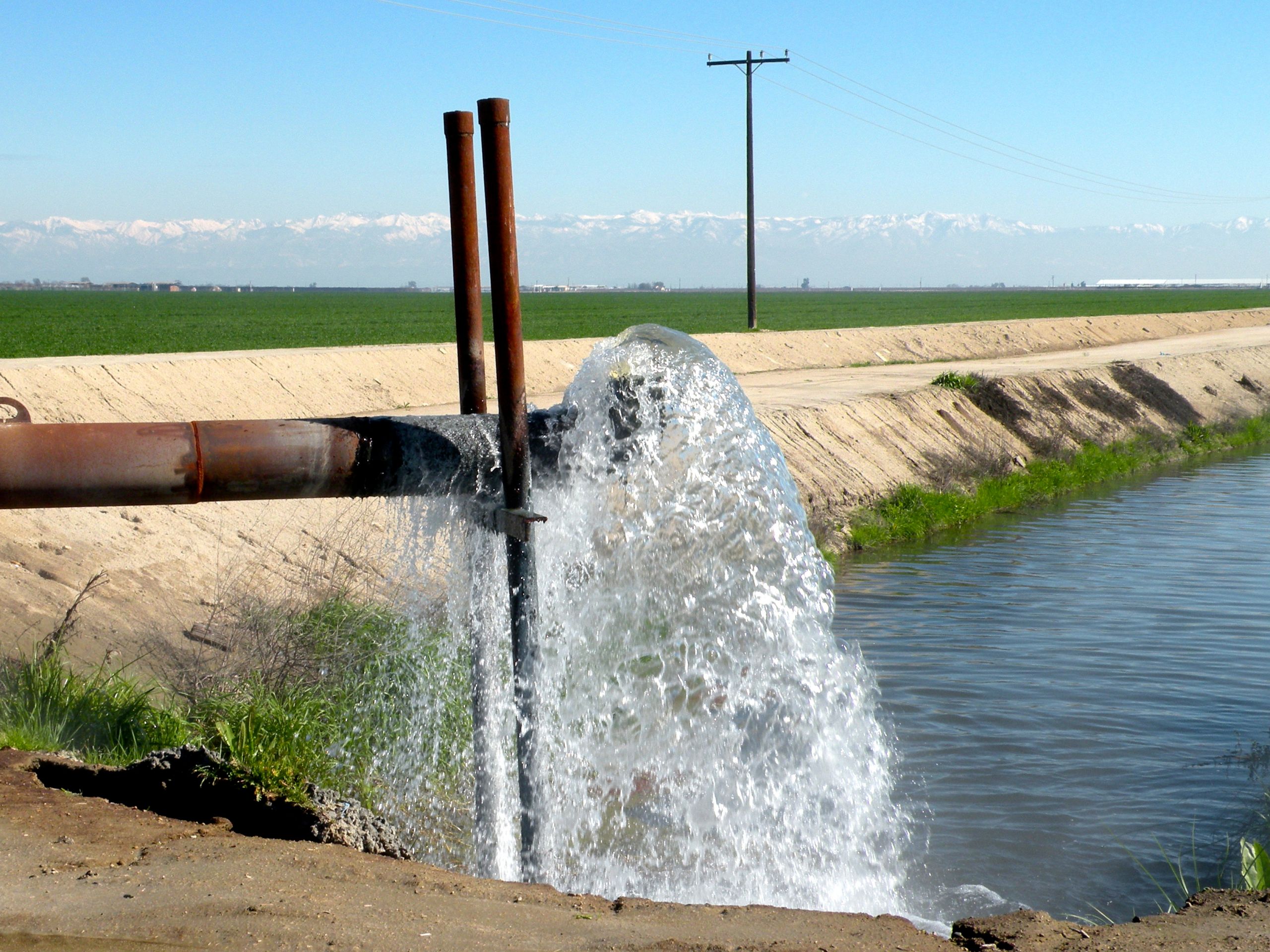
    How do California’s farmers and ranchers deal with energy uncertainty during times like this, when the intense heat demands an increase in irrigation? For many years, they have been working to improve both energy and water efficiency of their irrigation systems. And since 2014, CDFA’s State Water Efficiency and Enhancement Program (SWEEP) has been an important resource for California farmers, providing financial support for long-term efficiency improvements with a focus on greenhouse gas reductions.

    “For many years, SWEEP has been funding grants that help California farmers and ranchers save water and reduce greenhouse gases through reduced energy consumption,” said CDFA Secretary Karen Ross. “The proactive, hard work of these farmers really shines when the state deals with challenges like the recent heat waves. Our farmers’ and ranchers’ contributions provide us with food security plus a host of other benefits seen through SWEEP efforts, which are invaluable to the state, especially now.”

    Some SWEEP grant recipients, for example, have installed energy efficient technologies such as efficient pumping systems coupled with variable frequency drives to reduce energy demands of irrigation. Other grant recipients have also installed solar and other forms of renewable energy, resulting in less imported energy and thus reducing the strain on the grid. Energy-saving practices like these also result in reduced greenhouse gas production.

    Central Coast citrus and avocado grower Daryn Miller received a SWEEP grant, which helped provide two small solar arrays, one for each irrigation pump, to offset his farm’s GHG production use and save water. The project also included installation of soil moisture and weather sensing technologies that help the farmer make data-driven choices on when and for how long to irrigate his crops.

    “The objective overall was mostly to cut down our energy,” said Miller, “to really see how much water we were using … to get a good idea of where we’re at on a total amount of water and a total amount of electricity, and to essentially create our own little electric grid.”

    Fresno County fruit grower Balvinder Purewal received a SWEEP grant to enhance his 37-acre farm’s irrigation system with a high-efficiency pump, soil moisture sensors, double-line drip system and 25-kilowatt solar array. “The SWEEP program is going to help us save on both water from the ground level and save energy,” he said. This energy savings results in statewide GHG savings by reducing the energy grids reliance of other forms of energy production.

    In 2019 alone, SWEEP supported 122 projects with an estimated reduction in greenhouse gas emissions equal to 3,200 metric tons of carbon dioxide equivalent per year. This is equivalent to supporting the electricity needs for nearly 550 homes for one year, based on federal EPA equivalency factors. SWEEP utilizes similar incentive strategies to the United States Department of Agriculture: Natural Resources Conservation Service: Environmental Quality Incentives Program (NRCS:EQIP).

    Scientists tell us that extreme heat days and extreme heat waves are becoming more common in California due to climate change, and reports developed by CDFA in collaboration with several partners and engagement with the farmer community, further highlight the same concerns. With compounding impacts of climate change and other stressors on our environment and natural resources, SWEEP and other CDFA Climate Smart Agriculture programs are helping build a more resilient ‘California For All.’

  • False Chinch Bug in New Avocado Plantings

    False Chinch Bug in New Avocado Plantings

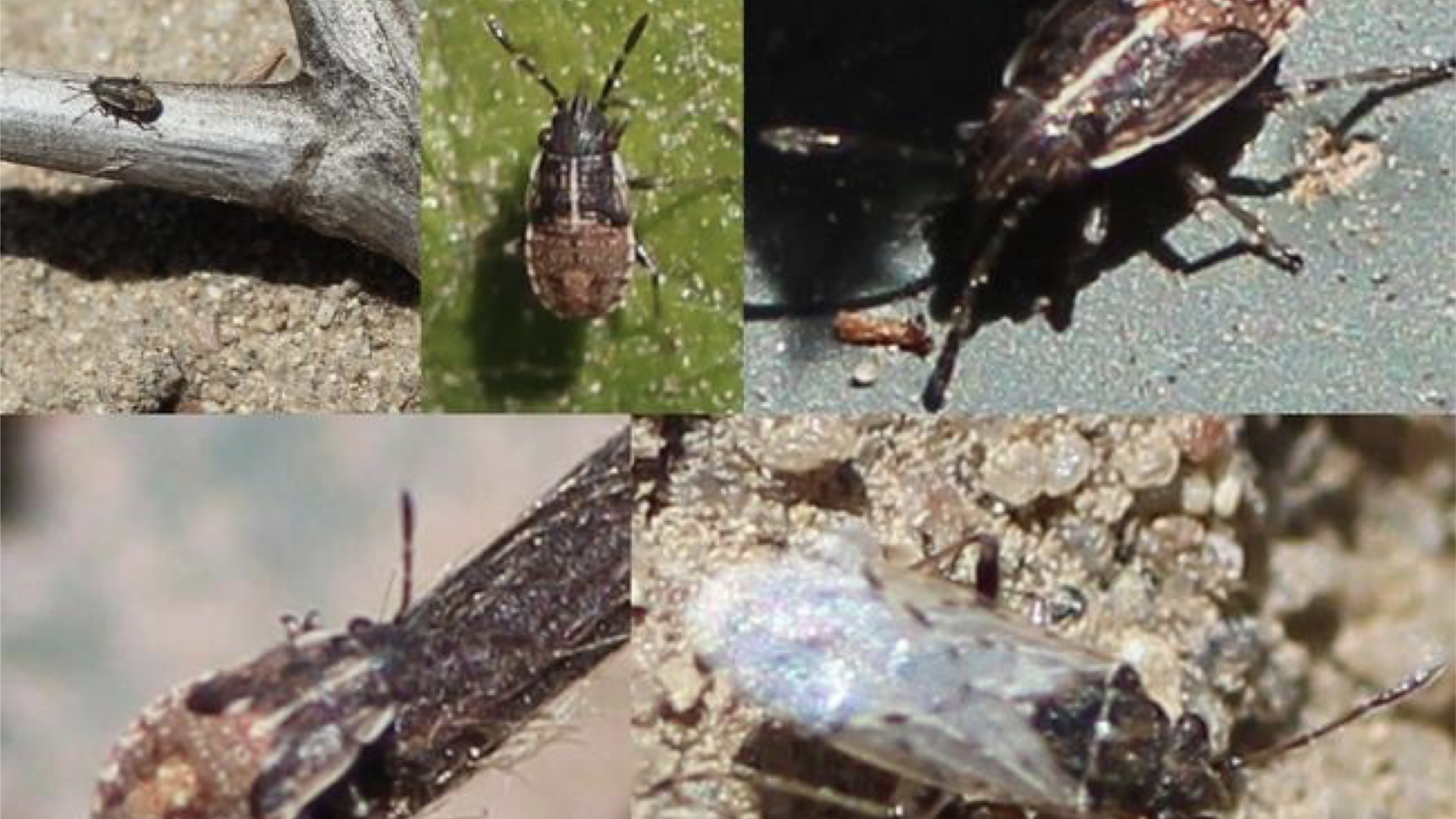
    The false chinch bug (FCB), Nysius raphanus (Hemiptera: Lygaeidae), is a pest of many plants. FCB is a generalist and has been found to be a problem in many cropping systems such as soybeans, quinoa, tobacco, cotton, broccoli and other Brassicaceae plants. FCB adults (above) is mostly light to dark gray, elongate, and about 0.12 inch (3 mm) long. Females lay eggs on host plants or in cracks in soil. The mostly pale gray nymphs have inconspicuous reddish to brown abdominal markings. FCB has 4-7 generations per year with all stages being potentially present throughout the year. All stages can be present throughout the year. They also can be found invading homes in the southwest. Their populations generally start in unmanaged fields with lots of weeds and are an issue for crops when they build up large numbers and move into the crops from the unmanaged, weedy fields. 

    This year it’s host of choice is young avocado plantings in Ventura County. False chinch bug occasionally causes severe injury on young trees by sucking sap from shoots and young stems. Infested shoots wither and die suddenly after attack, which typically occurs in May and June. Economic damage normally occurs in groves away from the coast only on young trees in border rows adjacent to uncultivated areas or grasslands. Otherwise healthy mature trees tolerate bug feeding.

    Here are photos of damage to young avocado provided by Tom Roberts, Integrated Consulting Entomology.

    To best manage FCB, a grower will need to catch it before it establishes and the populations explode. This is difficult because the pest will not reoccur every year on regular basis. From what has been seen in the field this year, FCB appears to prefer young avocado plantings and thus, a targeted approach is to monitor only in new plantings right as summer temperatures are rising. In paper in the journal, Phytoparasitica from 2006, the authors investigated what color sticky trap was best for monitoring and found that yellow worked best. Thus, passive monitoring with yellow sticky cards that are placed throughout the field and monitored weekly is a potential option. However, this approach can be expensive with the labor hours needed to properly process the sticky cards. A more practical approach is to sweep net weedy areas on the outside of avocado groves and adjacent unmanaged areas nearby weekly in search for the first signs of FCB.

    In conventional avocado production, there is only one insecticide recommended for use against FCB. Malathion 8 at 16 oz/acre. — By Monique Rivera & Ben Faber, UC Cooperative Extension

  • US Increases Market Share of Stone Fruit Exports in Taiwan

    US Increases Market Share of Stone Fruit Exports in Taiwan

    In 2019, U.S. peach, nectarine, and cherry exports to Taiwan increased as competitor market share declined. Taiwan’s peach and nectarine production is forecast to increase from 16,171 metric tons (MT) in 2019 to 19,000 MT in 2020 due to improved bearing. Taiwan’s robust handling of COVID-19 has led to a modest recovery in domestic consumption, which has allowed consumption to remain strong and imports to remain stable. In 2020, total Taiwan peach and nectarine imports are forecast to increase nominally to 15,000 MT and imports of cherries are forecast up at 12,000 MT.

    Read the full report from the USDA Foreign Agricultural Service HERE.

  • Removing Avocado Suckers with Glyphosate

    Removing Avocado Suckers with Glyphosate

    This is not good. You find an avocado tree with sun blotch or it is time to thin the orchard and you remove the offending tree. You know that if you don’t remove the sucker, you’ll end up with some rootstock growth that just gets in the way of the other trees. Avocado suckers can look like a valued tree until it’s time for harvest several years later, and then you are likely to find that it’s not the variety that you thought it was. Homeowners often find this problem several years after a freeze and the lemon tree that regrew from the freeze damage turns out to be the rootstock variety and produces some gnarly, seedy, juiceless fruit. Even without a frost, sometimes rootstocks which are selected for their vigor, can be more vigorous than the scion variety and will overgrow it. You then end up with whatever the rootstock fruit turns out to be.

    In some situations, it is legal and common to use a “cut stump” treatment to kill stumps and prevent resprouting. In these cases, glyphosate or triclopyr is sprayed, drizzled, or painted onto a freshly cut stump. Relatively high concentrations of the herbicide are applied to the cambium, which is the living tissue just under the bark. Cut stump treatments work well in many situations, including citrus orchards. This type of cut and spray treatment is commonly done to remove undesirable plants, like arundo and weedy tree species. However, in some trees, like avocado and many forest species, there can be root grafting, which are tree-to-tree root connections.

    Due to root grafting in a mature avocado orchard, it really can be one giant root system, one tree connected to all the other trees. And if a systemic herbicide is injected in one tree, the surrounding trees can be affected – they might get enough herbicide through the root graft to be injured or even killed along with the target tree. This technique has been used in Florida to remove Laurel Wilt Disease infected avocado trees which can rapidly infect surrounding trees with the killer fungus. This is a helpful technique, because it removes any doubt that all infected trees have been killed to prevent the spread to healthy trees in the orchard.

    In a healthy orchard in California, this is not a really good way to remove avocado stump sprouts. Every year reports come in of glyphosate killing good trees that surround a removed tree. Figure 3 is a recent case where the stump (circled in blue) was scored and painted with glyphosate. Within two weeks the surrounding tree were also killed. The systemic material was translocated from the cut surface by way of root grafts to the neighboring trees. And those trees are now dead, too.

    The stump (circled in blue) was scored and painted with glyphosate.

    So what to do? One thing done by those with a front-end loader or a backhoe, is to pull the stump and have an end to the sucker problem. It also reduces the possibility of chronic armillaria fungus persisting to infect trees. The problem is that it leaves a big hole to deal with which can open up a slope to erosion. If on a slope, it requires a decent sized tractor that can safely be operated on the slope without tearing up everything, including the irrigation system. And in the end, it’s expensive.

    The other approach is to just cut the tree down as low as possible without damaging the chain saw. Then as the irrigator makes inspections, just physically knock off the suckers as they come up. If walking the irrigation lines, it’s not a problem. Covering the stump and immediate area with a physical barrier such as thick, black plastic sheet (greater than 5 ml), can reduce the number of suckers. To speed degradation of the stump, the top of the cut can be scored and a salt such as urea or magnesium sulfate (both at 10 pounds per stump) can be applied. At this rate, rather than fertilize the stump, under moist conditions, this treatment facilitates the activity of wood-decaying microorganisms; it can also damage or reduce the regrowth of the suckers.

    There are also a range of registered contact herbicides that can be used to burn out the suckers. Materials, such as Scythe®, Axxe® and Suppress® are all registered for avocado sucker control. There are others. These contact herbicide work best on small tender suckers so don’t let the suckers grow more than a foot or so. For best control of suckers, apply them at the highest allowable rate with an approved adjuvant at a spray-to-wet rate. Because these products are not systemic, you’ll likely need repeat applications, as new fresh buds break and new suckers erupt.

    Using a contact spray means the grower would still need to be out in the orchard controlling the suckers. The grower still needs to be out in the orchard checking the irrigation lines. Why spray the suckers when they can just be broken off?

    Although systemic herbicide can be used effectively to control suckers or stump sprouts in some tree crops or situations where root grafting does not occur, this is not a recommended practice for avocado because of the risk of damage to nearby trees. — By Ben Faber & Brad Hanson, UC Cooperative Extension

  • California Citrus Acreage Report: Increase in Lemons & Mandarins

    California Citrus Acreage Report: Increase in Lemons & Mandarins

    The Pacific Regional Office of the USDA’s National Agricultural Statistics Service (NASS) conducts an acreage survey of California citrus growers as funding is available. The purpose of this survey is to provide bi-annual citrus acreage, which includes information on new plantings and removals. It is the continuation of a long series of industry-funded Citrus Acreage surveys.

    Users are cautioned that this report consists of two parts:

     Table 1 shows estimated statewide bearing acreage for the 2017-18, 2018-19, and 2019-20 seasons.

    -Tables 2, 3, and 4 show detailed acreage data by type, variety, and year planted — as voluntarily reported by citrus growers and maintained in NASS’ database.

    With perfect information, the estimated statewide bearing acreage and the detailed acreage data would be the same. Generally, this will not be the case for the following reasons:

    -A voluntary survey of approximately 5,400 citrus growers is unlikely to ever attain 100 percent completeness.

    -It is difficult for USDA/NASS to detect growers who are planting citrus for the first time. 

    PROCEDURES

    The major source of the citrus detailed acreage data was a questionnaire mailed to all citrus growers currently on NASS’ database. The mailing was made in January 2020 to approximately 5,400 citrus growers. The questionnaire contained previously reported crop, variety, and acreage information preprinted. Producers were asked to update the information with new plantings, removals, and any other corrections; and new growers were mailed a blank questionnaire. Growers were given about eight weeks to respond by mail. A telephone follow-up was then undertaken. Field personnel were unable to personally visit large growers who did not respond by mail because of social distancing requirements that have been in effect since March 2020.

    To arrive at the estimated statewide bearing acreage, the NASS citrus acreage database was compared with pesticide application data maintained by County Agricultural Commissioners and the Department of Pesticide Regulation.

    ACKNOWLEDGMENTS

    Thank you to the many orchard operators, owners, and management firms that provided their acreage information. Funding for the survey was provided by the California Citrus industry.

  • Managing Heat In California Avocado Groves

    Managing Heat In California Avocado Groves

    California Avocado Commission — According to a new report released by the California Department of Food and Agriculture (CDFA) and the Climate Science Alliance, Southern California agricultural regions will face more climate extremes — notably higher daily maximum temperatures and more frequent and intense heat events — in the coming decades. As Dr. Ben Faber notes in a recent blog post, although avocado groves have been successful in California, the trees are “poorly adapted to high temperatures and low humidity.” Therefore, avocado growers throughout the state should be aware of the impacts of heat on their trees.

    Avocado trees cool themselves by moving water through the roots and out their leaves through leaf pores known as stomates. As the water evaporates from the leaves, it helps maintain leaf temperature as well as prevent the trunk and branches from overheating. During a heat wave, an avocado tree tends to close its stomates to prevent excess water loss, which results in the leaf temperature increasing. In extreme circumstances, the leaves and stems can overheat and literally cook.

    California avocado varieties have different sensitivities to heat. While ‘Pinkerton’, ‘Lamb Hass’ and ‘Reed’ varieties are less susceptible to heat, ‘Hass’ and ‘Fuerte’ are most sensitive; and ‘Sir-Prize’ and ‘Sharwil’ tend to be somewhere in the middle.

    Protection Measures

    The timing of heat waves in California tends to coincide with peak season — when trees are producing their summer flush. When the temperatures is 100˚F or above, the trees tend to drop their fruit and flowers, thus excessive heat can impact the following year’s bloom.

    Well-watered trees will better tolerate the stresses imposed by a heat wave. Thus, growers should irrigate their trees in advance of a heat wave to ensure they are fully hydrated. Apply an additional 50% of the budgeted amount of water. If the heat wave lasts for several days, be certain to provide daily pulses of irrigation.

    Because avocado roots grow near the surface of the soil, mulch also helps trees manage heat by keeping the soil (and roots) cool.

    Cover crops also can aid in keeping groves cool. The cover crop can prevent water runoff, improve water retention in the soil, lower the air temperature in the grove and keep the soil cool.  In addition, cover crops will help improve soil structure, suppress weeds, increase soil organic matter and provide a home to beneficial pollinators and insects.

    Harvest During a Heat Wave

    Best practice is to make every attempt to wait and harvest fruit when the temperature is below 90˚F. No fruit should be harvested when the temperature is above 95˚F.

    When fruit is harvested during warmer temperatures, place the field bins in the shade to avoid exposing the harvested fruit to sunburn.  If fruit is left exposed to direct sunlight, the sunburn will only show up after it has been packed. Bins should be covered with bin covers or light-colored tarps. And bins should be sent to the packinghouse promptly to avoid decreased fruit quality caused by water loss.

    Heat Damage

    If you see significant leaf drop in your groves due to excessive heat, the following actions are recommended:

    • As soon as possible, whitewash branches exposed to the sun with special attention paid to branches on the west and south sides of the tree.
    • Trees that lose a significant portion of leaves cannot efficiently move water, therefore restrict irrigation amounts to ensure you avoid creating wet, soggy conditions that can lead to root rot. It’s best to irrigate less frequently and with smaller amounts of water.
    • Do not prune your trees — leave hanging leaves in place to protect the tree from sunburn. Once new tree growth has occurred (in the next 3 – 6 months), pruning can take place on living wood.
    • Adjust fertilization as you would with a frost-damaged tree: reducing the amount of fertilizer until the tree is re-established. If you see signs of a particular nutrient deficiency, adjust fertilization accordingly.

    For more information about managing heat in avocado groves, growers can view the following articles on the California avocado growers’ website:

  • CA Navel Orange Forecast Down 5%

    CA Navel Orange Forecast Down 5%

    The initial 2020-21 Navel orange forecast is 84.0 million cartons, down 5 percent from the previous year. Of the total Navel orange forecast, 81.0 million cartons are estimated to be in the Central Valley. Cara Cara variety Navel orange production in the Central Valley is forecast at 7.0 million cartons. These forecasts are based on the results of the 2020-21 Navel Orange Objective Measurement (O.M.) Survey, which was conducted from June 15 to September 1, 2020. Estimated fruit set per tree, fruit diameter, trees per acre, bearing acreage, and oranges per box were used in the statistical models estimating production.

    This forecast includes production of conventional, organic, and specialty Navel oranges (including Cara Cara and Blood orange varieties).

    Survey data indicated a fruit set per tree of 319, unchanged from the previous year but b e l o w the five-year average of 363. The average September 1 diameter was 2.198 inches, below the five-year average of 2.218 inches. The Cara Cara orange set was 251 with a diameter of 2.232 inches.

    SURVEY SAMPLE

    A sample of 785 Navel orange groves was randomly selected proportional to county and variety bearing acreage, and 733 of the groves were utilized in this survey. Once a grove was randomly chosen and grower permission was granted, two trees were randomly selected. The Navel orange sample included conventional, organic, Cara Cara, and Blood orange groves.

    For each randomly selected tree, the trunk was measured along with all connected branches. A random number table was then used to select a branch, and then all connected branches from the randomly-selected branch were measured.

    This process was repeated until a branch was reached with no significant limbs beyond t h i s p o i n t . This randomly-selected branch, called the terminal branch, was then closely inspected to count all fruit connected to this branch, as well as all of the fruit along the path from the trunk to the terminal branch. Since each selected path has a probability of selection associated with t h e p a t h , a probability-based method was then applied to estimate a fruit count for the entire tree.

    In the last week of the survey period, fruit diameter measurements were made on the right quadrant of four trees surrounding the two trees of every third grove. These measurements were used to estimate an average fruit diameter per tree. Of the 733 utilized groves, 11 were in Madera County, 125 were in Fresno County, 436 were in Tulare County, and 161 were in Kern County.

    SURVEY HISTORY

    A Navel Orange Objective Measurement Survey has been conducted in the Central Valley every year since the 1984-85 crop year, except for the 1991-92 season due to a lack of funding. The data from the first two years were used for research purposes in developing crop-estimating models. The Cara Cara forecast was undertaken at the request of the California Citrus Advisory Committee. 


  • CA Citrus Mutual Commends Actions Regarding Seasonal & Perishable Products

    CA Citrus Mutual Commends Actions Regarding Seasonal & Perishable Products

    California Citrus Mutual commends the Office of the U.S. Trade Representative (USTR), U.S. Department of Agriculture (USDA), and U.S. Department of Commerce (DOC) for the actions they recently announced to address the injury caused by increased imports of seasonal and perishable products. Low-priced imports have previously caused a substantial market disruption for the California citrus industry during its marketing season. We are encouraged by both the Administration’s plan and its determination to bring relief to fruit and vegetable growers who are suffering from similar import issues.

    The trade remedy steps announced include the self-initiation of Section 201 global safeguard action on certain imports, USTR’s coordination with specific sectors to monitor and investigate imports under the Section 201 provisions covering perishable agricultural products and citrus products, DOC’s coordination with effected sectors on possible self-initiated antidumping and countervailing duty actions, and the Administration’s indication that still other actions and investigations may be taken. These steps are essential safeguarding and supporting all U.S. fruit and vegetable growers harmed by this problem.

    In 2017, low-priced citrus imports from the Southern Hemisphere increased 40% over the prior year’s shipments, causing significant price declines and harm to California growers. Consistent with last week’s announcement, California Citrus Mutual will closely monitor imports in the coming California season and continue to coordinate with the U.S. Government regarding any import surges, unfair import practices, and injury to our citrus growers.

    About California Citrus Mutual (CCM)

    CCM is a voluntary, non-profit trade association representing CA citrus growers on the economic, regulatory, and political issues that impact them most.