Category: Industry News

  • Protecting Apples & Pears in Extreme Temperatures

    Protecting Apples & Pears in Extreme Temperatures

    Washington State University (WSU) scientists will lead nationwide research addressing the impact of extreme temperatures on apple and pear crops.

    Lee Kalcsits, associate professor and Endowed Chair of Environmental Physiology for Tree Fruit, heads a team of 21 scientists from seven institutions working to mitigate stresses on pome fruits and develop strategies that limit future risks.

    “This is a great team that will share existing knowledge and develop new ideas to support apple and pear growers dealing with extreme temperatures,” Kalcsits said.

    Funded by the USDA National Institute of Food and Agriculture’s Specialty Crop Research Initiative, the $6.75 million project will run for four years.

    Among research goals, the team will focus on extreme cold and heat, studying a variety of issues including cold hardiness patterns for new apple and pear cultivars; flowering and the emergence from dormancy during spring; and how to mitigate sunburn and enhance red color during extreme heat.

    “In Washington state we typically deal less with cold stress, but in 2023 and 2024 we had higher losses than normal due to cold,” said Kalcsits, an associate professor of horticulture based at WSU’s Wenatchee Tree Fruit Research and Extension Center(TFREC). “In the eastern U.S., the risk of cold damage is higher, so we can use some knowledge from scientists located there. They aren’t as used to extreme heat on the East Coast, so we can share some of our strategies more easily with them, thanks to this project.”

    Economists on the team, including a climate change economist, will collaborate with other specialists to examine the current risk of extreme climate issues, study historic impacts of extreme temperatures, and create models that will allow growers to more reliably assess risk.

    Team members will also look at the cost and benefit of different mitigation strategies to see if they’re worth the cost of implementation.

    Finally, the team aims to develop a coordinated, nationwide Extension strategy for mitigating fruit losses. Researchers plan to host a series of field days and fruit schools online and in person to provide growers with training that helps reduce losses due to temperature extremes.

    “When you look at the statistics, extreme temperatures are the leading cause of reductions in yield and packout,” Kalcsits said. “Even with our current strategies, losses occur. We need to develop a better understanding of the biological factors leading to those losses, and growers also need more effective options.”

    The project’s overarching objective is to make more apples and pears available for consumers.

    “It’s about developing new strategies for issues the industry already experiences,” Kalcsits said. “It’s not just climate change but understanding exposure to extreme temperatures and how that will change in the future. It will be great to have additional tools available now and to understand risks 20 or 50 years down the road.”

    Other WSU scientists on the project include WSU Pome Fruit Breeder Kate Evans; Biological Systems Engineering Assistant Professor Kirti Rajagopalan; School of Electrical Engineering and Computer Science faculty members Ananth Kalyanaraman and Paola Pesantez-Cabrera; and Sonia Hall, researcher at WSU’s Center for Sustaining Agriculture and Natural Resources.

    Other institutions involved in this project include Cornell University; the University of Maine; Michigan State University; Penn State University; Oregon State University; and the USDA Agricultural Research Service.

  • Researcher Enhances Tree-Pruning Robot

    Researcher Enhances Tree-Pruning Robot

    Martin Churuvija partnered with Australian researchers this summer to integrate artificial intelligence (AI) into his prototype tree-pruning robot. The Washington State University (WSU) biological systems engineering PhD student had the opportunity to work with scientists at the University of Technology Sydney (UTS) thanks to a partnership between WSU and the Australian university focused on robotics.

    He spent two months in Sydney this summer working with UTS experts to figure out how to get his robot’s operating system to recognize and accommodate deformations in apple trees, which can affect how the trees are pruned.

    Under the advisement of UTS Professor Alen Alempijevic, Churuvija updated the operating system of his robot to the latest software, enabling it to work with a newer camera system. Churuvija said the algorithms developed by UTS help his robot accommodate for minor tree movements while it scans.

    Alempijevic said Churuvija had great technical abilities and was pleased to see the research start to make inroads into agriculture automation.

    “Working together with Martin, and WSU, allows us to develop systems more rapidly,” Alempijevic said. “Being in opposite hemispheres — UTS in Australia, WSU in the USA — has the advantage of more deployment opportunities which are critical to increasing the robustness of systems.”

    Churuvija’s original system assumed a static tree structure — which worked in a controlled lab environment at the Irrigated Agriculture Research Extension Center in Prosser. Occasionally though, scans in the orchard would show odd, 3D pictures of a tree branch in a cone shape due to the wind disturbing a scan. Adding AI elements helps the robot piece together missing information and brings it closer to real-world development.

    “Using robots in orchard environments is extremely challenging,” Churuvija said. “Unlike indoor settings, outdoor conditions bring a range of obstacles. For example, our vision system — which uses cameras to perceive the world in 3D like humans — must recognize tree structures despite inconsistent lighting and wind.”

    Churuvija’s work is still in the research stage, but his ultimate goal is to help develop robots that can pick fruit as well as prune plants. He is currently focused on finalizing the development of the pruning robot and plans to run trials this winter.

    Churuvija’s trip to Australia wasn’t solely centered on lab time. He got to visit several Sydney landmarks such as the opera house and the zoo. Even though it’s on the other side of the globe from his lab in Prosser, Sydney felt comfortable, and it reminded Churuvija of his home city of Buenos Aires, Argentina.

    “Luckily the weather is similar to the weather from the place where I have lived the most,” he said. “It’s a big city so I got to interact with people from all over the place and visit the iconic places.” — By Tom Holm, Washington State University

  • SoCal Retailer Wins National Watermelon Promotion Board Contest

    SoCal Retailer Wins National Watermelon Promotion Board Contest

    The National Watermelon Promotion Board (NWPB) has named the winners of its annual Retail Merchandising Contest, which drew over 140 entries from retail chains, independent retailers, and commissaries across the U.S. and Canada. Now in its 16th year, the contest encouraged retailers to spotlight watermelon’s health benefits, value, and versatility through creative displays and marketing. New this year, the contest ran from June through August, aiming to capture the excitement of early summer watermelon demand.

    Judging criteria included category visibility, point-of-sale materials, visual merchandising, messaging nutritional benefits, recipes, selection education, and the use of print, online, and digital platforms. Contestants demonstrated a wide range of tactics, from engaging in-store displays and take-home materials to social media posts sharing watermelon recipes, nutrition tips, and fun facts.

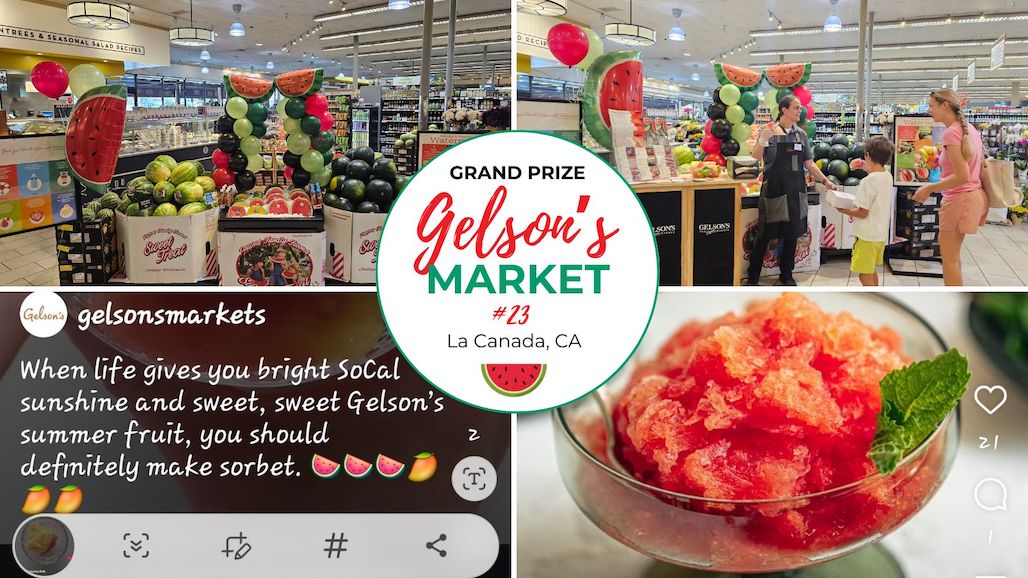
    This year’s Grand Prize winner, Gelson’s Market #23 in La Canada, CA, made a triumphant return to the winner’s circle after previously earning an Honorable Mention in last year’s contest. Gelson’s elevated their efforts this year, impressing judges with their creative displays and consumer education initiatives including in-store sampling events, social media recipe videos and selection and nutrition education, earning them the top prize.

    “This year’s entries were exceptionally innovative, showing watermelon’s health benefits and versatility through various media,” said Juliemar Rosado, Director of Retail and International Marketing at NWPB. “The winners stood out for their consumer education focus, with displays highlighting watermelon selection, recipe ideas and happiness. Whole, mini and fresh-cut watermelons were also featured to appeal to a wider range of shoppers.”

    In addition to the Grand Prize, Wegmans Food Markets in Rochester, NY took second place, and Schnuck Markets in St. Louis, MO secured third. Due to the remarkable quality of submissions this year, the NWPB awarded an additional Honorable Mention, recognizing a total of four retailers for their outstanding efforts:

    • Harps – Heber Springs, AR
    • Riverside Market #1135 – Montrose, MI
    • Tops Friendly Markets – Dunkirk, NY
    • United Grocery Outlet – Knoxville, TN

    “The team at Gelson’s #23 would like to express our gratitude for the opportunity to showcase the talent we have at Gelson’s Market,” said Thot Phommasaysy, Produce Manager at Gelson’s Market #23. “We take great pride in creating impactful displays that excite our customers. Gelson’s La Canada is proud to have won the Grand Prize this year in [NWPB’s] Retail Merchandising Contest. A special thank you goes out to Catrice Taylor, Produce Clerk for her dedication, hard work, and merchandising skills. Thank you Catrice, for helping La Canada Gelson’s become this year’s winner!”

    More than $10,000 in cash and prizes will be awarded to the winners. Gelson’s Market #23 will receive $5,000 as the Grand Prize winner, Wegmans will take home $2,500 for second place, and Schnuck Markets will receive $1,000 for third. Each of the Honorable Mention winners will be awarded $500 for their exceptional displays.

    For a complete list of winning displays, including images, visit the NWPB Retail Contest Winners page at watermelon.org. For additional information, contact Juliemar Rosado at jrosado@watermelon.org.

    About National Watermelon Promotion Board

    The National Watermelon Promotion Board (NWPB), based in Winter Springs, Florida, was established in 1989 as an agricultural promotion group to promote watermelon in the United States and in various markets abroad. Funded through a self-mandated industry assessment paid by more than 700 watermelon producers, handlers and importers, NWPB mission is to increase consumer demand for watermelon through promotion, research and education programs.

    A serving of nutrient-dense watermelon provides an excellent source of Vitamin C (25% DV), a source of Vitamin B6 (8% DV), and a delicious way to stay hydrated (92% water), with only 80 calories per 2-cup serving. Watermelon consumption per capita in the United States was nearly 16.9 pounds in 2023. Watermelon consumption in the United States was nearly 5.6 billion pounds in 2023. The United States exported an additional 377 million pounds of watermelon. For additional information, visit www.watermelon.org.

  • UC Davis Enters New International Strawberry Licensing Agreements

    UC Davis Enters New International Strawberry Licensing Agreements

    The University of California, Davis, has reached new agreements to license more than a dozen of its world-renowned strawberry varieties to growers in countries across the world.

    The agreements ensure that nurseries and fruit growers in Mexico, South America, Europe, Asia and the Middle East have access to all available varieties developed by the UC Davis Public Strawberry Breeding Program.

    Strawberry plant varieties developed at UC Davis produce about 60% of all strawberries consumed around the world.

    UK-based Global Plant Genetics, or GPG, will add 15 legacy varieties of UC Davis strawberry plants to its existing portfolio in China, South America, Europe, the Middle East and North Africa. GPG, which has been a UC Davis master licensee since 2018, already oversees licensing of a dozen of the more recently developed UC Davis varieties in those markets.

    Fresa Fortaleza, or F2, is the new master licensee for the legacy varieties in Mexico. Since 2020, the San Diego-based company has been the master licensee in Mexico for the more recently developed UC Davis varieties.

    Earlier this year, UC Davis severed ties with former master licensee Eurosemillas as to these legacy varieties.

    “We are pleased to have expanded our agreements with GPG and Fresa Forteleza,” said Helene Dillard, dean of the UC Davis College of Agricultural and Environmental Sciences. “We appreciate the shared commitment to maintaining outstanding relationships with our nurseries and growers and providing vigorous support for the UC Davis Public Strawberry Breeding Program.”

    The new agreements cover:

    • The European Union, Switzerland and the United Kingdom
    • Argentina, Brazil, Chile, Colombia, Ecuador, Mexico, Peru and Uruguay
    • China
    • Egypt, Israel, Jordan, Morocco and Turkey.

    The UC Davis Public Strawberry Breeding Program seeks to address the needs of growers by developing strawberries for positive characteristics including greater yield, flavor, disease resistance, and adaptation to different growing conditions. The university directly licenses strawberry varieties to nurseries in Canada and the U.S. and offers California strawberry growers a competitive advantage through exclusive access to new varieties for two years and reduced royalty rates.

    The program, funded primarily by revenue from licensing strawberry varieties, also trains students and postdoctoral researchers to be leaders in the field.

  • October Becomes National California Date Month

    October Becomes National California Date Month

    October is about to get a whole lot sweeter! The California Date Commission is proud to announce the inaugural National California Date Month, set to take place this October. It will celebrate the delectable, nutritious, and oh-so-versatile California Dates as well as honor the hardworking farm workers who bring these sweet treats from the palm trees to plates across America and the world.

    “Dates are more than just a fruit; they are a symbol of the hard work and resilience of our agricultural communities,” said Gordon Chuchian, chairman of the California Date Commission. “This month-long celebration is a tribute to the dedication of our farm workers and the enduring legacy of date farming in California.”

    Throughout the month of October, all aspects of California Dates, from their nutritional value and delicious recipes to their contribution to California’s agricultural richness and heritage will be celebrated with a variety of activities.

    Why Celebrate Dates?

    ✅ Unbeatable taste and quality, packed with natural sweetness
    ✅ Full of nutrients
    ✅ Incredibly versatile in the kitchen
    ✅ Rich heritage with farming skills passed down through generations

    Fresh Fruits or Dried Fruits? 

    California Dates are nature’s only NATURALLY DRY FRESH FRUIT. They are a low-moisture whole fruit with less than 25 percent moisture. The moisture content is the main difference in how dry the dates will be when harvested, which changes throughout the ripening stages.

    Fresh California Dates do not undergo a drying process after harvesting. They are washed, sorted, packaged, and shipped, and can be found in the produce aisles of your favorite grocery stores.

    There are also dried dates – dates that have been dehydrated after harvesting. With the moisture removed, these dates have a longer shelf life and are often found in the baking aisle of your favorite grocery store.

    Delicious Recipes

    In addition to being a delicious sweet treat, California Dates offer numerous health benefits. They are heart-healthy, filled with antioxidants, have a low glycemic index, provide a natural energy boost with no added sugars, and filled with essential vitamins and nutrients.

    California’s date industry is a cornerstone of the state’s agricultural landscape, producing over 85% of the dates grown in the United States. California’s unique climate and rich soil make it the perfect place to grow superior dates renowned for their quality, taste, and nutritional benefits.

    What’s Happening in October

    Leading up to and throughout October there will be several exciting events and promotions to help people discover the wonders of California Dates including:

    Culinary Experiences: Restaurants and bars throughout the Greater Palm Springs area will feature date-inspired menus all month long. From sweet and savory main dishes, sides, and desserts to creative date cocktails and the famous California Date Shakes, California Dates will be showcased in innovative and delicious ways, allowing patrons to experience the diverse culinary potential of this versatile fruit.

    Virtual Spotlights: Chefs, mixologists, and nutritionists will be featured online, providing valuable insights to viewers, no matter where they are located.Breakfast with Champions: A special event will honor the farm workers whose labor and dedication are the backbone of the date industry. Their contributions will be celebrated, acknowledging the vital role they play in bringing this nutritious fruit from farm to tables around the country.

    Happening Now for Consumers – A National Contest

    Starting September 10th and continuing through the end of October, the California Date Commission will be holding a national consumer contest. Prizes include:

    •  Boxes of California Dates with $100 grocery gift cards
    • A private online cooking class for contest winners hosted by California Dates ambassador and celebrity chef Aarti Sequeira.
    • A California Dates VIP Experience at the Palm Desert Food & Wine Festival (March 2025). The prize package includes a 3-night stay at an area hotel, tickets to the Celebrity Chef Farm Tour & Luncheon, tickets to the Saturday Grand tasting event, and a California Dates Swag bag.  Consumers can enter the contest here.

    For up-to-date information about National California Date Month events and promotions, follow California Dates on Facebook and Instagram (@datesaregreat) and visit the National California Date Month web page.

    About the California Date Commission

    The California Date Commission is a commodity board working on behalf of all date producers within the Coachella Valley to oversee the quality development of dates and date products and provide field and nutrition research, regulatory support and generic marketing promotion.

  • California Citrus Grower’s Conference, Oct. 23

    California Citrus Grower’s Conference, Oct. 23

    Growers are invited to register now for the Citrus Research Board (CRB)’s Annual California Citrus Grower’s Conference on October 23, 2024, in Visalia, California, at the Visalia Convention Center. Registration will close on Monday, October 14.

    This event is designed specifically for growers and will showcase the outstanding research efforts ongoing for the benefit of California citrus growers and industry. This conference is an invaluable opportunity to learn, connect with fellow growers, and stay involved with innovative research. Additional information can be found at the registration link HERE.

    Scheduled Speakers

      • Casey Creamer, California Citrus Mutual
      • Ashraf El-kereamy, Ph.D., University of California, Riverside
      • Ivan Milosavljević, Ph.D., Citrus Research Board
      • Sandipa Gautam, Ph.D., University of California Agriculture and Natural Resources
      • Daniele Zaccaria, Ph.D., University of California, Davis
      • Raymond Yokomi, Ph.D., USDA Agricultural Research Service
      • Isaac Mazor, Nanovel LTD
      • Amanda Zito, Fresno County Department of Agriculture
      • Luxin Wang, Ph.D., University of California, Davis
      • James (Jim) Adaskaveg, Ph.D., University of California, Riverside
      • Melinda Klein, Ph.D, Citrus Research Board
      • Bodil Cass, Ph.D., University of California Agriculture and Natural Resources
      • Robert Clark, Ph.D., EcoData Technology

    Continuing Education Units (CEUs)

    The following continuing education units have been approved:
    • Department of Pesticide Regulations – 1.5 hours of Other and .5 hours of Laws & Regulations
    • Certified Crop Advisers – 2.5 hours of Integrated Pest Management, .5 hours of Soil & Water Management, and .5 hours of Crop Management
  • Harnessing the Power of Hydrogen to Support California Agriculture

    Harnessing the Power of Hydrogen to Support California Agriculture

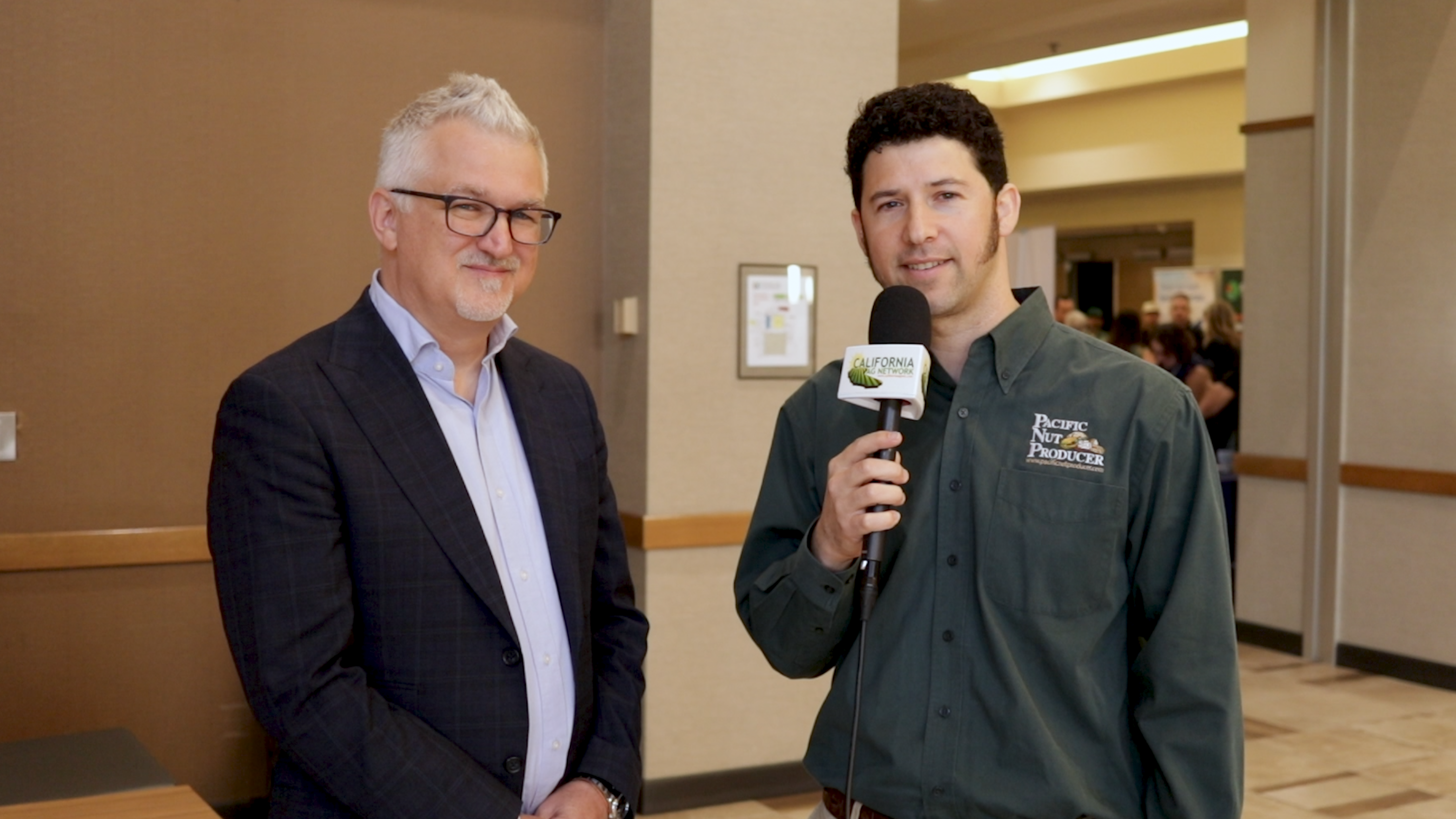
    California leads the nation in the adoption of renewable energy. Significant investments have been made in solar electricity generation and biogas digesters in its agricultural industry, but what about hydrogen power? The State of California was recently awarded $1.2 billion from the Federal Dept. of Energy to invest in hydrogen power as a renewable energy source and offers much promise to the agricultural processing and trucking industries. Neil Navin from SoCalGas met with Matthew Malcolm on California Ag Network to share some of the possibilities, and explain how hydrogen power compares with electricity in its sources for sustainable generation and its ability to serve the needs of trucking and large equipment. Watch this brief interview and learn more in Malcolm Media’s agricultural publications.

  • What Are You Doing For Your Orchard’s Financial Longevity?

    What Are You Doing For Your Orchard’s Financial Longevity?

    Your prune orchard is an investment – the longer it remains a productive, high-yielding orchard the higher your return on that investment and the longer you can avoid the (very expensive) need for orchard removal, replanting, and years of non-bearing and low initial yields.

    Do you know what thiophanate-methyl is? It is the active ingredient in the fungicide Topsin-M. While this is not a pesticide advertisement or recommendation, research from the lab of Dr. Themis Michailides (UC Davis, based at Kearney Ag Research & Extension Center) has shown that Topsin-M is the most consistently effective fungicide for protecting fresh pruning wounds. Pruning wounds are very easily colonized by canker causing fungi (CytosporaBotryosphaeria, and others). These fungi infect the fresh pruning cut with wind splashed spores during rainstorms.

    So, all you must do is prune, quickly clear the brush, and apply Topsin-M or another thiophanate-methyl product? Unfortunately, it’s not quite that simple. Although this fungicide is the best protective spray we have to-date, it significantly reduces but does not prevent all canker infections that can shorten your orchard’s lifespan. Still, to give your orchard the best shot at long sustained health and financial viability -integrate this spray in with other best practices:

    1. Skip pruning when you can (following a heavy crop, the year after detailed pruning, etc.), but make sure to shaker thin if a heavy crop sets because limb breakage is also an opportunity for canker infection.
    2. Prune around rain whenever possible. Early fall or after bloom are pruning timing options that may (should?) avoid rain. Never prune with rain in the forecast.
    3. Quickly push brush and consider spraying with a thiophanate-methyl product (Topsin®-M, etc.).
    4. Prune out and remove dead wood in the orchard to reduce canker inoculum. Burn pruning debris where permitted.

    *Note, Mention of any chemistries or trade names does not constitute a recommendation and are for informational purposes only. Always consult with your PCA before use and adhere to the pesticide label and local and state regulations.  — By Luke Milliron, UCCE Orchard Advisor Butte, Glenn & Tehama Counties, and Franz Niederholzer, UCCE Farm Advisor, Colusa, Sutter & Yuba Counties

  • Phellinus Wood Rot, or “Why do my Prune Trees Blow up at Harvest?”

    Phellinus Wood Rot, or “Why do my Prune Trees Blow up at Harvest?”

    California’s prune industry faces a significant challenge: a decline in orchard lifespan. Average productive life has shrunk from an estimated 30 years in 1998 to just 20 years as of 2022 (UC Cost and Return Studies). Heat stress, repeated mechanical damage, and disease are likely contributing factors. A primary disease culprit associated with premature orchard decline is the loss of fruit-producing scaffolds likely caused by the heart rot fungus Phellinus pomaceus (formerly called P. tuberculosus).

    Phellinus pomaceus specifically targets Prunus spp., unlike most wood decay fungi which have a broader host range. This fungus is common in natural forests of Europe and Asia. It invades the heartwood, causing white rot that weakens branches. In California prune trees, this results in broken branches that reduce fruit production. Additionally, weakened trees become more susceptible to other stressors, ultimately shortening orchard lifespan.

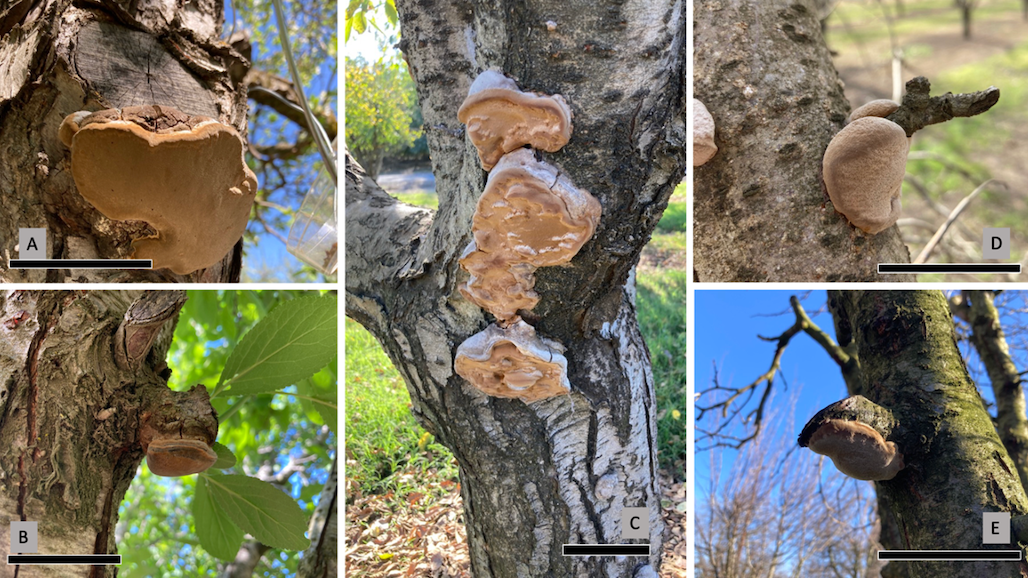
    Prune growers should be aware of the signs of Phellinus pomaceus infection. Look for shelf-like fruiting bodies (conks) on trunks or branches (see photos) – these are the fungus’ reproductive structures and indicate established infection. Additionally, broken or pruned branches with exposed white rot decay (also pictured) can indicate the disease. Growers often discover this internal heart rot in major scaffolds leading up to and during harvest, when branches that appear healthy snap under the weight of fruit or during shaking– aka “blowing up.”

    Our research in investigating Phellinus pomaceus and developing management strategies is supported by funding from the California Prune Board. We are focused on investigating several key areas:

    Distribution of the fungus, its impacts, and management choices: We are surveying prune orchards to assess the prevalence and severity of infection statewide and investigating potential links between disease occurrence and factors like pruning practices, irrigation types, spray applications of dormant oils, the presence of other pathogens, and local weather conditions. Surveys in mature prune orchards reveal a high prevalence of Phellinus pomaceus infection levels in the Sacramento Valley compared to historical studies, with all surveyed contemporary orchards over 14 years showing signs of the infection. Conversely, extremely limited infection has been observed so far in the San Joaquin Valley. Weather stations have been installed in 10 orchards from Red Bluff to Madera since Fall 2023 and provide specific in-orchard conditions that may be related to the progression of the disease.

    Additionally, we are collaborating with researchers in France and South America to see if Phellinus pomaceus is a problem in other major prune-producing regions. Surveys in Chilean prune orchards are planned for September 2024 with additional funding from UC Davis Chile Life Sciences Institute.

    Potential Control Methods: Since there is currently no known chemical control for Phellinus pomaceus, we are exploring bio-control alternatives. Two trials are underway to investigate the potential of Trichoderma spp. (a beneficial fungus used as a bio-control product in other crops, one trade name is Vintec®), to protect pruning wounds from Phellinus pomaceusinfection. The first trial is a multi-year project (started in 2020) wherein orchard blocks have been sprayed with Trichodermaproducts annually and disease progress is being monitored. Due to the slow progression of this disease, results will not be clear for many more years. The second trial is direct application on fruiting bodies to observe any effects on growth and spore production. After a single season in this trial, unfortunately Phellinus appears unhampered in its life cycle – though these results are still pending. A third trial is upcoming and will consist of targeted pre-inoculation of fresh pruning wounds with different combinations of Phellinus pomaceus spores and Trichoderma bio-controls and re-sampling a short time later to observe disease progression in the presence of these alternative spray applications.

    Spore Dispersal and infection routes: Understanding the life cycle of fungal pathogens is crucial for disease prevention, though current literature is lacking in relevant studies on Phellinus pomaceus. We are working to understand how the disease colonizes and spreads in California prune orchards. Recent dissection of infected trees indicates the primary route of infection is through pruning wounds, which are colonized by airborne spores released by the fungus during specific windows.

    We are monitoring airborne fungal spores in orchards throughout the year to identify these peak periods of Phellinus pomaceusspore dispersal. This information can help growers time pruning activities to minimize infection risk. Initial results show peak spore production in late January to early April, depending on the region. These data currently support orchard managers to avoid pruning during this time, when chances of infection are likely highest. More official data will be coming in the next year.

    Fruiting body of Phellinus pomaceus. Characteristic association with pruning wounds shown in A, B, D, E. Scale bars 10 cm (4 inches).

    We will continue to share our findings and develop management recommendations for growers. Stay tuned for future updates on the completion of orchard surveys and the impacts of orchard management practices, the results of Trichoderma spp. trials, and how our growing understanding of the life cycle of Phellinus can improve management of the disease. We are grateful to the California Prune Board for generously funding this important research.

    Please reach out to Laurel Hoffman, PhD Graduate Student in the lab of Dr. David Rizzo of the UC Davis Dept. of Plant Pathology if you have concerns or questions about this research at Hoffman@ucdavis.edu. — By Laurel Hoffman, UC Davis Dept. of Plant Pathology PhD Graduate Student, Rizzo Lab

  • Avocado Sales Back to Record-Breaking Highs

    Avocado Sales Back to Record-Breaking Highs

    Second quarter holidays generated the highest growth rates in 2024 according to the most recent Avocado Holiday Retail Recap created by the Hass Avocado Board (HAB). Cinco De Mayo, Memorial Day and Father’s Day sold a combined 154.6 million units, generating $191.6 million in dollar sales, a $32.4 million increase in dollar sales versus 2023.

    Additionally, all three holidays contributed to category promotional gains in promotional lift. During Cinco de Mayo week, small avocados (4046) fueled unit growth due to their large share of category sales. However, promotional performance showed large avocado (4225) promotions outperformed small avocados (4046) and bagged avocados, driving a +73.2% promotional lift in volume, +35.7 points higher than the promotional volume lift achieved by small avocado (4046) promotions.

    Key highlights from the report include:

    • Cinco De Mayo sales and units soared, reaching four-year highs in both dollars and units. Avocado units reached 59.8M, a +2% increase versus the prior year, while dollar sales soared +22% to $68.5M. Small avocados (4046) drove unit growth during the holiday, contributing an additional +3.1M units to the category.
    • During Memorial Day, avocado dollars climbed +18% to $61.5M in sales while units fell -2% to 47.5M units. The average holiday selling price reached $1.29/unit, a +20% increase compared to the prior year.
    • Father’s Day avocado dollar sales secured $61.6 in sales, a four-year high and a +22% increase from the prior year while unit sales declined -1% to 47.3M units. Large avocados promotions performed well during the holiday generating the highest promotional volume lift at +20%.
    The Hass Avocado Board’s recently published second quarter retail recap notes that Cinco De Mayo promotions for large avocados (4225) outperformed other Q2 holidays. Promoted sales of large avocados generated a volume lift for each holiday. However, Cinco De Mayo largely outperformed other summer holidays.

    The Avocado Holiday Retail Recap provides detailed analyses of promoted and non-promoted volume and dollar sales, pricing dynamics, lift metrics, and promotional efficiency across various bulk avocado sizes and bagged avocados. Each report also details regional sales information providing insightful information for future holiday promotion planning.

    For a complete overview of avocado sales performance during each 2024 holiday please visit hassavocadoboard.com and download the full report.

    About The Hass Avocado Board

    The Hass Avocado Board (HAB) exists to help make avocados America’s most popular fruit. HAB is the only avocado organization that equips the entire global industry for success by collecting, focusing, and distributing investments to maintain and expand demand for avocados in the United States. HAB provides the industry with consolidated supply and market data, conducts nutrition research, educates health professionals, and brings people together from all corners of the industry to collectively work towards growth that benefits everyone. The organization also collects and reallocates funds to California and importer associations to benefit specific countries of origin in promoting their avocado brands to customers and consumers across the United States.