Category: Industry News

  • 2020 Vegetable Crops Chemical Use Report

    The 2020 Agricultural Chemical Use Survey of vegetable producers collected data about pesticide use as well as pest management practices on acres planted to 22 different vegetable crops. NASS conducted the survey among producers in 18 states, focusing on the states that were major producers for the surveyed crops. (Fig. 1)

    Data are for the 2020 crop year, the one-year period beginning after the 2019 harvest and ending with the 2020 harvest. Data are available online for all 22 vegetables (see sidebar for how to access). This report highlights the three vegetables sampled in the most states: onions, pumpkins, and snap beans.

    Who Uses Agricultural Chemical Use Data?

    Producers, consumers, suppliers, policymakers, USDA and other federal and state agencies rely on chemical use and other pest management data to make decisions about health, environment, safety, and trade issues. Some examples of how the data are used:

    • To evaluate the quality and safety of U.S. food products, providing assurances to both domestic and international customers.

    • To identify industry trends and determine the impact of on-farm chemical use and pest management.

    • To assess the quality of streams, rivers, and groundwater; the impact of human activities; the benefits of conservation practices; and the effectiveness of integrated pest management.

    • To identify which chemicals farmers count on, making it more likely regulators will re-register the product.

    Pesticide Use

    The pesticide active ingredients used on vegetables are classified as herbicides (targeting weeds), insecticides (targeting insects), fungicides (targeting fungal disease), and other chemicals (targeting all other pests and other materials, including extraneous crop foliage).

    Onion growers applied herbicides to slightly more acres (91% of planted acres) than fungicides or insecticides (90% and 73% of planted acres, respectively). Pumpkin growers applied herbicides and fungicides to 79% and 75% of planted acres, respectively. Snap bean growers applied herbicides to 94% of planted acres but insecticides and fungicides to fewer acres. (Fig. 2). Further detail on the top pesticides can be found in Table 1.

    Pest Management Practices

    The survey asked growers to report on the practices they used to manage pests, including weeds, insects, and diseases. Vegetable growers reported practices in four categories of pest management strategy, widely referred to as PAMS – prevention, avoidance, monitoring, and suppression. Table 2 shows the top practice in each category.

    • Prevention practices involve actions to keep a pest population from infesting a crop or field.

    • Avoidance practices use cultural measures to mitigate or eliminate the detrimental effects of pests.

    • Monitoring practices involve observing or detecting pests through systematic sampling, counting, or other forms of scouting.

    • Suppression practices involve controlling or reducing existing pest populations to mitigate crop damage. 

  • 2021 CA Table Olive Forecasted to More than Double

    2021 CA Table Olive Forecasted to More than Double

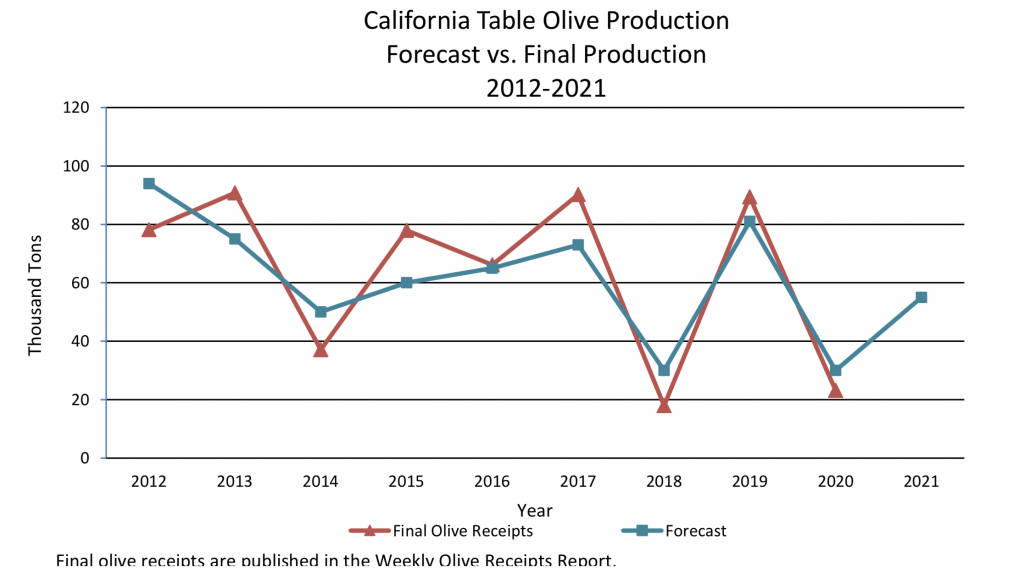
    The 2021 California table olive forecast is 55,000 tons, up considerably from last year’s crop of 23,200 tons, according to a survey conducted by the USDA, National Agricultural Statistics Service, Pacific Regional Office. Bearing acreage is estimated at 12,800, which results in a yield of 4.30 tons per acre.

    The Manzanillo production forecast is 53,800 tons, Sevillano production forecast is 1,100 tons, and other varieties are expected to total 100 tons.

    Growers reported variable crop yields by both variety and area. Manzanillo yields were reported to be higher and more consistent than the Sevillano variety yields. Sizes were reported to be smaller than normal due to high heat and lack of water availability.

    Labor costs and marketing remains an issue for California olives growers, with many uncertain how much of their crop will be economical to harvest.

    SURVEY SAMPLE

    There were 309 growers sampled for the survey. Reports from 153 were used to establish this forecast. The sample is designed to provide a State estimate of all varieties; estimates by variety are less precise.

    ACKNOWLEDGMENTS

    A special thanks goes to the many olive growers who participated in the survey. Time spent completing the survey is appreciated, and helpful in estimating current condition of the olive industry in California. The California Table Olive Forecast is funded by the California Olive Committee.

  • COVID & Logistical Issues Reduce US Stone Fruit Exports into Taiwan

    COVID & Logistical Issues Reduce US Stone Fruit Exports into Taiwan

    Taiwan’s peach production for MY2021/22 is forecast to increase to 17,000MT. Peach and nectarine imports are forecast down to 13,500 MT due to reduced demand at peak fruit season caused by Taiwan’s COVID-19 outbreak in May and June. Cherry consumption for MY2021/22 is forecast flat at 12,400 MT. In 2020, total import volume from the United States decreased by almost 25 percent and market share fell to 50 percent, mainly due to decreased supply. Because of COVID restrictions on shopping at wet markets and local fruit shops as well as logistical problems, domestic fruit demand is expected to decrease in MY 2021/22. 

    MY 2021/22 peach production is forecast up to 17,000 metric tons (MT) due to less than expected damage from rain. Taiwan faced severe drought conditions during spring to early summer 2021, the critical period for peach growth. Peach fruit size this year is expected to be smaller but sweeter. Although the previous forecast had MY 2020/21 production recovering and surpassing that of MY 2019/20, 2020 production was essentially flat at 16,000 MT.

    Taiwan’s peach harvest season runs from March to August depending on the variety and planting elevation. In Taiwan, half of peach production is located near Taichung City, with the remainder followed by Taoyuan City, Hsinchu County, and Nantou County. There are several peach varieties sold through auction market. By order of harvest, there are: early peach (早桃) from March, followed by sweet peach (甜桃), Fu-Shou peach (福壽桃), Ying-Go peach (鶯歌桃), and honey peach (水蜜桃) in July and August. The sweet peach variety is the largest by volume in the local auction market. Read the full report from the USDA Foreign Agricultural Service HERE

  • Soil-Biodegradable Mulch In Strawberry Field Day, Aug 17

    The UC Cooperative Extension, Washington State University and Monterey Bay Marine Sanctuary have been working together this past year field testing five different formulations of biodegradable bed mulch in strawberry.  See five types of soil-biodegradable mulches (BDMs) applied to strawberries in Salinas Valley. Learn what a BDM is, what it is made from, and comparative economics with traditional PE plastic mulch. See first-hand how it is performing in the field and learn from other farmers who are trialing it about their experiences and expectations. Learn about how plastic impacts soil health. For more information on the event, contact Jazmine Mejia-Muñoz at jazmine@californiamsf.org or call (661) 331-2612. Register HERE  All local and state health guidelines will be enforced. If you have not received a Covid vaccine please wear a mask.

    Location:

    Strobel Ranch
    1656 Castroville Road
    Salinas, CA 93907
    This event is supported by the ‘California Climate Investments’ program.
  • Detection of Citrus Disease (HLB) in San Diego County Establishes New Quarantine Area

    Detection of Citrus Disease (HLB) in San Diego County Establishes New Quarantine Area

    The California Department of Food and Agriculture (CDFA) has declared a quarantine in north San Diego County following the detection of the citrus disease Huanglongbing (HLB), or citrus greening, in two citrus trees on one residential property in the city of Oceanside. This is the first time the plant disease, which does not harm people but is deadly to citrus, has been detected in San Diego County. CDFA is working with the United States Department of Agriculture (USDA) and the San Diego County Agricultural Commissioner on this cooperative project.

    The detection will require a mandatory 68-square-mile quarantine area around the find site to restrict the movement of citrus fruit, trees and related plant material. The quarantine area is bordered on the north by Stagecoach at Camp Pendleton; on the south by Tamarack Ave in Carlsbad; on the west by the Pacific Ocean; and on the east by North Santa Fe in Vista. HLB quarantine maps for San Diego County are available online at: https://www.cdfa.ca.gov/plant/hlb/regulation.html. Please check this link for future quarantine expansions, should they occur. An HLB quarantine area currently exists in parts of Orange, Los Angeles, Riverside and San Bernardino counties, where more than 2,400 trees have tested positive for the disease and have been removed.

    The quarantine prohibits the movement of all citrus nursery stock or plant parts out of the quarantine area. Provisions exist to allow the movement of commercially cleaned and packed citrus fruit. Fruit that is not commercially cleaned and packed must not be moved from the property on which it is grown, although it may be processed and/or consumed on the premises. This includes residential citrus, such as oranges, lemons, grapefruit and kumquats.

    Residents are urged to take several steps to help protect citrus trees:

    – Do not move citrus plants, leaves or foliage into or out of the quarantine area or across state or international borders. Keep it local.
    – Cooperate with agricultural officials placing traps, inspecting trees and treating for the pest.
    – If you no longer wish to care for your citrus tree, consider removing it so it does not become a host to the pest and disease.

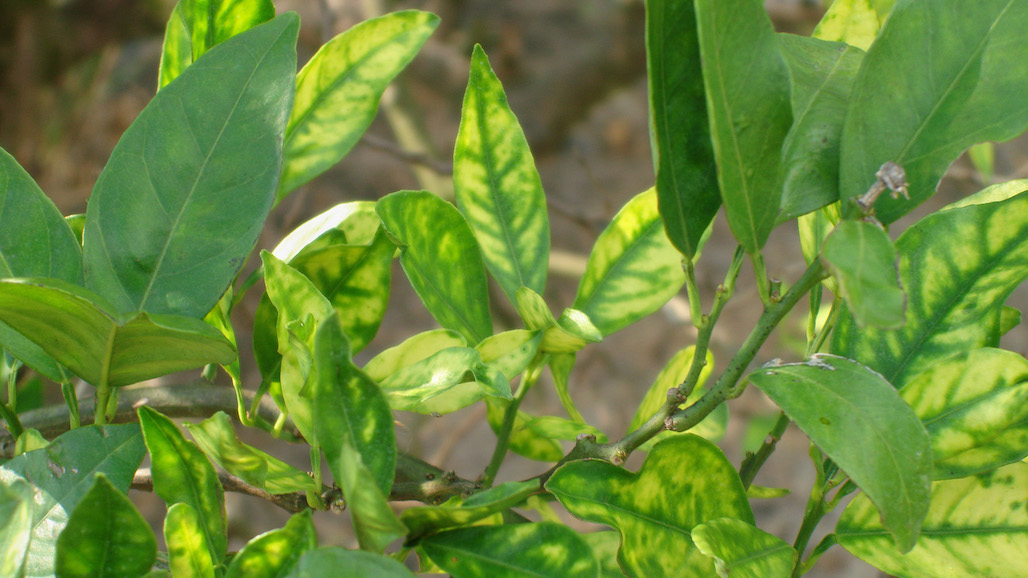
    HLB is a bacterial disease that affects the vascular system of citrus trees and plants. It does not pose a threat to humans or animals. The Asian citrus psyllid can spread the bacteria as the pest feeds on citrus trees and plants. Once a tree is infected, there is no cure; the tree will produce bitter and misshaped fruit and die within a few years.

    CDFA staff are scheduling removal of the infected trees and are in the midst of surveying citrus trees in a 250-meter radius around the detection site to determine if any other trees are infected with HLB. A treatment program for citrus trees to reduce Asian citrus psyllid infestations will also be conducted within 250-meter radius of the find site. By taking this action, a critical reservoir of the disease and its vectors will be removed, which is essential to protect surrounding citrus from this deadly disease.

    CDFA, in partnership with the USDA, local County Agricultural Commissioners, and the citrus industry, continues to pursue a strategy of controlling the spread of the Asian citrus psyllid while researchers work to find a cure for the disease.

  • Monitoring Stem Water Potential in Citrus (Case Studies with StemSense)

    Monitoring Stem Water Potential in Citrus (Case Studies with StemSense)

    – SPONSORED CONTENT –

    Reliable and valid information about plant water status is a critical input variable for optimizing citrus orchard growth. Precisely managing citrus water stress during all phenological stages enables maximized production by: avoiding drought stress during flowering and fruit sets; achieving appropriate sugar levels; and maintaining fruit quality by, for example, avoiding peel creasing for example.

    Controlled water status can best be precisely achieved by monitoring the Stem-Water Potential (SWP) values regularly. After five successful years of experimentation and development, Saturas’ StemSenseTM sensors were installed in mature commercial citrus orchards around the world, and at the leading research phytotron in Israel. Saturas has a full library of commercial case studies and are available by request. This brief overview cites results from two: China and Spain

    China Layout

    Three Saturas StemSenseTM sensors were installed in an OR (Clementine) citrus orchard in the Hongjing farm, China. The StemSenseTM sensors were installed randomly in the orchard to represent the whole orchard status. The StemsenseTM sensors measured daily mid-day SWP values.

    Results and Conclusions

    Figure 1 illustrates seasonal values of Saturas StemSenseTM mid-day SWP values, daily ET0 and irrigation volume. Of note, is the positive and significant response to irrigation and changes in evapotranspiration. Note, for example, the rain stoppage from Aug 23th to Aug 30th, as reflected by the gradually increasing SWP values.

    Figure 1
    Figure 1 – Seasonal values of Saturas’ StemSenseTM Mid-Day SWP values, daily ET0 and irrigation volume.

    Spain Layout

    Five Saturas StemSenseTM sensors were installed in a lemon orchard in the Velcarda farm, Spain.
    The StemSenseTM sensors were installed randomly in the orchard to represent the whole orchard status. The StemSenseTM sensors measured daily mid-day SWP values.

    Results and Conclusions

    Figure 2 illustrates seasonal values of Saturas StemSenseTM mid-day SWP values, daily ET0 and irrigation volume. The Saturas StemSenseTM sensors showed a highly correlative response to irrigation and changes in evapotranspiration Note, for example, the increase in SWP values during late July- early Aug, the influence of the small irrigation on Aug 2nd, and the response of the trees to the regular irrigation started on Aug 13th.

    Figure 2
    Figure 2 – Seasonal values of Saturas’ StemSenseTM Mid-Day SWP values, daily ET0 and irrigation volume.

    Saturas StemSenseTM sensors showed a very rapid response to irrigation and a positive and significant correlation to manual pressure chamber measurements.

    Conclusions

    The StemSenseTM sensors, in these two case studies, demonstrated high measures of correlation to environmental stimuli such as ET, precipitation and irrigation while delivering reliable and valid SWP values over time. The commercial utility of StemSenseTM sensors is mutli-layered. The specific result of these studies demonstrates that the Saturas StemSenseTM sensors contribute reliable and valid information to the grower, critical for making good decisions for scheduling irrigation.
    In addition, the experimental and commerical aplications demonstrated a high correlation to manual pressure chamber measurements. Replicability of experimental outcomes has allowed Saturas to expand into the apple, avocado, cherry, almond, kiwi, vine markets.

    Avishai Avni-Maya PhD
    Chief agronomist
    Saturas Ltd
    972-50-7737778
    avishai@saturas-ag.com

  • Ag Goals & Progress of Voluntary Agreements for Bay-Delta Flows

    What is now being referred to as a 20 year drought in California has caused many problems for not only farmers, but all Californians and wildlife. In addition to the dire need for water infrastructure renovations, farming groups are also very focused on pursuing voluntary agreements for alternatives to the California State Water Resources Control Board plan for Bay-Delta flows.  Watch this brief interview with Merced County farmer, Randy Fiorini who shared some insights from the Delta Stewardship Council as the discussions on voluntary agreements have resumed.
    Please thank this video’s sponsor Suterra for their industry support.
  • Ag Goals & Progress of Voluntary Agreements for Bay-Delta Flows

    Ag Goals & Progress of Voluntary Agreements for Bay-Delta Flows

    What is now being referred to as a 20 year drought in California has caused many problems for not only farmers, but all Californians and wildlife. In addition to the dire need for water infrastructure renovations, farming groups are also very focused on pursuing voluntary agreements for alternatives to the California State Water Resources Control Board plan for Bay-Delta flows.  Watch this brief interview with Merced County farmer, Randy Fiorini who shared some insights from the Delta Stewardship Council as the discussions on voluntary agreements have resumed.
    Please thank this video’s sponsor Suterra for their industry support.
  • Merced Grower Works with Farmland Trust to Protect Acreage from Urban Development

    Merced Grower Works with Farmland Trust to Protect Acreage from Urban Development

    Merced County almond, walnut and peach grower, Randy Fiorini is proud to be the first farmer to work with both the Henry Mayo Newhall Foundation and California Farmland Trust in a conservation fundraising campaign to protect agricultural land from urban expansion. Watch this brief video with Randy Fiorini as he explains the program and needed support to realize his goal.

    Please thank this video’s sponsor Suterra for their industry support.

  • Washington Issues Rules to Protect Farm Workers from Wildfire Smoke

    Washington is under a state of emergency, with more than 600 wildfires reported already this year. That’s about double the normal rate, according to the state Department of Natural Resources. Where there’s fire, there’s smoke that can expose outdoor workers in construction, agriculture, and other jobs to health risks from breathing particulate matter in the air.

    To help these and other workers, the Department of Labor & Industries (L&I) filed emergency rules today to help protect employees exposed to wildfire smoke. Washington is just the second state to issue regulations regarding workers and wildfire smoke. California was the first, adopting its rules in 2019.

    “This wildfire season is shaping up to be even worse than last year,” said L&I Director Joel Sacks. “We’re establishing these emergency rules to protect employees who have to work outside, breathing in smoky air all day long.”

    Smoke from wildfires contains chemicals, gases, and fine particles that can harm health. The most concerning hazard is associated with the smallest particles, or Particulate Matter (PM), that are less than 2.5 micrometers (PM 2.5). These particles can get deep into the lungs, worsening existing health conditions like asthma, negatively impacting heart health, and increasing the risk of death.

    The new wildfire smoke rules spell out to employers how to identify harmful smoke exposure risks and when to notify their workers. They also require employers to:

    • Train employees and supervisors about wildfire smoke;
    • Ensure employees showing symptoms of wildfire smoke exposure are monitored and receive medical care when necessary; and,
    • Take actions to eliminate or reduce exposures to wildfire smoke where feasible, when levels of particulate matter are high.

    The rule sets the standard for dangerously poor air quality at PM 2.5 concentrations of 55.5 micrograms per cubic meter (μg/m3) or an Air Quality Index (AQI) of 151.

    Measures to eliminate or reduce worker exposure may include:

    • Moving work to enclosed buildings, structures, or vehicles where the air is adequately filtered;
    • Moving employees to areas with lower smoke exposure;
    • Reducing work intensity;
    • Providing additional rest periods; and,
    • Providing employees with respirators, such as an N95 or a KN95 disposal mask at no cost for voluntary use when levels of particulate matter are high.

    Although not required, L&I also recommends employers take action to reduce employee exposure to dangerous air at even lower levels of particulate matter, especially for sensitive groups with asthma or other lung conditions.

    Monitoring air quality
    The emergency wildfire smoke rules include several ways employers can check PM 2.5 levels. They can check sites including the EPA’s AirNow website or state Department of Ecology’s Air Monitoring Network and download mobile apps like “EPA AirNow” or “Air Quality WA.” They can also purchase equipment to check it themselves.

    What’s next
    The emergency rules are in effect immediately (July 16, 2021); employers will be given a brief grace period before enforcement begins.  
    L&I gathered stakeholder input and referenced California’s regulations to develop the emergency wildfire smoke rules. L&I will announce opportunities to provide input on permanent rules in the coming months.