Category: Non-Video

  • Leslie Wada Named USHBC’s First-Ever Senior Director of Nutrition and Health Research

    Leslie Wada Named USHBC’s First-Ever Senior Director of Nutrition and Health Research

    The U.S. Highbush Blueberry Council (USHBC) recently announced the appointment of Leslie Wada, Ph.D., RD, as senior director of nutrition and health research. A longtime consultant for the council, Wada will continue to manage USHBC’s multi-million dollar pipeline of health research projects as she has for the past 12 years. In her expanded role, Wada will have increased ownership and responsibility in leading the health and nutrition pillar of the USHBC’s 2021-2025 strategic plan, integrating the research projects and results with the council’s overall strategy in marketing and promotions.

    A registered dietitian with an undergraduate degree in nutrition and dietetics from the University of California, Davis, Wada earned a Ph.D. in nutritional sciences from the University of California, Berkeley. She worked as a research scientist on nutrition studies and taught classes in dietetics at UC Berkeley before leaving academia to work with companies that developed functional foods and ingredients. For the past 20+ years, she has worked as an independent consultant for companies in the food and agriculture industry.

    To hear Wada tell the story of the heart-healthy properties of blueberries, check out this podcast episode of “The Business of Blueberries” from earlier in the year.

  • USAID Awards UC Davis $15 Million for Global Horticulture Research Program

    USAID Awards UC Davis $15 Million for Global Horticulture Research Program

    The U.S. Agency for International Development will provide a base $15 million investment over the next five years, with up to $34.5 million total funding possible, to support a global research program led by the University of California, Davis, that advances fruit and vegetable production, handling, and consumption.

    The Feed the Future Innovation Lab for Horticulture will work with and promote local leadership in communities across the globe to advance horticultural and social innovations for nutritional and financial security. This competitive five-year program was first awarded to UC Davis in 2009 and renewed in 2014.

    “Horticulture offers big health, economic and environmental benefits,” said Elizabeth Mitcham, program director and a UC Cooperative Extension specialist in the Department of Plant Sciences. “UC Davis will be leading an outstanding global consortium that will be able to make big impacts on developing sustainable, local expertise and innovative technical and social solutions to empower horticulture producers and their communities.”

    UC Davis will be joined in a consortium with Florida A&M University, Michigan State University, Texas A&M, and World Vegetable Center, along with subject matter experts from Penn State University and Making Cents International, to help manage this program.

    The Horticulture Innovation Lab will focus their efforts in West Africa, East Africa, South/Southeast Asia and Central America. At the forefront of their research will be the development of environmentally sustainable, market-oriented production and post-harvest handling methods that provide smallholder farmers and other stakeholders in fruit and vegetable value chains more income, as well as improved access to fruits and vegetables to better nourish their families and communities.

    Locally led, globally supported

    Within the UC Davis-led consortium are partners and specialists with expertise in horticulture, agronomics, agri-sociology, agribusiness and agri-policy. The Horticulture Innovation Lab will convene these global, regional and local experts to determine research needs in each geographical area. Once these research needs are defined, the team will emphasize a holistic, locally led approach to build community resilience and to support inclusivity. 

    “We asked ourselves, ‘how do you effect change in a system now that overcomes immediate challenges and those yet to present themselves?’” said Erin McGuire, associate director of the Horticulture Innovation Lab. “We need to understand the implications of our projects and to work closely with local leaders and community members to ensure a pipeline of appropriate innovations now and in the future.”

    Building on fertile grounds

    Fruits and vegetables provide vital nutrients for healthy communities, empower women and youth, and improve overall sustainability in production systems — this was the central tenet informing all of the work that the Horticulture Innovation Lab did during its first 10 years.

    As a direct result of the Horticulture Innovation Lab’s work, more than 750 horticultural technologies are now available for transfer and scaling in communities across the globe. More than 32,000 farmers are applying or using these technologies as a result of the lab and its network’s collective work, and more than 13,000 hectares of land are under new management practices.

    The Horticulture Innovation Lab produced a number of innovative technologies, including a chimney solar dryer that more efficiently dries and preserves fruits and vegetables for long-term storage, and a simple tool called the DryCard that lets farmers know if food is safe for dry storage.

    Additionally, researchers facilitated the adoption of improved agricultural methods, such as drip irrigation in Guatemala, and conservation agriculture for vegetable production and a packinghouse in Cambodia, that led to climate and social resilience.

    The Horticulture Innovation Lab is a part of Feed the Future, the U.S. government’s initiative to combat global hunger and poverty. It brings partners together to help some of the world’s poorest countries harness the power of agriculture and entrepreneurship to jump-start their economies and create new opportunities.  — By Matt Marcure, UC Davis

  • Celebrating Prune Growers for California Farmer and Farmworker Month

    Celebrating Prune Growers for California Farmer and Farmworker Month

    October is California Farmer and Farmworker Month, and the California Prune Board is celebrating those within the industry who work so hard to produce the premium fruit that contributes to health and wellbeing.

    “California’s prune growers and orchard workers have worked tirelessly through the pandemic to keep this wholesome fruit on tables and in pantries for families, frontline workers, and food banks,” said Kiaran Locy, California Prune Board, Director of Brand & Industry Communications, and Buy California Marketing Agreement board member. “While many Americans were sheltering in place and working from home, the California Prune industry worked together with retailers and distributors to ensure a consistent and stable supply of premium fruit.”

    The California Prune industry generates more than $717 million in annual economic impact flowing into the state economy creating and sustaining more than 7,000 full-time equivalent jobs. California’s prune industry is an important economic driver that contributes to the economic health of the communities throughout the state.

    “Choosing California Prunes and other California-grown food, wine, flowers, garden and nursery plants, directly supports and stabilizes our economy,” added Locy. “California is the largest producer of agricultural products in the nation and the largest producer of prunes in the world.”

    California Prune growers steward 43,000 acres of land. Generations of growers across the Sacramento and
    San Joaquin Valleys have brought a craftsmanship to cultivating their trees with the best orchard management practices. The California Prune industry has invested millions of dollars in agriculture and sustainability research that conserves energy, reduces water use, and improves the safety and quality of prune production while ensuring longevity for the industry.

    Growing a healthy food takes dedication and California’s prune growers and orchard workers are part of the vital network of producers that provide nutritious school meals and pantry-stable wholesome fruits for the most vulnerable of our population. Each year California Prunes works with USDA to secure prune purchases for school nutrition programs and food banks which also helps support the livelihood of prune-growing communities.

    As prune growers and orchard workers are an invaluable part of California’s ag community, the California Prune Board celebrates October California Farmer and Farmworker Month by spotlighting a series of meet-the-grower profiles, sharing videos on “What Makes California a Great Place to Grow Prunes” and “How I Got Into Agriculture,” alongside heritage recipes from grower families. The California Prune Board is further sharing these stories on social media channels throughout the month of October in partnership with #CAGROWN to honor the grower and orchard workers’ contributions and dedication to ensuring a safe food supply, even under the most daunting of circumstances.

    Always in season, California Prunes are good for your gut, heart, and bones. With under 100 calories per serving this fruit has no added sugar and packs a powerful punch of important vitamins, minerals, antioxidants, and fiber that support overall health and wellbeing.

    California Prune fans can access heritage recipes from grower families by visiting:https://californiaprunes.org/california-prunes-101/our-growers/ and follow @CAPrunes on Instagram, Facebook,Pinterest, YouTube, and Twitter.

    Mitchell Family Prune Cake
    What’s a prune farmer’s favorite way to eat prunes? Well, for the Mitchell family of Yuba City, Calif., the choice is easy: this old-fashioned prune cake recipe takes the (ahem) cake. A soft, prune-studded spice cake is covered in a buttery-sweet glaze that has everyone going back for another slice (or two.)

    SERVINGS: 12 pieces PREP TIME: 20 minutes COOK TIME: 1 hour
    INGREDIENTS

    For the cake:

    1 heaping cup California Prunes, minced (28-30 prunes)

    2 cups boiling water

    1 cup neutral baking oil or olive oil

    1 1/2 cups sugar

    1 tablespoon vanilla extract

    3 eggs

    2 cups all-purpose flour (or 2 cups gluten-free flour +
    2 teaspoons xanthan gum)

    1 teaspoon baking soda

    1 teaspoon cinnamon

    1 teaspoon nutmeg

    1/2 teaspoon cardamom

    1 teaspoon coarse kosher salt

    1 cup buttermilk

    1 cup walnuts, roughly chopped


    For the icing:

    1/4 cup melted butter

    1 cup sugar

    1/2 cup buttermilk

    2 teaspoons molasses

    1 teaspoon vanilla extract

    1 pinch coarse kosher salt


    DIRECTIONS

    Place the minced prunes in a large bowl and cover with boiling water. Soak for 20 minutes, then drain thoroughly.

    Preheat the oven to 300°F and spray a 13×9 metal or glass baking pan with cooking spray. Set aside.

    In a large mixing bowl combine the oil, sugar, vanilla, and eggs. Whisk to combine.

    In a separate mixing bowl combine the flour (or gluten-free flour + xanthan gum), baking soda, cinnamon, nutmeg, cardamom, and salt. Whisk to combine.

    Add the dry ingredients to the egg mixture alternating with the buttermilk in 3 additions. Stir to combine. Fold in the drained prunes and walnuts.

    Scrape the mixture into the prepared pan and bake for 45-60 minutes until cooked through and a toothpick in the center comes out clean.

    While the prune cake is baking, make the icing:

    Combine all the ingredients into a medium-sized saucepan. It will seem like the pot is too big, but the sugar mixture needs room to swell up in the pan. Bring to a boil and cook for 4-5 minutes or just before the softball stage.

    While the cake is hot from the oven and still in the pan pour the icing over the cake. Use a fork to gently poke holes all around the top of the cake so that it can absorb the icing. Enjoy the Mitchell family’s Old-Fashioned Prune Cake at your next special occasion!

    Recipe Notes: Sugar in the cake recipe can be substituted for 1/2 cup monk fruit.
  • Half Moon Bay’s World Heavyweight Championship Of Godzilla Gourds, Oct. 11

    No weigh? Weigh! Bring it on burly, beefy, bodacious behemoths!
     
    The excitement is building in Pumpkintown as the World’s Greatest Gourd Growers and their mind-blowing, Volkswagen-sized orange orbs hope to squash the world record on Monday, October 11 at the 48th Safeway World Championship Pumpkin Weigh-Off — the “Super Bowl of Weigh-Offs” — in the World Pumpkin Capital of Half Moon Bay, California and and this year organizers, in association with title sponsor Safeway, are upping the ante big time to celebrate the world’s greatest gourd growers.
     
    The world’s biggest top prize has been increased to $9/pound (from $7/pound) for the 2021 weigh-off champion. Also at stake are thousands of dollars in super hefty prize money doled out to the top 20 plus the big carrot: a $30,000 total mega-prize for a new world record pumpkin entered at Half Moon Bay.
     
    The weighing of pumpkins will begin around 7am and anticipate ending the weighing around 11am followed by the awards presentation and luncheon.
     
    Defending champion Travis Gienger’s rhinoceros-sized 2,350-pound mega-gourd (he named it The Tiger King) handily won the 2020 Safeway World Championship Pumpkin Weigh-Off in Half Moon Bay CA. It was the heaviest pumpkin weighed in North America in 2020.
     
    Beauty will share center stage with beefy brawn — a special $1,000 prize will be awarded to the “Joe Cotchett Family Most Beautiful Pumpkin”.
     
    Additional special bonus prizes include: Biggest California Pumpkin — $1,000; Biggest Coastside Pumpkin — $1,000.
     
    Using forklifts and special harnesses, the gargantuan gourds will be carefully placed on a 5-ton capacity, industrial-strength digital scale under the watchful eye of officials from the San Mateo County Agricultural Commissioner’s Office of Weights, Sealers, and Measures. Half Moon Bay’s Weigh-Off will serve as an officially sanctioned Great Pumpkin Commonwealth (GPC) site.

    Spectators are welcome. Admission is free.
     
    WEIGH-OFF LOCATION:
    IDES Grounds, 735 Main Street, Half Moon Bay CA.
     
    COVID PANDEMIC RESTRICTIONS: 
    The event will be held in accordance with State, County and City Health and Safety guidelines at the time of the weigh-off. Health guidelines strongly recommend that attendees be fully vaccinated. If not fully vaccinated, guidelines strongly recommend that attendees obtain a negative COVID-19 test prior to attending the event and wear a face covering at the event.

    LIVESTREAM ON FACEBOOK: Follow the weigh-off Livestream on Facebook.
     
    OFFICIAL RULES:
    • This event is open to growers of giant competition-sized pumpkins only.
    • Pumpkins must be grown, cared for, and entered by the weigh-off contestant.
    • Each contestant is limited to one entry.
    • Pumpkins that have won prizes in any other weigh-off competitions are not eligible.
    • In the event of a tie, prize money will be distributed equally among the tied parties.
    • Decisions of the judges are final in all cases.
    •Pumpkins must be in healthy and undamaged condition, free of rot, holes and cracks through the cavity, chemical residue, and soft spots.
    •To be classified as pumpkin, specimen must be 75% yellow/orange in color; all others will be classified as squash.
    •The vine must be trimmed to one inch from the stem. No foreign material is permitted in the weighing.
    •All pumpkins will be weighed without the use of tarps or other carrying devices.
    •Pumpkins will be classified by division based on where the specimen is grown, not the residence of the grower.
    •The weigh-off will be conducted in accordance with GPC rules.
     
    DELIVERY OF ENTRIES:
    Growers are responsible for bringing their entries to the weigh-off by 7:00 a.m. Weigh-off staff will move using brute strength manpower, special harnesses and forklifts. ALL entries will be handled with care.
     
    WEIGHING:
    The weighing and inspection will be officiated by the GPC and San Mateo County Department of Agriculture Office of Weights and Measures. The official weighing will be conducted using a 5-ton capacity digital scale.
     
    GROWER PRE-REGISTRATION IS REQUIRED:
    This event is open to growers of giant competition-sized pumpkins only. Growers are required to pre-register online on through this Eventbrite page. This will help us manage and control the event and provide an accurate count of entries. Participating growers are allowed to have a limited number of family and assistants (max. 4 including grower). Your cooperation will help us run a well-organized event.This event is open to growers of giant competition-sized pumpkins only.

     
    GROWERS AWARDS LUNCHEON:
    There will be an awards luncheon to honor all contestants immediately following the weigh-off.
     
    GROWERS VIP WELCOME PARTY, SUNDAY EVENING (OCT. 10) AT CAMERON’S INN & PUB:
    Registered weigh-off growers and their small traveling party (4 max.) are cordially invited to a VIP (Very Important Pumpkin) Party with complementary food and beverage at Cameron’s Inn & Pub on Sunday, Oct. 10 from 5-8pm. Please bring your weigh-off pumpkins to the VIP party for news media on-site to preview the weigh-off entries.
     
    WORLD’S BIGGEST TOP PRIZE – $9/Pound
    1st place prize money will be awarded in a “pay-by-the-pound” system with the champion receiving a hefty $9 per pound.
     
    WORLD RECORD MEGA-PRIZE – $30k
    The Safeway World Championship Pumpkin Weigh-Off is offering a special $30,000 mega-prize for the world record breaking pumpkin at the prestigious Half Moon Bay event. To receive the $30,000 mega-prize, the grower must break and hold the world record at the conclusion of the Half Moon Bay weigh-off. If two or more growers happen to break the world record at Half Moon Bay, the prize money would go to the grower of the heaviest pumpkin. The current world record heavyweight champion pumpkin is 2,703 pounds held by Stefano Cutrupi of Italy just set in late September, 2021! Magnifico!! Here’s how the $30,000 breaks down: the winner receives a world’s biggest $9 per pound plus plus the difference to get to a total of $30,000.
     
    PRIZE MONEY:
    1st Place — $9 per pound
    2nd Place — $3,000
    3rd Place — $2,500
    4th Place — $2,000
    5th–10th Place — $1,000 each
    11th–20th Place — $200 each
     
    SPECIAL PRIZES:
    World Record Pumpkin — $30,000 (total)
    Biggest California Pumpkin — $1,000
    Biggest Coastside Pumpkin (Montara to Pescadero) — $1,000
    Most Beautiful Pumpkin — $1,000
    Special GPC plaques and ribbons will also be awarded.
     
    LIVESTREAM ON FACEBOOK: Follow the weigh-off Livestream on Facebook https://www.facebook.com/halfmoonbaypumpkinweighoff/
     
    CONNECT WITH US ON SOCIAL MEDIA:
    FACEBOOK https://www.facebook.com/halfmoonbaypumpkinweighoff/
    TWITTER @HMBPumpkinFest
    INSTAGRAM https://instagram.com/hmbpumpkinfest
     
    2021 PUMPKIN FESTIVAL SIDELINED AGAIN BY CITY COUNCIL VOTE 
    For the second year in a row, the world-famous Half Moon Bay Art & Pumpkin Festival will not be allowed to take place after the Half Moon Bay City Council voted unanimously to deny organizers the required special event permit for this year’s carefully planned, months-in-the-works, single day HMB Pumpkin Minifest 49.5 that had been slated to bring back the uniquely joyous, feel-good Pumpkin Fest vibe to Main Street on October 16. Heartbreak beyond words x two now for our non-profits, our local artists and musicians, our suppliers, vendors and sponsors, local businesses and the entire Coastside community and festival fans everywhere.

  • FDA Findings from Yuma Romaine Lettuce Sampling

    The FDA is releasing the findings of a sampling assignment for which FDA collected and tested romaine lettuce from commercial coolers in Yuma County, Arizona during February and March 2021. The agency tested the lettuce for Shiga toxin-producing Escherichia coli (STEC), specifically enterohemorrhagic Escherichia coli (EHEC), and Salmonella spp. This assignment was part of the FDA’s ongoing surveillance following multistate E. coli O157:H7 outbreaks of foodborne illness in recent years linked to or potentially linked to romaine lettuce.

    The agency’s goal in conducting this assignment was to determine whether the target pathogens and specific strains may be present in romaine lettuce from the Yuma agricultural region, to help prevent foodborne illness when possible. If product that tested positive for EHEC or Salmonella was found, the Agency planned to work with industry and state regulatory partners to identify the cause (e.g., farm follow-up investigation) to inform future regulatory and/or research efforts and to develop strategies that could help preventive additional outbreaks.

    The FDA collected 504 romaine samples for EHECs and Salmonella spp., with the testing performed by an independent laboratory on contract, as part of a pilot project. Each sample consisted of 10 subsamples, and each subsample was made up of at least 300 grams of romaine lettuce (whole heads, hearts or individual leaves).  Collecting and testing samples composed of multiple subsamples increases the probability of detecting pathogens if present, since microbial hazards may not be uniformly present.

    During the assignment the FDA detected E. coli O130:H11 in one sample.  The isolate was found to be moderate to high risk and could be capable of causing severe illness in humans, though it was not linked to any known human illnesses, and no product ever reached consumers. The owner of the product did not harvest the remaining crop from the field where it was grown.

    In response to the finding, FDA conducted an investigation at the farm to identify possible sources and routes of contamination. The FDA was able to collect romaine lettuce from the field, multiple samples of soil, water, sediment, and animal fecal material. FDA also assessed farm equipment and other surfaces. Only one of the total 24 samples yielded STEC (specifically, E. coli O116:H-). This sample came from the outer leaves of romaine lettuce. The strain was further characterized as low risk to human health, and FDA’s analysis indicated the strain was not linked with any past known foodborne illness outbreaks.

    Helping to ensure the microbiological safety of leafy greens continues to be a priority of the FDA. Romaine lettuce and other leafy greens are among the most widely consumed vegetables in the United States and are an important part of a healthy diet. The agency is working on several fronts to help prevent microbial contamination of leafy greens and to prevent outbreaks of foodborne illness. Chief among these efforts is the FDA’s Leafy Greens STEC Action Plan (LGAP), which features public health approaches related to response, prevention and addressing knowledge gaps. The FDA continues to collaborate with industry, states, academia and other stakeholders through activities outlined in the LGAP to address this important public health issue.

  • Agriculturists Jeani and John Ferrari Recognized with CA Farmland Trust’s Vance Kennedy Award

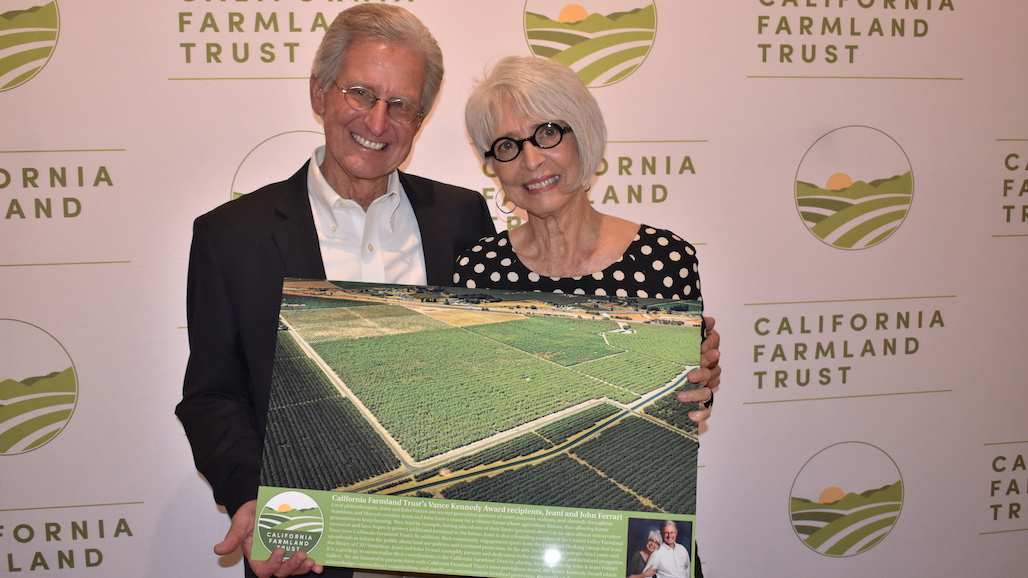
    Local philanthropists and long-time supporters of farmland protection, Jeani and John Ferrari, were honored by California Farmland Trust (CFT) as the 2021 Vance Kennedy Award recipients.

    The Vance Kennedy Award was established in 2014 in honor of Dr. Vance Kennedy, a founding member of CFT, because of his extraordinary contributions and efforts to the organization. Recipients of this prestigious award demonstrate significant commitment and dedication to furthering the protection of farmland in our most valuable regions. The Ferraris are the third recipients to receive the Vance Kennedy Award.

    “Being recognized by California Farmland Trust, an organization we hold in the highest regard, is a meaningful recognition,” John said. “CFT does the work that our region desperately needs, protecting our most important farmland for the long-term. It’s an esteemed award, and Jeani and I are honored.”

    As second-generation growers of sweet potatoes, almonds, walnuts, and peaches, Jeani and John’s passion and dedication to agriculture and farmland protection runs deep through Stanislaus and Merced counties. In addition, the Ferraris almond orchard is home to the first agricultural conservation easement enacted by Central Valley Farmland Trust (CVFT), now CFT, and Jeani served as a founding CVFT board member.

    Jeani and John exemplify community engagement, spanning from the Farmland Working Group that Jeani spearheads to inform the public about land use policies, to the “new” Turlock and CSU Stanislaus libraries, and the arts including the Carnegie Arts Center. John served on the Emanuel Medical Center’s foundation board and fundraising committees in support of the Cancer Center and Cardiovascular Operating Suites, where his dedication throughout the planning and fundraising process was invaluable.

    “The contributions Jeani and John have made since CFT’s inception and within our communities are extremely worthy of recognition, and the Vance Kennedy Award is especially fitting,” said Charlotte Mitchell, executive director at California Farmland Trust. “We are honored and thankful to work with such amazing community supporters and farmland protection advocates.”

    The California Farmland Trust is a California nonprofit 501(c)(3). Our mission is to help farmers protect the best farmland in the world. To date, we have protected 16,934 acres of farmland on 78 farms. To learn more visit us: www.cafarmtrust.org

  • Agriculturists Jeani and John Ferrari Recognized with CA Farmland Trust’s Vance Kennedy Award

    Agriculturists Jeani and John Ferrari Recognized with CA Farmland Trust’s Vance Kennedy Award

    Local philanthropists and long-time supporters of farmland protection, Jeani and John Ferrari, were honored by California Farmland Trust (CFT) as the 2021 Vance Kennedy Award recipients.

    The Vance Kennedy Award was established in 2014 in honor of Dr. Vance Kennedy, a founding member of CFT, because of his extraordinary contributions and efforts to the organization. Recipients of this prestigious award demonstrate significant commitment and dedication to furthering the protection of farmland in our most valuable regions. The Ferraris are the third recipients to receive the Vance Kennedy Award.

    “Being recognized by California Farmland Trust, an organization we hold in the highest regard, is a meaningful recognition,” John said. “CFT does the work that our region desperately needs, protecting our most important farmland for the long-term. It’s an esteemed award, and Jeani and I are honored.”

    As second-generation growers of sweet potatoes, almonds, walnuts, and peaches, Jeani and John’s passion and dedication to agriculture and farmland protection runs deep through Stanislaus and Merced counties. In addition, the Ferraris almond orchard is home to the first agricultural conservation easement enacted by Central Valley Farmland Trust (CVFT), now CFT, and Jeani served as a founding CVFT board member.

    Jeani and John exemplify community engagement, spanning from the Farmland Working Group that Jeani spearheads to inform the public about land use policies, to the “new” Turlock and CSU Stanislaus libraries, and the arts including the Carnegie Arts Center. John served on the Emanuel Medical Center’s foundation board and fundraising committees in support of the Cancer Center and Cardiovascular Operating Suites, where his dedication throughout the planning and fundraising process was invaluable.

    “The contributions Jeani and John have made since CFT’s inception and within our communities are extremely worthy of recognition, and the Vance Kennedy Award is especially fitting,” said Charlotte Mitchell, executive director at California Farmland Trust. “We are honored and thankful to work with such amazing community supporters and farmland protection advocates.”

    The California Farmland Trust is a California nonprofit 501(c)(3). Our mission is to help farmers protect the best farmland in the world. To date, we have protected 16,934 acres of farmland on 78 farms. To learn more visit us: www.cafarmtrust.org

  • Yeast and Bacteria Together Biosynthesize Plant Hormones for Weed Control

    Yeast and Bacteria Together Biosynthesize Plant Hormones for Weed Control

    Plants regulate their growth and development using hormones, including a group called strigolactones that prevent excessive budding and branching. For the first time, scientists led by UC Riverside have synthesized strigolactones from microbes. The work is published in the open-access journal, Science Advances.

    Strigolactones also help plant roots form symbiotic relationships with microorganisms that allow the plant to absorb nutrients from the soil. These two factors have led to agricultural interest in using strigolactones to control the growth of weeds and root parasites, as well as improving nutrient uptake.

    These root-extruding compounds don’t come without risks. They also stimulate germination of witchweeds and broomrapes, which can cause entire crops of grain to fail, making thorough research essential prior to commercial development. Scientists are still learning about the physiological roles played by this diverse group of hormones in plants. Until recently, manufacturing pure strigolactones for scientific study has been difficult and too costly for agricultural use.

    Yanran Li

    “Our work provides a unique platform to investigate strigolactone biosynthesis and evolution, and it lays the foundation for developing strigolactone microbial bioproduction processes as alternative sourcing,” said corresponding author Yanran Li, a UC Riverside assistant professor of chemical and environmental engineering.

    Together with co-corresponding author Kang Zhou at National University Singapore, Li directed a group that inserted plant genes associated with strigolactone production into ordinary baker’s yeast and nonpathogenic Escherichia colibacteria that together produced a range of strigolactones.

    Producing strigolactones from yeast turned out to be very challenging. Although engineered yeast is known to modify the strigolactone precursor, called carlactone, it could not synthesize carlactone with any of the specific genes used by the researchers.

    “This project started in early 2018, yet for over 20 months there was basically no progress. The gatekeeping enzyme DWRF27 is not functional no matter how we try in yeast,” Li said. “Kang developed a microbial consortium technique to produce a Taxol precursor in 2015 and that inspired this wonderful collaboration.”

    The team turned toward E. coli, which had already been shown capable of producing carlactone. The carlactone it produced, however, was unstable and could not be further modified by engineered E. coli into any strigolactones. Li’s group managed to optimize and stabilize the carlactone precursor.

    To their delight, when the yeast and bacteria were cultured together in the same medium, the E. coli and yeast worked as a team: E. coli made carlactone, and the yeast transformed it into various final strigolactone products. The method also produced enough strigolactones to extract and study. Using this platform, the group identified the function of multiple strigolactone biosynthetic enzymes, showing that sweet orange and grape have the potential to synthesize orobanchol-type strigolactones.

    The team also engineered microbe metabolism to boost strigolactone production threefold to 47 micrograms per liter, enough for scientific study. Though commercial production of strigolactones is still a long way off, the new method for biosynthesizing them from a yeast-bacterium consortium will help scientists learn more about this important group of plant hormones, especially the enzymes involved.

    Enzymes are protein catalysts and are responsible for modification of carlactone by yeast. Because carlactone is unstable, it cannot be purchased from commercial sources. As a result, many plant scientists have difficulty studying new enzymes that may work to transform carlactone into strigolactones.

    “The new yeast-bacterium co-culture provides a convenient way for scientists to complete such works because the bacterium makes carlactone in situ,” Zhou said. “With discovery of more enzymes and optimization of the microbial consortium, we can manufacture strigolactones in quantity in the future.”

    Li and Zhou were joined in the research by Sheng Wu, Anqi Zhou, and Alex Valenzuela of UC Riverside; and Xiaoqiang Ma at the Singapore-MIT Alliance for Research and Technology. The paper, “Establishment of strigolactone-producing bacterium-yeast consortium,” is available here. — By Holly Ober, UC Riverside

  • Tomato Trade with Mexico could Cost US Growers $250M a year

    As Mexico increases tomato exports across the world, including to the United States, prices plummet for American growers. That practice could cost American growers as much as $252 million per year — or 27% in revenue — if imports from Mexico increase by 50% in coming years, based on historical trends, new University of Florida research shows.

    That’s a huge loss for American farmers, who produced 1.3 billion pounds of fresh tomatoes in 2020, less than one-third the harvest from the year 2000.

    That decline is due to competition from Mexico and other challenges, said Zhengfei Guan, an associate professor of food and resource economics at the UF Institute of Food and Agricultural Sciences.

    Zhengfei Guan, a UF/IFAS associate professor of food and resource economics at the Gulf Coast Research and Education Center, studies tomato trading and its impacts on American growers, among other areas of research.

    Guan just published a study on the consequences of intensifying Mexican competition for American growers. The market positions of Mexican and domestic tomato industries completely reversed over the past 20 years. Mexico now dominates the U.S. market, with three times more market share than the domestic industry. That change sparked Guan’s interest in pursuing the new study.

    “The two countries had a series of trade disputes over fruit and vegetables recently,” he said. “One reason is that surging imports from Mexico boosted by subsidies have depressed prices, and American growers are quickly losing market shares.”

    “The findings from our study will provide tomato producers and policy makers with important insights on the challenges and the sustainability of the U.S. tomato industry,” Guan said.

    In his study, Guan measured the potential losses the U.S. industry will sustain as a result of the increasing imports from Mexico, given the steep growth over the years. As a frame of reference, the volume of imported tomatoes from Mexico increased by about 60% over the years 2009-2019.

    Results of Guan’s research show that prices of domestic tomatoes are particularly sensitive to imports from Mexico in an increasingly saturated market. The imports are especially damaging to the Florida tomato industry which has about $400 million in sales and has the same harvest seasons as Mexico.

    The trade deficit complicates matters for farmers in several commodities – not just tomatoes. Specifically, fruit and vegetables — such as tomatoes, strawberries, peppers, cucumbers and melons – accounted for 50% of the total U.S. agricultural imports from Mexico in 2020, according to the U.S. Department of Agriculture. “But all may not be lost, if the US fruit and vegetable industry could revolutionize the production technology,” said Guan. “Mechanization or automation will be a game changer and is the future for this labor-intensive industry.” — By Brad Buck, University of Florida Institute of Food & Agricultural Sciences

  • California Navel Orange Crop Forecast Down 14%

    California Navel Orange Crop Forecast Down 14%

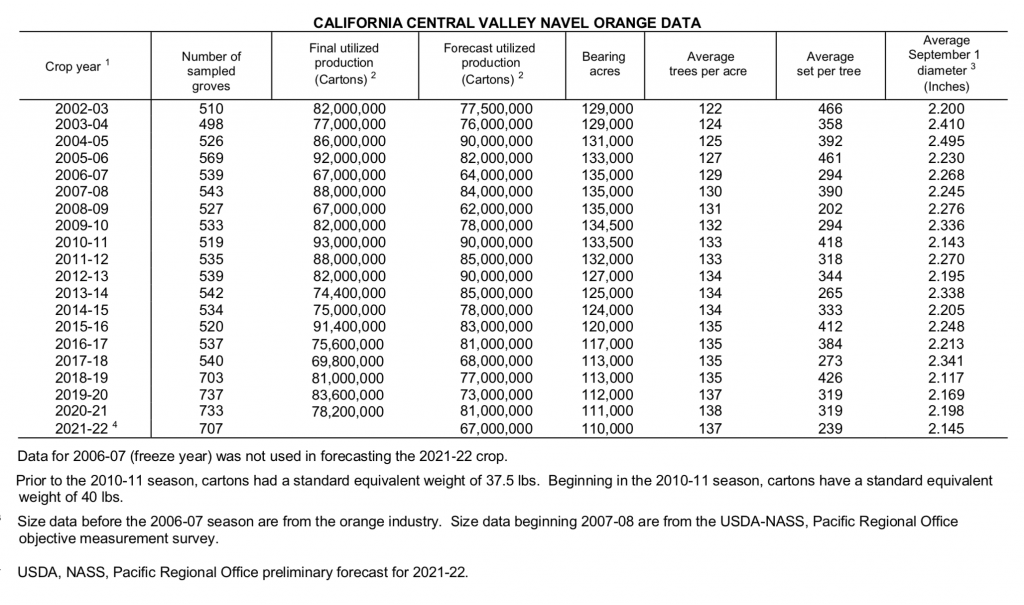
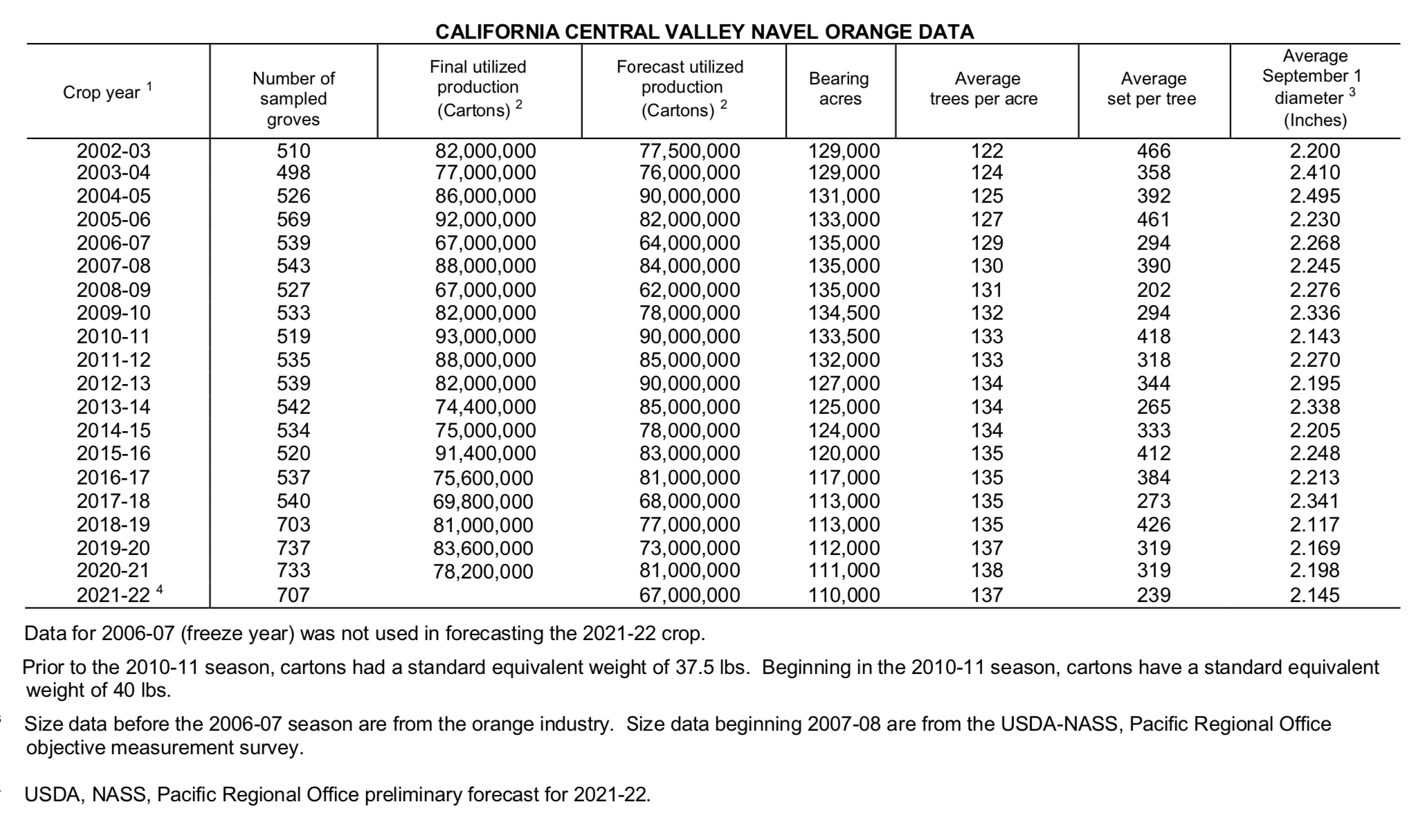
    USDA National Agricultural Statistics Service — The initial 2021-22 California Navel orange forecast is 70.0 million cartons, down 14% from the previous year. Of the total Navel orange forecast, 67.0 million cartons are estimated to be in the Central Valley. Cara Cara variety Navel orange production in the Central Valley is forecast at 6.0 million cartons. These forecasts are based on the results of the 2021-22 Navel Orange Objective Measurement (O.M.) Survey, which was conducted from June 15 to September 1, 2021. Estimated fruit set per tree, fruit diameter, trees per acre, bearing acreage, and oranges per box were used in the statistical models estimating production.

    This forecast includes production of conventional, organic, and specialty Navel oranges (including Cara Cara and Blood orange varieties).

    Survey data indicated a fruit set per tree of 239, down 25% from the previous year and b e l o w the five-year average of 344. The average September 1 diameter was 2.145 inches, below the five-year average of 2.208 inches. The Cara Cara orange set was 211 with a diameter of 2.146 inches.

    SURVEY SAMPLE

    A sample of 785 Navel orange groves was randomly selected proportional to county and variety bearing acreage, and 707 of the groves were utilized in this survey. Once a grove was randomly chosen and grower permission was granted, two trees were randomly selected. The Navel orange sample included conventional, organic, Cara Cara, and Blood orange groves.

    For each randomly selected tree, the trunk was measured along with all connected branches. A random number table was then used to select a branch, and then all connected branches from the randomly-selected branch were measured.

    This process was repeated until a branch was reached with no significant limbs beyond this point. This randomly-selected branch, called the terminal branch, was then closely inspected to count all fruit connected to this branch, as well as all of the fruit along the path from the trunk to the terminal branch. Since each selected path has a probability of selection associated with the path, a probability-based method was then applied to estimate a fruit count for the entire tree.

    In the last week of the survey period, fruit diameter measurements were made on the right quadrant of four trees surrounding the two trees of every third grove. These measurements were used to estimate an average fruit diameter per tree. Of the 707 utilized groves, 10 were in Madera County, 119 were in Fresno County, 419 were in Tulare County, and 157 were in Kern County.

    SURVEY HISTORY

    A Navel Orange Objective Measurement Survey has been conducted in the Central Valley every year since the 1984-85 crop year, except for the 1991-92 season due to a lack of funding. The data from the first two years were used for research purposes in developing crop-estimating models. The Cara Cara forecast was undertaken at the request of the California Citrus Advisory Committee.