On February 23, 2022, 3-4 pm Dr. Brenna J. Aegerter, Farm Advisor with the University of California Cooperative Extension San Joaquin County will lead a zoom meeting under the UC Ag Experts webinar series discussing powdery mildew, black mold fruit rot, and various soilborne diseases in processing tomatoes. She will describe symptoms, factors that contribute to their development, and management options. 1.0 CEU (other) from DPR and 1 CEU (IPM) from CCA are pending. Register to attend the virtual meeting HERE.
Category: Non-Video
-
California’s Vegetable Value Down 15% from 2020
The value of California’s 2021 utilized vegetable production dropped 15% to $7.24 billion compared to 2020’s value of $8.55 billion according to the USDA National Agricultural Statistics Service, Pacific Regional Field Office.
Despite the decrease in state’s overall total value of utilized production, crops showing an increase included asparagus, snap beans, cabbage, celery, cucumbers, garlic, honeydews, onions, chile peppers, pumpkins and tomatoes.
California fresh market and processing vegetable growers harvested 920,800 acres of principal vegetable crops in 2021, up 1% from 2020. Utilized production totaled 404 million hundred weight down 6% from 2020’s 428 million hundred weight.
California leads the nation in vegetable production, accounting for over 40% of the U.S. vegetable acreage.
USDA NASS recently posted the Vegetables 2021 Summary for vegetables grown during the 2021 crop year in California and across the U.S. The report includes survey data collected for acreage, production, marketing year price and value collected on an annual basis for 26 vegetable and melon crops in the U.S. Questionnaire content, survey timetables, and survey administration are state specific. Data are gathered by telephone interviews, mail, faxed, and online reporting.
For a copy of the full report, visit Vegetables 2021 Summary. Below are comments for crops where The Golden State is the largest producer.
Artichokes: Total California production in 2021 totaled 833 thousand cwt, up 9% from 2020. Planted area was estimated at 4,900 acres, down 4% from the previous year. Area harvested, at 4,900 acres, was down 4% from 2020. The value of the crop totaled $57.5 million, 10% below the previous season. Utilized production totaled 833 thousand cwt, all of which was for the fresh market.
Despite artichokes in the Coachella region getting off to a late start due to the desert heat, the plants flourished and were very productive. In the primary growing region of the Central Coast, cool winter weather and pest pressures reduced early supplies, but better spring weather allowed the crop to recover with good quality and excellent production.
Broccoli: Total California production in 2021 totaled 12.3 million cwt, down 14% from 2020. Planted area was estimated at 95,000 acres, up 6% from the previous year. Area harvested, at 94,500 acres, was also up 6% from 2020. The value of the crop totaled $631 million, 19% less than the previous year. Utilized production totaled 12.3 million cwt, of which 11.8 million cwt was for the fresh market and 22.7 thousand tons for processing.
Broccoli prices increased as cooler weather in growing areas limited supplies. Crown quality was very good. Brown bead, hollow core, and yellowing were reported to be minor issues.
Cabbage: Total California production in 2021 totaled 5.40 million cwt, down 8% from 2020. Planted area was estimated at 14,800 acres, down 2 % from the previous year. Area harvested, at 14,600 acres, was up 2% from 2020. The value of the crop totaled $155 million, 5% more than the previous season. Utilized production totaled 5.40 million cwt.
Weather during planting in the fall of 2020 and through head development in 2021 was favorable. No significant pathogen impact on the crop was reported. Demand for cabbage was on the rise with consumer interest in health benefits during the continuing pandemic. Weather conditions were a mixture of dry and wet conditions during the season in most of the cabbage producing areas.
Cantaloupes: Total California production in 2021 totaled 6.90 million cwt, down 4% from 2020. Planted areas was estimated at 23,500 acres, up 7% from the previous year. Area harvested, at 23,400 acres, up 7% from 2020. The value of the crop total was $163 million, a decrease of 11% from previous year. The utilized production was 6.90 million cwt, all of which was for the fresh market.
Production of cantaloupes was strongly impacted by higher input costs, including water.
Carrots: Total California production in 2021 totaled 25.2 million cwt, up 2% from 2020. Planted area was estimated at 61,700 acres, an increase of 2% from the previous year. Area harvested, at 61,400 acres, is also up 2% from 2020. The value of the crop totaled $654 million, 5% less than the previous year. Utilized production totaled 25.1 million cwt.
The rise in the pandemic led to a surge in carrot demand, resulting in an increase in prices and labor costs. The market was steady with good supplies; growers saw jumbo and cello size in the fields. In the southern San Joaquin and Cuyama Valleys, the top carrot producing counties in California, growers reported severe drought conditions, limiting water supplies in 2021.
Cauliflower: Total California production in 2021 totaled 7.07 million cwt, down 11% from the previous year. Planted area was estimated at 39,400 acres, up 6% from 2020. Area harvested, at 39,300 acres, was up 7% from the previous year. The value of the crop totaled $266 million, 2% less than the previous season. Utilized production also totaled 7.07 million cwt.
Prices received by growers improved. Cooler weather slowed growth, resulting in lighter volume, but quality remained strong with good sizing and color
Celery: Total California production in 2021 totaled 15.3 million cwt, a decrease of 5% from 2020. Planted area was estimated at 28,000 acres, down 4% from the previous year. Area harvested, at 27,800 acres, showed a decrease of 3% from the previous year. The value of the crop totaled $375 million, up 5% from previous year. Utilized production for 2021 totaled 15.3 million cwt, down 5% from 2020.
Cold and wet weather slowed production during the end of the year. Some growers in the Oxnard area reported crop damage due to flooding and a canal breach. Additionally, fusarium and insects caused reduced yields for some producers. The market was tight for organic celery during a portion of the 2021 growing season.
Garlic: Total California production in 2021 totaled 4.19 million cwt, an increase of 18% from 2020. Planted area was estimated at 26,500 acres, up 12% from the previous year. Area harvested, at 26,200 acres, also showed an increase of 11% from 2020. The value of the crop totaled $244 million, up slightly from the 2020 value of $242 million. Utilized production also totaled 4.19 million cwt.
Despite the minimal water availability and the extreme heat, the garlic crop was above average. Moisture received in April was beneficial and the crop was able to survive the hot temperatures
Honeydew: Total California production in 2021 totaled 1.76 million cwt, down 20% from 2020. Planted area and harvested area were both estimated at 6,900 acres, down 4% from the previous year. The value of the crop totaled $48.9 million, up 7% from the previous season. All production was sold for the fresh market.
Higher input costs, including water, reduced supply of honeydew melons. Consumer demand increased, which resulted in higher prices than the previous season.
Head lettuce: Total California production in 2021 totaled 24.9 million cwt, down 11% from 2020. Planted area was estimated at 76,000 acres, up 3% from the previous year. Area harvested, at 75,400 acres, was also up 3% from 2020. The value of the crop totaled $728 million, 19% less than the previous season. All utilized production was sold for the fresh market.
The head lettuce market was steady while supply remained low. Labor, weather, and quality were concerns throughout the growing season. High temperatures and humidity in the Salinas Valley during July and August caused stress for some of the crop, which resulted in internal burn and fog burn. There were also reports of below freezing temperatures causing harvesting and packing delays.
Leaf lettuce: Total California production in 2021 totaled 10.2 million cwt, down 23% from 2020. Planted area was estimated at 50,000 acres, down 6% from the previous year. Area harvested, at 49,700 acres, was 4% lower than 2020. The value of the crop totaled $532 million, 44% less than the previous season. Utilized production was all sold for the fresh market.
Production of leaf lettuce continued to trend downward as the market remained steady. Quality was fair, while pricing remained competitive. Extreme temperatures affected crop quality and harvest efforts. There were reports of below freezing temperatures, causing harvesting and packing delays.
Romaine lettuce: Total California production in 2021 totaled 20.1 million cwt, down 12% from the 2020 total. Planted area was estimated at 71,300 acres, up 3% from the previous year. Area harvested, at 70,400 acres, was up 4% from 2020. The value of the crop totaled $768 million, 37% less than the previous season. All production was sold for the fresh market.
The Romaine lettuce crop experienced some quality issues that affected yields and resulted in substantial price decreases compared to 2020.
Onions: Total California production in 2021 totaled 19.0 million cwt, down slightly from 2020. Planted area was estimated at 45,800 acres, up 7% from the previous year. Area harvested, at 45,300 acres, was up 6% from 2020. The value of the crop totaled $297 million, 10% more than the previous year. Of the utilized production, 9.51 million cwt was sold for the fresh market and 475 thousand tons were for processing.
Growers had low expectations early in the season, given the extreme heat challenges and limited water supply. Onions dried up too quickly and volumes were disappointing. Dryness and long periods of intense heat, led to expansion of wildfires and prolonged lack of sunlight, causing minimal damage to the crop. Widespread, Fusarium basal rot was reported on the west side of the San Joaquin Valley, causing some onions to decay and lower yields.
Bell peppers: Total California production in 2021 totaled 3.83 million cwt, down 24% from 2020. Planted area was estimated at 9,200 acres, down 22% from the previous year. Area harvested, at 9,000 acres, was down 23% from 2020. The value of the crop totaled $185 million, 31% less than the previous year. Utilized production totaled 3.82 million cwt, of which 2.17 million cwt was for the fresh market and 82.2 thousand tons was for processing.
Bell pepper growers were faced with rising production costs and transportation issues.
Spinach: Total California production in 2021 totaled 5.17 million cwt, up 2% from 2020. Planted area was estimated at 40,300 acres, down 5% from the previous year. Area harvested, at 39,800 acres, was also down 5% from 2020. The value of the crop totaled $359 million, 11% less than the previous season.
Water supply was an issue for spinach growers as they experienced severe drought conditions during the 2021 growing season.
Tomatoes: Total California production in 2021 totaled 224 million cwt, down 4% from 2020. Planted area was estimated at 251,000 acres, down 2% from the previous year. Area harvested, estimated at 248,900 acres, was unchanged from the previous year. The value of the crop totaled $1.18 billion, 6% higher than 2020. Utilized production totaled 222 million cwt, of which 6.72 million cwt was for the fresh market and 10.8 million tons were for processing.
Drought concerns impacted planting decisions for the 2021 processing tomato crop and planted acreage decreased significantly from early season contracted intentions. Extremely high temperatures in May and throughout the summer lowered expected yields and slowed down operations at the canneries. Harvest began the first week of July and continued through November, marking the longest harvest in recent years.
For more agricultural statistics, visit www.nass.usda.gov.
-
California Olive Oil Grower Meeting, March 3
Please join the Olive Oil Commission of California (OOCC) for California Olive Oil Day on March 3, 2022, at the Robert Cabral Agriculture Center in Stockton. During this meeting, industry experts and researchers will present information on the latest innovation and research critical to the production of top-quality extra virgin olive oil.
The meeting will begin at 9 a.m. with a welcome from OOCC Executive Director, Chris Zanobini and Research Committee Chairman, Michael Fox.
New research will be presented on several topics pertaining to olive orchard and disease management and best growing practices. These topics will include: water management strategies for hedgerow olive orchards in California: evaluation of canopy management practices on established Super High-Density olives for olive oil production: investigating young tree decline as a result of autumn frost events; epidemiology and management of olive knot; and evaluation of new fungicides in the control of olive leaf spot/peacock spot.
The research in this session will be presented by Giulia Marino, Dept of Plant Science, University of California, Davis; Ciriaco Chavez, Boundary Bend; Mohammed Nouri, UC Cooperative Extension Orchard Systems Advisor, San Joaquin County; and James Adaskaveg, Professor, Dept of Plant Pathology, UC Riverside.
Javier A Fernandez Salvador, Executive Director of the UC Davis Olive Center will then provide an update on the Center’s activities and Selina Wang will present findings of the Olive Center’s analysis of 2020 olive oil quality data collected as part of the OOCC’s mandatory sampling and testing program. Wang will also present findings from the Olive Center’s evaluation of fatty acid and sterol profiles.
Wang will then provide reports on the UC Ag and Natural Resources Production Manual for Olive Oil and the latest findings from a study on utilizing olive pomace to make pavement. These presentations will be followed by an update on the establishment of benchmark data for the olive oil industry in California from Kyle J. Birchard of Integrative Economics, LLC.
Attendees can also expect to hear updates from Kimberly Holding, CEO of the American Olive Oil Producers Association (AOOPA), and Shanna Rahman, Board Chair of the California Olive Oil Council (COOC).
The day will conclude at 12:30 p.m. with lunch provided by the OOCC. To RSVP, please email anne@agamsi.com.
-
Sacramento Valley Processing Tomato Production Meeting, Feb. 10
The UC Cooperative Extension (Colusa, Sutter, Yuba, Yolo, Solano & Sacramento Counties) invites growers to attend the 2022 Sacramento Valley Processing Tomato Production Meeting virtually (Zoom) on February 10th from 9:00-11:40 a.m. DPR and CCA Continuing Education Credits have been requested. Registration is free and can be done online HERE. Some of the topics of discussion will include: broomrape biology & management, automation with mechanical in-row cultivators for conventional processing tomatoes, root knot nematode management, and the unusual outbreak of beet curly top in 2021. Click HERE to see the full agenda.
-

Annual Sweetpotato Growers Meeting, Feb. 15
Growers are excited to be gathering back in-person for the 56th annual Sweetpotato meeting held by the UC Cooperative Extension in the UCCE Classroom at 2145 Wardrobe Ave. in Merced, CA. The Sweetpotato Council of California will also be holding their business meeting right after. Due to current Covid rules, face masks will be required to be worn throughout the meeting. Attendees are invited to come and sign in at 7:30 a.m. and enjoy some coffee and Jantz Sweetpotato muffins. The meeting with end at noon with lunch. Presenters will include: UCCE Farm Advisor Scott Stoddard, Assistant Merced County Ag Commissioner Sean Runyon, Brian Hegland from Teleos Ag Solutions, Jill Silverman Hough from the Sweet Potato Council of California, Robert Drozdowski from AgriControl Technologies, and Darren Barfield from the Sweet Potato Council. DPR and CCA Continuing Education Credits have been requested. Click HERE for the full agenda.
-
Inaugural Global Harvest Automation Report Reveals Grower Investment
Growers are keen to adopt automation to bridge the growing labor gap and ensure that their crops can be picked in time, according to the Global Harvest Automation Report, a first-of-its-kind study commissioned by Western Growers. The report is the first in a new annual series that will track, measure and report on industry progress in harvest automation across the fresh produce industry.
The Global Harvest Automation Report is part of WG’s Global Harvest Automation Initiative, which aims to accelerate ag automation by 50 percent in 10 years.
“One of the main aims of the report was to take a comprehensive look at the entire harvest ecosystem and provide a quantitative look to the Western Growers membership at how much harvest innovation is impacting their operations across fresh products for specialty crops, where the most progress is occurring, and why,” says WG VP of Innovation Walt Duflock. “Second, we wanted to provide an in-depth view of the innovators who are doing the heavy lifting by crop type, so growers would know who to contact based on the crops they grow.”
Among the findings of the report, which was prepared in collaboration with consultants at Roland Berger:
- 65 percent of participating growers have invested in automation over the past three years
- The average annual spend on automation was $350,000-$400,000 per grower
- Spending occurred in pre-harvest and harvest assist activities, including weeding, thinning, harvesting platforms and autonomous ground vehicles. It is anticipated that 30-60 percent of these activities will be automated by 2025.
- Harvest automation itself remains limited because of the technical difficulties in replicating the human hand to harvest delicate crops. It is anticipated that 20 percent of harvest activities will be automated by 2025.
Full print copies of the Global Harvest Automation Report will be available at the Western Growers booth at the World Ag Expo Feb. 8-10, 2022 in Tulare, Calif.; to download a complete digital copy please click here.
-
CA Tomato Processors Forecast Larger Crop In 2022
USDA National Agricultural Statistics Service — As of January, California’s tomato processors reported they have, or will have, contracts for 12.2 million tons in 2022, which is an increase of 10% compared to 11.1 million contracted tons forecast in the August 2021 California Processing Tomato Report. Processors estimate that the contracted production for 2022 will come from 245,000 acres, generating an average yield of 49.8 tons per acre. The contracted planted acreage forecast is 7% higher than the 2021 acreage of 229,000 reported under contract in August.
The USDA-NASS Pacific Regional Office surveyed California’s tomato processors for their intended contract acreage and tonnage for the upcoming 2022 season. The data reported by processors was either tonnage with derived acreage, or acreage with derived tonnage.
This early processing tomato estimate is funded by the California League of Food Producers.


-
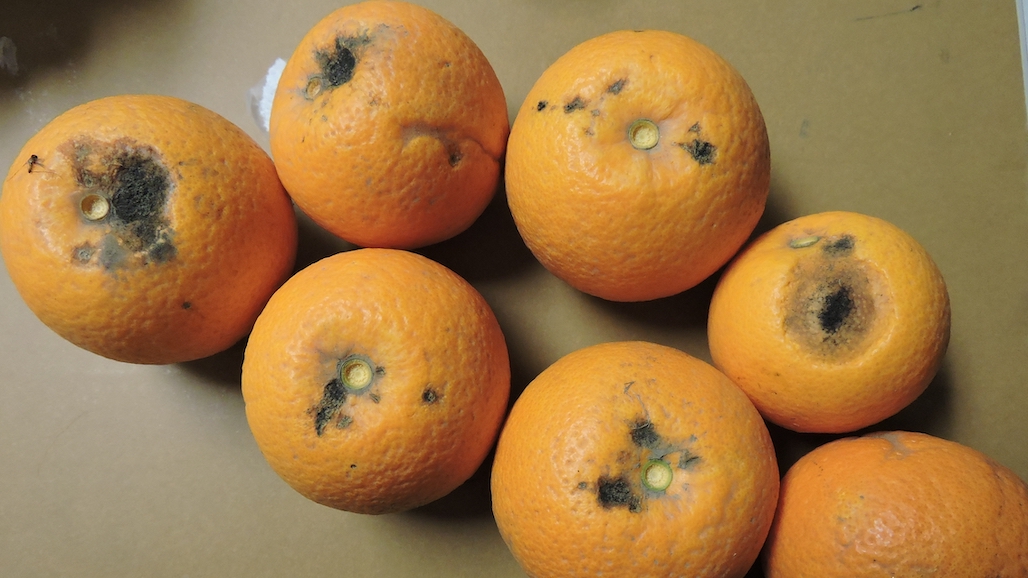
Weather Conditions Cause of Rind Breakdown in Satsuma Mandarin
Although you never know about the weather, we do know that if heavy rain occurs after color break in mandarins there can be significant rind breakdown. This problem can destroy much of the crop and the problem is largely preventable.
Pre-harvest rind decay of mandarins in California generally occurs shortly after rain falls and is most severe on Satsuma mandarins. Although some researchers have associated the problem with fungi such as Alternaria species, isolations from affected fruit have been inconsistent. Inoculations with isolated fungi only sometimes reproduce disease symptoms and only on water-soaked fruit. Furthermore, in preliminary field trials there were conducted in Butte Co in the fall of 2002 and 2003, fungicide treatments that included Topsin-M, Pristine and Abound only reduced the incidence of disease from 99% in the control to approximately 90% . These data suggested that mandarin rind breakdown is a physiological, abiotic disorder of fruit rather than a pathological problem and the fungi isolated are rather secondary causes of rind decay than primary pathogens.
Rind breakdown of citrus was previously reported by Fawcett and others in the 1930s. Wet weather combined with a sudden decrease in temperature was shown to result in generation of rind oil and collapse of cells just under the cuticle. In laboratory and field trials in 2003, fruit treatments with water repellants reduced the incidence of rind breakdown to very low levels. Field trials were again conducted in the fall of 2004. Fungicide treatments were ineffective in these trials. In all trials, application so Vapor-Gard or Omni oil significantly reduced the disorder. In all programs with Vapor-Gard and Omni oil, a first application was made at the end of October and there was no significant difference in efficacy when additions applications were done. When tree were protected from rainfall using a tent, the disorder could not be detected, indicating the rind breakdown is correlated to rainfall.
In summary, results from the trials support previous findings by Fawcett that mandarin rind disorder is an abiotic, weather-related problem of mature fruit that has undergone a green to orange color change. Using a water repellant helps protect the fruit. — By Ben Faber, UCCE Ventura County Advisor
-
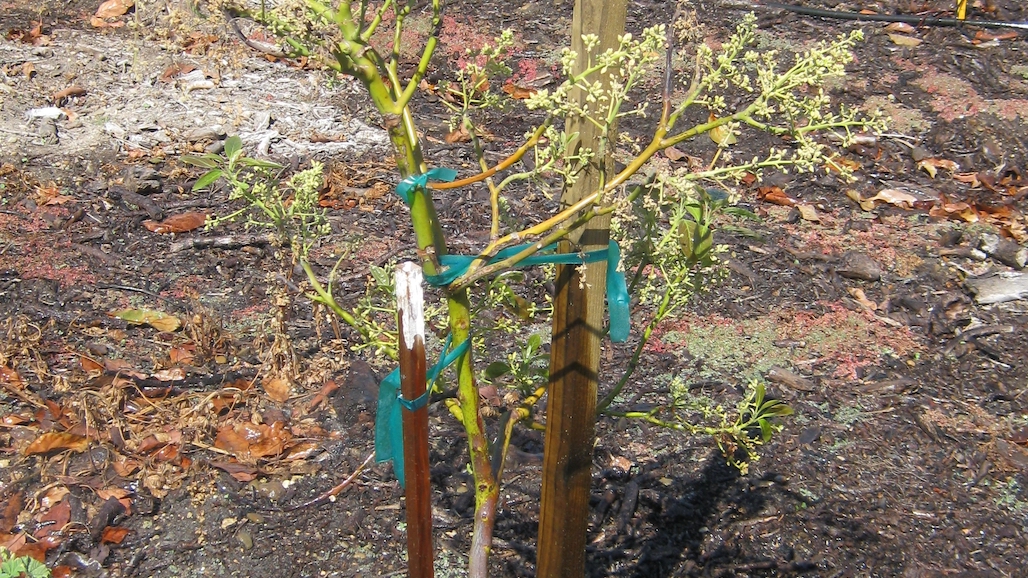
Research Indicates Paint Not Effective At Protecting Young Avocados From Herbicide Drift
California Avocado Commission — While it is often common practice for fruit growers to apply white latex paint to the bottom 2 to 3 feet of young, newly planted trees in order to provide some protection from herbicide drift, researchers note there is little evidence to prove this practice is effective.
A recent blog post by Dr. Ben Faber summarized the findings of a California field experiment conducted in 2017 that measured the impact of latex paint in preventing herbicide injury on young almond trees. The block of trees consisted of greenhouse-grown trees in cartons. Nine weeks prior to the herbicide applications, the cartons were removed for trees in the “no paint” and “old paint” sections so their bark could harden off. Two days prior to applying the herbicide, the cartons were removed for the “new paint” trees and then the trees were painted.
According to the researchers:
- The paint did not provide significant protection from glyphosate or glufosinate.
- Tree stress caused by trunk-applied herbicides was lowest in trees with no paint, suggesting that allowing the bark to harden on young trees is an important means of protecting them from herbicide drift.
- In most treatment combinations, old and new paint applications did not reduce tree stress as effectively as allowing the bark to harden on trees nine weeks prior to application.
- The most effective means of protecting trunks was installing a carton. However, it is important to remember that once the carton is removed (as the tree matures), there may be green bark present which would be vulnerable to herbicides.
-
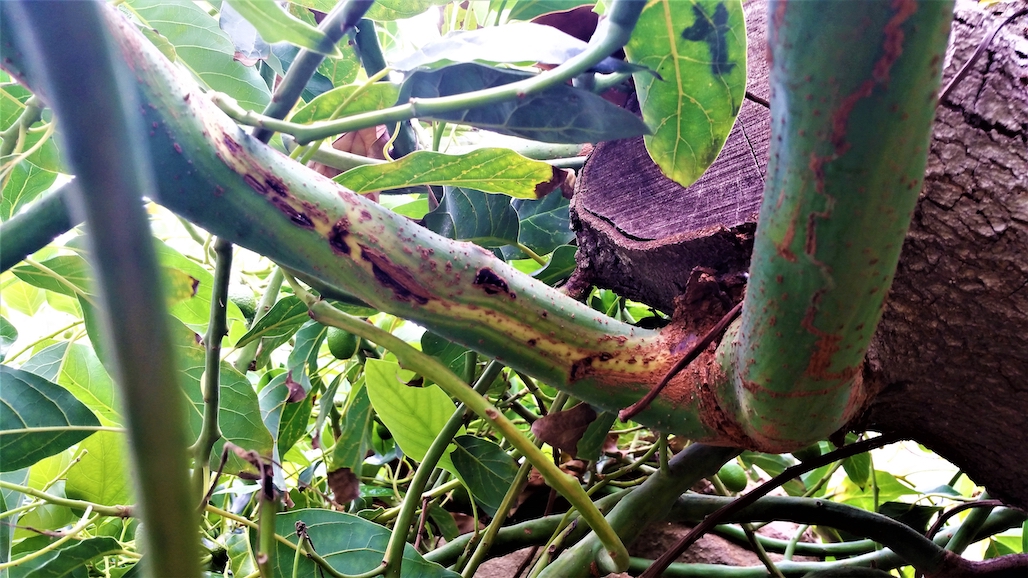
CA Avocado Disease Management Webinar, FEB. 16
The California Avocado Society, California Avocado Commission and UC Cooperative Extension are hosting a free online Grower Webinar: Avocado Disease Management session on Wednesday, February 16 from 9:00 a.m. – 11:00 a.m.
The webinar is designed to provide growers and grove managers with information concerning management strategies for diseases that California avocado trees are prone to. The online seminar will cover:
- Approaches to combating avocado root rot, including pesticide management
- The availability of a new chemical to manage Phytophthora
- Other chemical and horticultural practices related to disease management in California avocado groves
The presenters include Dr. Ben Faber, Crops Advisor for the UC Cooperative Extension, and Dakota Camino, PCA with Syngenta.